First Seen
2024-05-20T20:46:28+00:00
simple-description (qwen3.5_2b-q8_0)
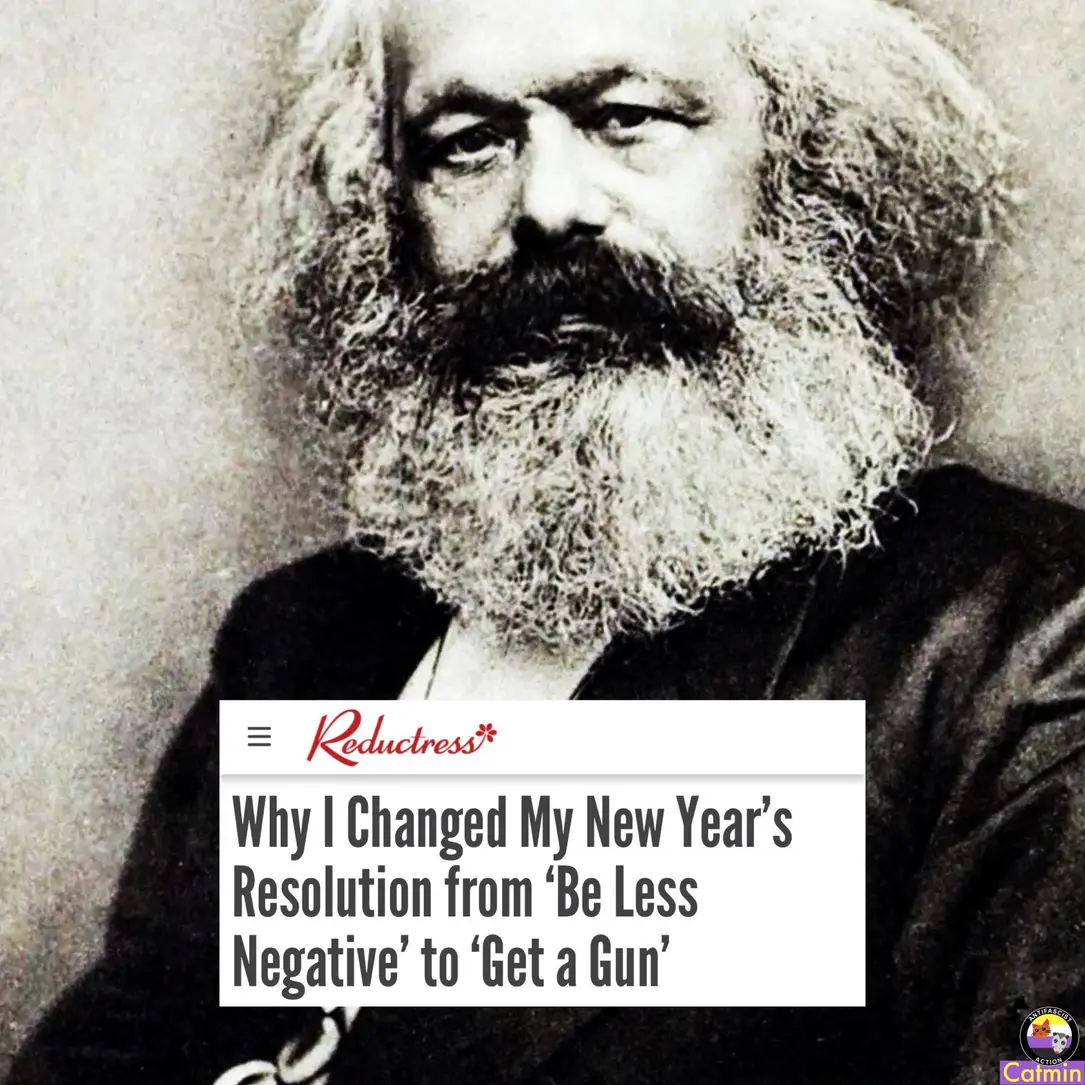
This image is a "red flag" meme that satirizes political hypocrisy. The meme features a historical picture of Karl Marx—the founder of the movement often cited in these jokes—overlaid with a headline that parodies the famous US political correction trend, where people switch to "Get a Gun" to avoid being seen as too "negative." The text reads: "Why I Changed My New Year’s Resolution from 'Be Less Negative' to 'Get a Gun'"
simple-description (llama3.2-vision_11b)
The meme is a humorous image of Karl Marx, the father of Marxism, with the caption "I changed my New Year's resolution from 'Be less bitter' to 'Get a gun'". The meme is a play on the common New Year's resolution to "be less bitter" or "get a gun" (a common joke about changing resolutions), but with a Marxist twist, referencing the famous Marxist phrase "the proletariat will have to get guns" (or "get a gun").
detailed-analysis (gemma3-27b-vision)
Okay, let's break down this image and its potential meanings using the requested theoretical frameworks. It's a provocative image, so these analyses will likely delve into potentially uncomfortable territory.
Visual Description
The image is a digital composition juxtaposing a portrait of Karl Marx with a screenshot of an article titled “Why I Changed My New Year’s Resolution from ‘Be Less Negative’ to ‘Get a Gun'.” Marx is depicted in a classic, stern portrait with a long, dark beard and intense gaze. The screenshot is superimposed over the image, appearing as a digital window. The contrast between the historical figure of Marx and the contemporary, provocative headline is striking and creates an immediate tension. The image itself is somewhat grainy.
Marxist Conflict Theory
This is where the image strongly resonates. At its core, Marxist theory examines class struggle and the material conditions that shape power dynamics. The juxtaposition of Marx with the article title is deeply ironic. Marx advocated for the proletariat to overthrow the bourgeoisie (the ruling class) through collective action and revolution. The shift in New Year's resolution from "Be Less Negative" to "Get a Gun" can be interpreted as a symptom of alienation and disempowerment.
- Alienation: The original resolution, "Be Less Negative," suggests a desire for personal self-improvement within the existing system. The shift to acquiring a gun implies a loss of faith in systemic change and a turn towards self-reliance and potentially violent defense. This speaks to a feeling of alienation from societal structures.
- False Consciousness: The individual who makes this change might be experiencing a 'false consciousness,' believing that the solution to their problems lies in individual action (acquiring a gun) rather than collective action to address systemic issues.
- Capitalist Violence: The image subtly suggests that the conditions created by capitalism might be pushing individuals towards a violent solution to their problems. The article's headline implies a feeling of vulnerability and a need for protection in a society perceived as hostile.
Foucauldian Genealogical Discourse Analysis
Michel Foucault's genealogical approach traces the historical development of power relations through discourse. Analyzing the image through this lens means examining how the concepts of "negativity," "gun ownership," and even "revolution" have been historically constructed and how power operates through these discourses.
- Discursive Shift: The image illustrates a shift in discourse from one focused on personal emotional regulation ("Be Less Negative") to one centered on physical defense and potential aggression ("Get a Gun"). This shift can be examined in terms of broader cultural anxieties and the normalization of violence.
- Power/Knowledge: The connection to Marx points to a historical narrative of revolutionary struggle. The image, by associating this narrative with the seemingly individual action of acquiring a gun, suggests a reinterpretation of power dynamics. Is this a legitimate form of resistance, or a misdirected expression of frustration?
- Biopower: One could argue this signals a turn toward individual self-preservation, a component of biopower, where individuals internalize responsibility for their own safety and well-being in the face of perceived threats.
Postmodernism
Postmodern thought often challenges grand narratives and embraces ambiguity and irony. The image fits well within this framework.
- Irony and Juxtaposition: The primary effect of the image is its ironic juxtaposition of a historical figure associated with socialist revolution with a seemingly individualistic and potentially conservative action (acquiring a gun). This challenges any easy or straightforward interpretation.
- Deconstruction of Meaning: The image deconstructs the meaning of “revolution.” Traditionally, it means collective uprising; here, it's reduced to a personal act.
- Rejection of Grand Narratives: The image implicitly rejects the grand narrative of socialist revolution, suggesting that individuals have lost faith in systemic change and turned inward.
Critical Theory
Critical Theory, building on Marxism, examines the role of ideology and power in maintaining social control.
- Ideological Critique: The image can be seen as a critique of the ideological conditions that lead individuals to believe that violence is a legitimate solution to their problems. The shift in resolution could be a symptom of a society that emphasizes individualism, competition, and fear.
- Culture Industry: The article, in its form, is a product of the culture industry, and the image is a piece of visual media. This points to the role of media in shaping perceptions and reinforcing dominant ideologies.
- Domination and Resistance: Is the act of acquiring a gun an act of resistance or a manifestation of internalized oppression? This ambiguity is at the heart of the image's power.
Queer Feminist Intersectional Analysis
This is a more complex application, but still potentially relevant.
- Patriarchal Violence: The turn toward gun ownership could be linked to patriarchal structures and the normalization of violence as a means of asserting power and control. The image could be read as a critique of the ways in which masculinity is constructed and reinforced.
- Intersectional Vulnerability: Individuals who exist at the intersection of multiple marginalized identities (race, gender, class, sexual orientation, etc.) may experience heightened vulnerability and feel compelled to arm themselves for protection.
- Challenging Binary Oppositions: The image subtly challenges binary oppositions between "negativity" and "action," "passivity" and "aggression."
In conclusion: The image is a potent and layered piece of visual communication. It utilizes irony and juxtaposition to raise complex questions about power, ideology, alienation, and the potential for violence in contemporary society. The theoretical frameworks discussed here offer different lenses through which to interpret its meaning, revealing a rich and multifaceted message.
tesseract-ocr
SY The oe — ie: Wea AS Roe Ny ea Bere CS AN SA ee Us ene A Sa y j pS ‘ Fa oe Fes “ae Why | Changed My New Year's ieee Resolution from ‘Be Less gees Negative’ to Get a Gun’
simple-description (llama3.2-vision)
This meme features a photo of Karl Marx, a 19th-century philosopher and economist. The image is overlaid with a news headline from the satirical website Reductress, which reads "Why I Changed My New Year's Resolution from 'Be Less Negative' to 'Get a Gun'". The tone of the headline is humorous and ironic, implying that the author's new year's resolution is a sarcastic and humorous take on the typical "be less negative" resolution.