First Seen
2023-05-10T21:03:36+00:00
simple-description (llama3.2-vision_11b)
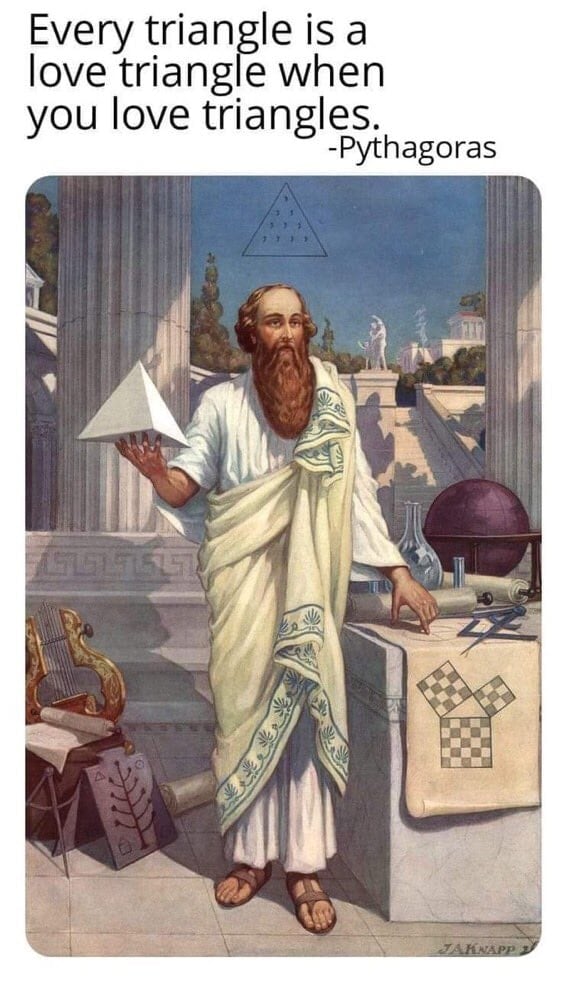
The meme is a play on the classic phrase "I love you" and replaces "you" with a mathematical equation, making it a humorous reference to the category of math. The image is likely a picture of the Greek mathematician Euclid, but the text "I love" is replaced with "I = ∅" which is a mathematical equation.
detailed-analysis (gemma3-27b-vision)
Okay, let's break down this meme image through the lenses you've requested. It's surprisingly rich for a seemingly simple joke!
Visual Description
The image is a heavily stylized, almost illustrative depiction of Pythagoras. He's presented as a classical figure – long flowing beard, draped in a white and gold robe, and sandals. He's dramatically holding a paper-cutout equilateral triangle aloft. The background appears to be a classical architectural setting, likely referencing a Greek temple or study. Various geometric shapes (spheres, cubes, a checkerboard pattern) and objects (possibly a lyre) are scattered around as props, reinforcing the association with mathematics and philosophy. A triangular halo floats over his head. The text above reads: "Every triangle is a love triangle when you love angles - Pythagoras." The image has a slightly painterly quality, reminiscent of a historical illustration or commemorative portrait.
Foucauldian Genealogical Discourse Analysis
This image provides a fascinating example of how a concept ("triangles") gets discursively re-appropriated and reshaped.
- Discourse and Power: The image taps into the historical discourse surrounding Pythagoras and his school. He is traditionally seen as a figure of rigorous logic, mathematical precision, and a search for underlying order in the universe. This historical framing confers a certain authority on the statement.
- Genealogy of "Love Triangle": The genealogy of the phrase "love triangle" has its own separate history. Originally referring to romantic relationships, this image re-articulates it, imbuing it with a mathematical meaning. It performs a shift in the signifying chain. The image constructs a novel association that wasn’t historically present.
- Episteme and Shifting Understandings: The meme subtly reflects a broader shift in how we understand knowledge. The historically defined 'truth' of geometry is being playfully undermined. What was once a logical, objective field is being folded into the realm of subjective experience (loving angles). It’s a micro-example of a move away from a purely rational episteme toward a more fluid, playful one.
- Subjectivation: The meme implicitly positions the viewer as a subject capable of appreciating this re-articulation, of being 'in on the joke'. It invites a certain mode of interpretation, based on a playful connection between mathematical concepts and human emotions.
Critical Theory
From a critical theory perspective (particularly drawing on the Frankfurt School), this meme can be analyzed as a form of playful critique of Enlightenment rationality.
- Instrumental Reason: The Enlightenment emphasized instrumental reason – the idea that reason should be used to achieve practical goals. Pythagoras and his mathematical pursuits are foundational to that tradition. However, the meme subverts this by suggesting that even in a field predicated on logic, subjective experience ("loving angles") can intrude.
- Reification: The image can also be read as a playful dismantling of reification – the tendency to treat abstract concepts (like angles) as concrete realities. By injecting emotion into the equation, the meme reminds us that even mathematical concepts are constructions, shaped by human perception and interpretation.
- Culture Industry: Though it’s a single image, it speaks to the broader phenomenon of the “culture industry” and its tendency to repurpose and remix historical figures and ideas. It turns a philosopher into a source of lighthearted, easily consumable wisdom.
Marxist Conflict Theory
The application to Marxist conflict theory is slightly more tenuous but possible.
- Ideology and Hegemony: The traditional discourse around Pythagoras and mathematics has historically served to reinforce certain ideologies – the supremacy of reason, the value of order, and the pursuit of objective knowledge. The meme can be seen as a minor disruption of that ideological framework, a playful undermining of the “naturalness” of mathematical concepts.
- Alienation: One could argue that the modern emphasis on pure rationality and objective knowledge has led to a sense of alienation from subjective experience and emotional intelligence. The meme, by reintroducing emotion into the equation, might be seen as a small attempt to counter that alienation. However, it's a very subtle critique.
Postmodernism
This meme is inherently postmodern in its approach.
- Deconstruction: It actively deconstructs the traditional association between mathematics and objective truth. The meme doesn’t deny the logic of geometry but playfully juxtaposes it with a subjective emotional state.
- Intertextuality: The meme relies heavily on intertextuality – the relationship between the image of Pythagoras, the concept of a triangle, and the phrase "love triangle." It draws on existing cultural references to create a new meaning.
- Pastiche & Playfulness: The image utilizes pastiche – the blending of different styles and references. The classical illustration style combined with a modern, witty caption creates a playful, self-aware effect.
- Rejection of Grand Narratives: The meme subtly challenges the "grand narrative" of Enlightenment rationality by suggesting that even in a field predicated on logic, subjective experience has a place.
Queer Feminist Intersectional Analysis
This lens requires some stretching, but is potentially interesting.
- Challenging Binary Thinking: The traditional associations with geometry – precision, order, logic – can be seen as aligned with patriarchal and heteronormative ideals of rationality and control. The meme, by injecting emotionality and playfulness, subtly disrupts those associations.
- Reclaiming Language: The phrase “love triangle” has historically been used to describe often fraught and complex heterosexual relationships. This meme reappropriates that phrase, giving it a new and playful meaning unrelated to romantic entanglement.
- Intersectional Play: The meme’s humor stems from the unexpected connection between seemingly disparate concepts (mathematics and emotion). This unexpected juxtaposition can be seen as a metaphorical representation of the complexities and intersections of identity and experience.
In conclusion, this seemingly simple meme is surprisingly rich in meaning when analyzed through various critical lenses. It highlights how language, imagery, and cultural references can be used to challenge assumptions, disrupt ideologies, and create new meanings.
simple-description (llama3.2-vision)
This meme is a humorous image of the ancient Greek philosopher Pythagoras, who is known for his contributions to mathematics, particularly the concept of the "Pythagorean theorem." The image depicts Pythagoras in a traditional Greek setting, surrounded by ancient Greek symbols and instruments. The text above the image reads, "Every triangle is a love triangle when you love triangles," which is a play on words referencing the mathematical concept of triangles and the phrase "love triangle," a term used to describe a romantic relationship with multiple partners.
tesseract-ocr
Every isis isa love triangle when you love triangles. -Pythagoras » al - bs atti yi Be tt py ei 7 ' oo | be ca