First Seen
2023-05-10T21:03:36+00:00
simple-description (llama3.2-vision_11b)
The meme is a humorous illustration of a person's inner thoughts, where they're expressing frustration and desperation at being misunderstood. The text in the image reads: "I'm not arguing, I'm just explaining why I'm right. And also why you're wrong. And also why you're wrong about why I'm right." This meme pokes fun at the common experience of feeling misunderstood and the tendency to escalate into arguments when trying to explain one's perspective.
detailed-analysis (gemma3-27b-vision)
Okay, let's break down this image through various critical lenses.
Visual Description
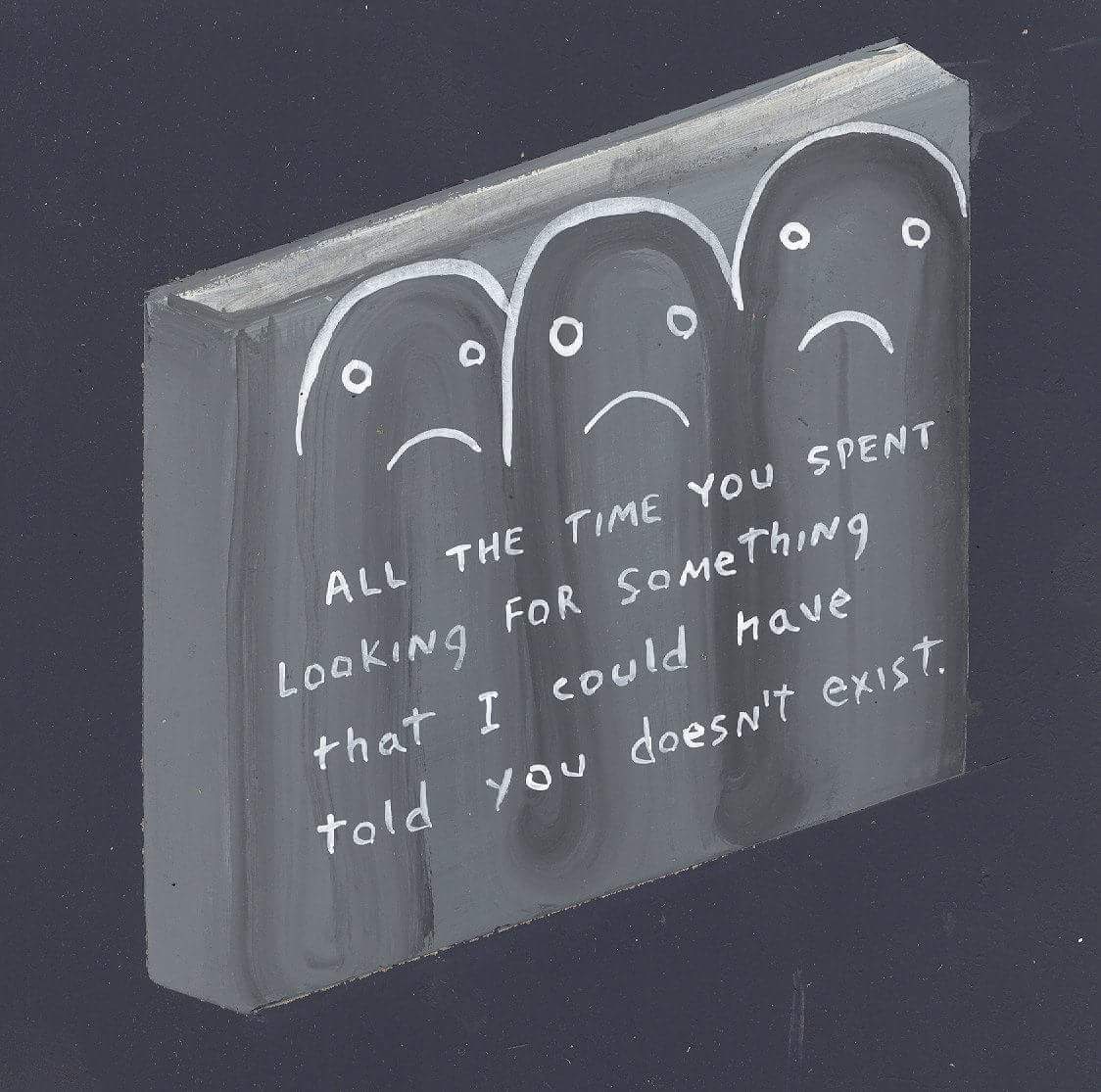
The image depicts a small, three-dimensional canvas or box-like structure, seemingly painted with a dark grey or black paint. Arranged across the front are three stylized, cartoonish faces. Each face has large, sad eyes and a downturned mouth, giving off a sense of melancholy or emptiness. They are minimal, almost emoji-like in their simplicity. Handwritten in yellow paint across the front of the structure are the words: "ALL THE TIME YOU SPENT LOOKING FOR SOMETHING THAT I COULDN'T HAVE TOLD YOU DOESN'T EXIST." The text is positioned as if written on the surface of the object, and its slightly uneven quality adds to the sense of raw, personal expression. The background is pure black, isolating the object and intensifying the mood.
Foucauldian Genealogical Discourse Analysis
This image strongly invites a Foucauldian reading. The text itself presents a power dynamic. The "I" is a source of knowledge, withholding information (the non-existence of "something"). The "you" is engaged in a search, a discourse built around the assumption that this "something" might exist.
The discourse operates as a system of knowledge/power. The "I" controls the truth—the fact of non-existence. By not revealing this truth, the "I" maintains a position of authority. The "you's" fruitless search, then, isn’t simply a personal failing; it’s a result of being trapped within a discourse where certain truths are obscured.
A genealogical approach would look at the history of this discourse. What social, cultural, or psychological forces led to the creation of the expectation for "something" in the first place? What functions does this expectation serve? The object itself – the boxy structure – could be seen as a metaphor for the confining structures of discourse and the way they shape our perceptions. The sad faces reinforce the negative affective consequences of participating in a fruitless search based on a false premise.
Critical Theory
From a Critical Theory perspective, the image is a critique of societal structures and the alienation they create. The "something" being sought could represent various things – happiness, meaning, fulfillment, love, success – all promises made by dominant ideologies. The "I" could be read as the voice of disillusionment, exposing the inherent emptiness of those promises.
The object as a box-like structure is suggestive of containment. Is "you" trapped in a metaphorical box of expectations, searching for fulfillment within a system that is inherently unable to provide it? The sad faces amplify the feeling of existential despair, pointing to the broader critique of consumer culture, capitalism, or other systems that create needs and then fail to satisfy them. The artwork speaks to the idea that systems often create a lack, leading us to continually search for something that is ultimately unattainable.
Postmodernism
The image leans heavily into postmodern sensibilities. The text challenges the notion of a fixed, objective truth. The "something" being sought is deliberately vague, making its meaning subjective and open to interpretation. The statement "that I couldn't have told you doesn't exist" is a self-referential paradox: if it's unprovable, how can you know it doesn't exist? This linguistic ambiguity aligns with the postmodern rejection of grand narratives and claims to absolute knowledge.
The minimalist, cartoonish style of the faces can be seen as a deconstruction of representation. They are not realistic portrayals of emotion, but simplified signs pointing to emotion, highlighting the constructed nature of meaning. The image also plays with the concept of authorial intent. Is the “I” deliberately misleading, or simply stating a frustrating truth?
Queer Feminist Intersectional Analysis
This reading may be more subtle, but it’s present. The "something" being searched for could represent societal validation or acceptance, particularly relevant within queer and feminist frameworks. Many marginalized groups are constantly seeking recognition and affirmation from systems designed to exclude them. The "I" could then represent a voice revealing the futility of this search, the idea that patriarchal, heteronormative, or other oppressive systems will never fully accept or validate those they marginalize.
The sad faces could be interpreted as the emotional toll of internalized oppression, the exhaustion of constantly striving for acceptance from a hostile world. Furthermore, the "I" withholding knowledge could be a form of self-protection—a refusal to perpetuate the cycles of seeking validation from sources that consistently fail to provide it. This intersects with the concept of radical self-love and the rejection of external standards of worth. The intersectional aspect comes in recognizing that this experience is compounded for individuals with multiple marginalized identities.
I hope this comprehensive analysis is helpful. Let me know if you'd like me to elaborate on any specific section.
simple-description (llama3.2-vision)
This meme is a humorous illustration of a person's emotions after being ghosted by someone. The image shows a series of three cartoon faces with increasingly disappointed and frustrated expressions. The text on the image reads: "All the time you spent looking for something I could have told you didn't exist."
tesseract-ocr
cee a _ ale | ua if t ae E a) fa ey aie : 2 - el me 00 ) fe. * i i a voll (ies tae a _ ae : i i) iy, fi cs Ie wa : . - oF fl Us g ; bw vit eg tare) ae fe Re ore “ Fae os ] fee GEE) Sa SM ee ( fae onsale: (ao | Pe “el : oo ee ee Uo)! Gee. Sc @ | | ue - a » Wrens) t ee 2 ae o ee ais ae he ; = 1 2 ee N y aa eA Ne yd Oe a se ey | <a fe B aa : eh Woe et we i h ie ee al — ‘ ; . : s ;