First Seen
2023-05-10T21:03:36+00:00
simple-description (llama3.2-vision_11b)
The meme is a humorous take on the challenges of mental health. It features a split image of a person with a worried expression, with a caption that reads "me trying to remember what I had for lunch 5 minutes ago vs me trying to remember what I had for lunch 5 years ago". This meme pokes fun at the struggles of recalling everyday details, while also highlighting the difficulties of remembering past events.
detailed-analysis (gemma3-27b-vision)
Here's an analysis of the meme, broken down into relevant sections. It's important to note that applying these theoretical frameworks to a meme is inherently interpretive and can be somewhat playful. Some sections won't apply, as indicated.
Visual Description
The image is a split meme.
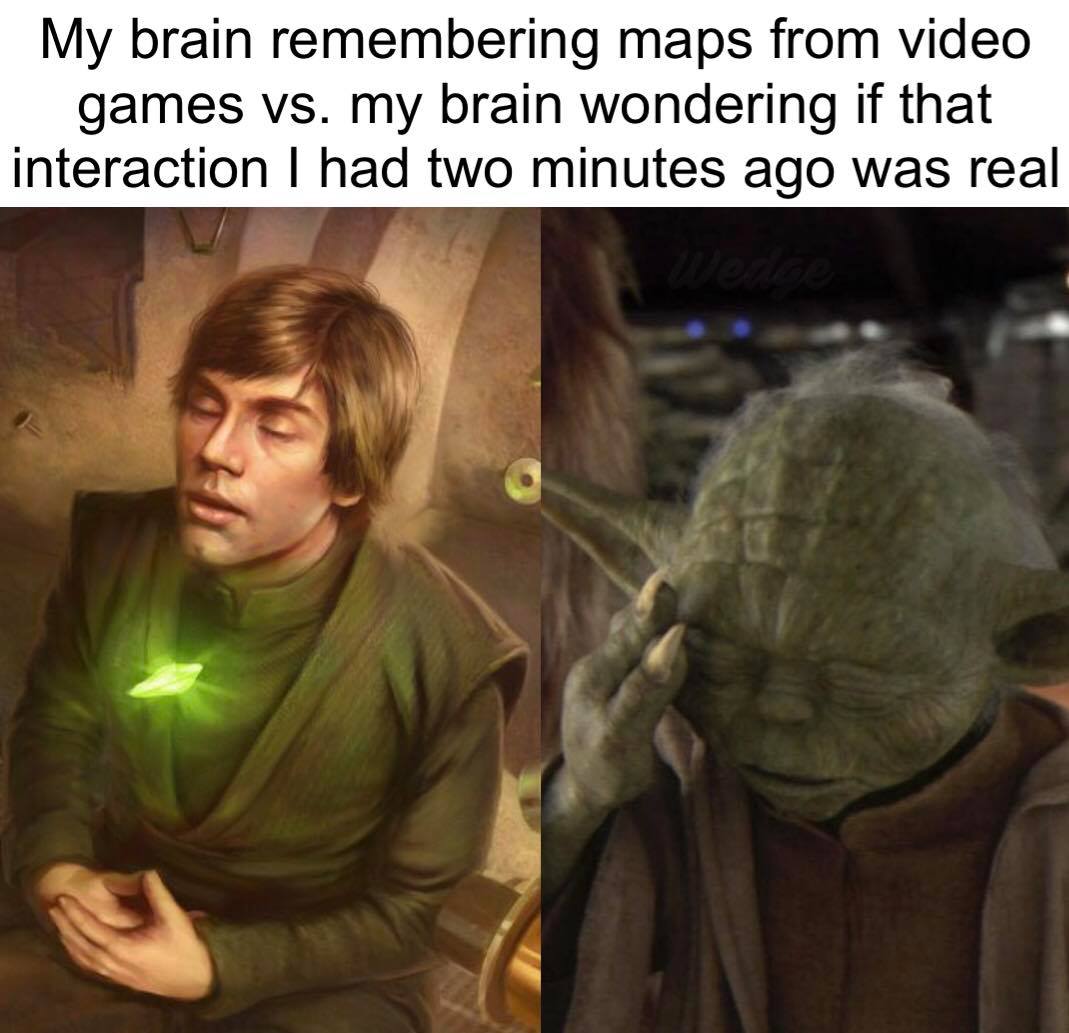
- Left Side: Depicts Luke Skywalker in a meditative pose from Star Wars, apparently levitating a small green object (likely a training sphere). The overall tone is serene, focused, and suggests mastery/memory. The lighting is warm and evocative of inner peace.
- Right Side: Shows Yoda, also in a meditative/focused pose, but surrounded by a chaotic array of hovering droids and mechanical parts. The scene is much more visually cluttered and frenetic, suggesting mental overload.
- Text: The caption reads: "My brain remembering maps from video games vs. my brain wondering if that interaction I had two minutes ago was real."
Foucauldian Genealogical Discourse Analysis
This meme touches on how our "brains" (and thus our subjectivity) are constructed through discursive practices.
- Power/Knowledge: The meme implies a shift in where knowledge is held and prioritized. Historically, "important" knowledge (navigation, geography) was rooted in the real world. Now, the brain readily stores and accesses detailed spatial information from virtual worlds (video game maps), demonstrating a shift in the accepted domains of knowledge and expertise.
- Genealogy of Memory: Foucault's genealogical method traces the historical development of concepts. This meme implicitly suggests that our brains are becoming different – adapted to prioritize and retain information from digitally constructed environments. We're witnessing a genealogy of memory itself, shifting from organic lived experience to algorithmic encoded experience.
- Discipline & Subjectivation: Video games are a form of discipline – they require memorization, spatial reasoning, and response training. The meme highlights how these “disciplines” shape the subject, influencing what the brain prioritizes. The real-world interaction, less structured and defined, is deemed less worthy of memory.
Critical Theory
The meme resonates with some key tenets of critical theory, specifically relating to the cultural impact of technology and the erosion of ‘authentic’ experience.
- Commodification of Experience: The meme points to the dominance of synthetic experience over authentic experience. Spending hours meticulously learning video game maps becomes a more salient "memory" than a brief human interaction. This highlights the commodification of experience—we invest time and cognitive energy in systems not necessarily rooted in the “real.”
- The Culture Industry: The meme implicitly criticizes the 'culture industry' (as described by Adorno & Horkheimer). The vivid and compelling nature of digital worlds (games) overwhelms the mundane or less structured qualities of real-world interactions. This creates a hierarchy of experience, privileging the curated, predictable, and visually stimulating.
- Alienation: The meme subtly suggests a form of alienation. The brain prioritizing a digital map over a real human interaction implies a disconnect from lived experience and an attachment to the simulated.
Marxist Conflict Theory
While not a primary lens for interpreting this meme, a connection can be drawn.
- Commodification of Attention: Video games are a capitalist product designed to capture and retain attention (a limited resource). The meme illustrates how the relentless pursuit of profit (through engaging game design) influences our cognitive processes, prioritizing virtual experiences over real-world ones. Our attention (and thus our mental capacity) becomes a commodity in the digital marketplace.
- False Consciousness: One could argue that the meme implies a kind of "false consciousness"—we're distracted by the shiny, engaging world of games, diverting our mental energy from more meaningful or socially productive activities. (This is a stretch, though.)
Postmodernism
This meme is heavily rooted in postmodern ideas.
- Simulacra and Simulation: (Baudrillard) The meme embodies the concept of simulacra – copies that precede and ultimately replace the real. The brain’s ease with remembering a virtual landscape while struggling to retain a real-world encounter suggests that the simulated world is becoming more "real" than reality itself. We live in a hyperreality where the distinction between real and simulated is increasingly blurred.
- Fragmentation & Loss of Grand Narratives: The meme reflects a fragmented experience of reality. The inability to retain a recent interaction contrasts with the precise recall of a game map. This points to a loss of a coherent, overarching narrative (a "grand narrative") of lived experience.
- Playfulness & Irony: The meme is itself a playful act of self-awareness, acknowledging the absurdity of this cognitive prioritization. This self-referentiality is characteristic of postmodern art and thought.
Queer Feminist Intersectional Analysis
This framework is less directly applicable. However, one could argue:
- The 'Default' Experience: The meme implicitly assumes a certain "default" cognitive experience. It does not account for neurodiversity or differences in how individuals process information. Individuals with certain cognitive conditions may experience this dynamic differently.
- Gendered Expectations & Cognitive Load: (A stretch) Historically, certain types of spatial reasoning (mapping, navigation) have been associated with masculine roles. The meme's emphasis on video game maps (often featuring action and exploration) could subtly reinforce these gendered associations.
In conclusion, the meme is a surprisingly rich cultural artifact that speaks to the anxieties and transformations of the digital age. It’s a playful acknowledgement of how technology is reshaping our brains, our memories, and our experience of reality. The most powerful interpretations are rooted in postmodern and critical theory frameworks.
simple-description (llama3.2-vision)
This meme is a humorous comparison between two images. The first image is of Luke Skywalker from the Star Wars franchise, looking confused and disoriented. The text above the image reads, "My brain remembering maps from video games vs. my brain wondering if that interaction I had two minutes ago was real." The second image is of Yoda from the same franchise, with a similar look of confusion and concern. The meme is poking fun at the way our brains can struggle to remember certain events or interactions, and the struggle to distinguish between what's real and what's not.
tesseract-ocr
My brain remembering maps from video games vs. my brain wondering if that interaction | had two minutes ago was real on I) | A a , a s =~ Ty Se, ~ 5