First Seen
2023-05-10T21:03:36+00:00
simple-description (llama3.2-vision_11b)
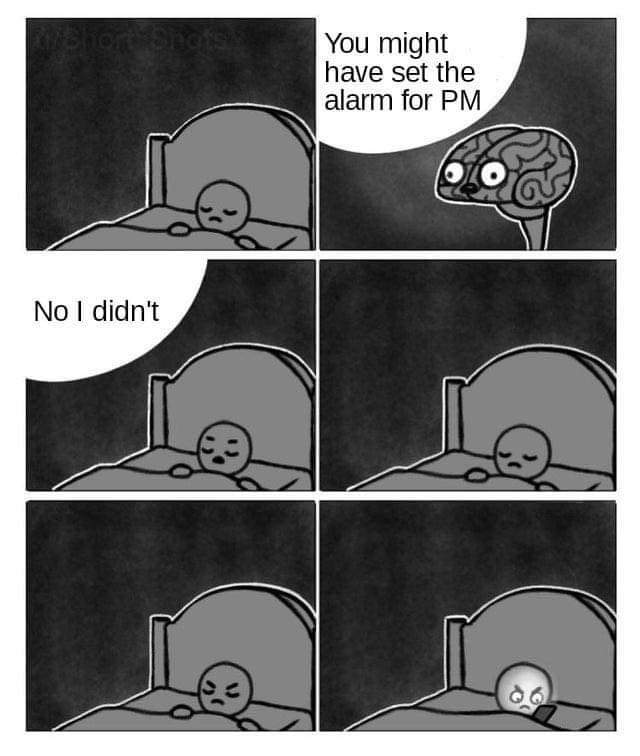
The meme is a humorous take on the struggles of mental health, specifically the common experience of lying awake at night and feeling anxious or overwhelmed. The image shows a person lying in bed with a thought bubble, captioned "I'm not actually awake, I'm just anxious and can't sleep". This relatable sentiment is often a challenge for individuals with mental health conditions, and the meme pokes fun at the internal monologue that can keep people up at night.
detailed-analysis (gemma3-27b-vision)
Okay, let's break down this comic with the requested theoretical lenses. It's a deceptively simple image, but ripe for analysis.
Visual Description
The comic is a six-panel, black and white drawing in a minimalist style. Each panel depicts a small, simplified human head in bed, presumably trying to sleep. The head is under a large, dark arch, suggesting a canopy or a shrouded space, evoking feelings of confinement. The expression on the face shifts subtly from neutral to increasingly distressed or pained. In the first panel, a disembodied brain appears above the head, speaking in a speech bubble. The text in the bubble says, "You might have set the alarm for PM." Subsequent panels have the head responding "No I didn’t". The backgrounds are simply flat black, reinforcing a sense of interiority and isolation. The overall visual effect is stark and unsettling.
Foucauldian Genealogical Discourse Analysis
This comic is highly amenable to a Foucauldian reading. The "brain" as a speaking entity represents a discourse – a system of thought, language, and practice that shapes how we understand the world. In this case, the discourse is time, and specifically, its categorization of AM and PM.
- Power/Knowledge: The brain isn't just offering a factual statement; it's exercising power through knowledge. It defines the potential mistake, and its assertion immediately instills anxiety in the individual. The speaker knows something about the subject that the subject does not. This is a manifestation of how discourses can shape and control through defining norms and possible deviations from them. The comic does not necessarily say whether the brain is correct, it only shows the power in delivering the message.
- Genealogy: We can trace the “genealogy” (historical development) of the AM/PM system. It wasn’t always this way; it’s a constructed system of organization. The anxiety arises from the perceived consequences of failing to adhere to this constructed system. The comic points to how deeply ingrained these systems become and how they function as implicit rules governing our lives.
- Discipline: The initial statement functions as a form of self-discipline. The brain's suggestion immediately leads the individual to scrutinize their past actions, attempting to regulate their behavior based on the potential "error". It’s a quiet, internalized form of discipline. The brain does not need to physically discipline, it can influence and manipulate through the imposition of a standard.
- Subjectivation: The anxious reaction demonstrates subjectivation – the process through which individuals internalize norms and become governed by them. The individual doesn’t question the logic of AM/PM, only the possibility of failing to adhere to it.
Critical Theory
From a Critical Theory perspective, this comic illustrates the inherent alienation and anxiety produced by modern life.
- Reason and Domination: The AM/PM system, ostensibly a rational tool for organizing time, becomes a source of anxiety and self-doubt. This suggests how “reason” itself can be a form of domination, imposing artificial structures that create unnecessary stress.
- False Consciousness: The individual accepts the legitimacy of the AM/PM system without questioning its underlying assumptions. This lack of critical reflection can be interpreted as a form of "false consciousness," where individuals are unaware of the structures that shape their lives.
- Alienation: The fact that the brain is separate from the head reinforces a sense of alienation – a disconnect between the self and its own cognitive processes. The brain is an external force imposing judgment. This resonates with the Critical Theory idea that modern systems often separate individuals from their own agency and creative potential.
Postmodernism
A Postmodern reading centers on the deconstruction of grand narratives and the instability of meaning.
- Meta-Narrative Disruption: The comic subtly undermines the "grand narrative" of time as a linear, objective progression. The anxiety arises from a minor disruption within that system, exposing its fragility.
- Simulacra and Simulation: The comic might be seen as reflecting the "simulacra" – copies that precede the real. The anxiety isn't about a tangible event but about the possibility of an error in a symbolic system. The simulation (the potential alarm) becomes more real than the experience itself.
- Deconstruction: The simplicity of the image allows for a deconstruction of the very concept of "mistake". What does it mean to "set the alarm wrong?" The comic highlights the arbitrary nature of these categories.
Queer Feminist Intersectional Analysis (Less Directly Applicable, but Possible)
This is the most difficult lens to apply, but we can still tease out some readings.
- Internalized Oppression: The anxiety can be interpreted as a form of internalized oppression, where the individual internalizes the rigid expectations of a system (time) and polices their own behavior. This could map onto broader anxieties about fitting in and meeting societal standards.
- The Weight of Responsibility: The comic subtly illustrates the disproportionate burden of mental labor and emotional regulation often placed on marginalized groups. The individual is entirely responsible for managing this potential error, mirroring the expectation that individuals must constantly navigate and compensate for systemic biases.
In conclusion: This deceptively simple comic packs a significant amount of theoretical weight. It’s a powerful illustration of how seemingly benign systems and structures can exert subtle but pervasive forms of control, shape our perceptions, and contribute to everyday anxiety.
simple-description (llama3.2-vision)
The meme is a comic strip with six panels. In the first panel, a person is lying in bed with a clock in the background. In the second panel, the person is startled by an alarm clock going off, but in the third panel, they realize it's not the alarm clock that's going off, it's their phone. The person then looks at their phone and sees that it's 3:30 AM. The person then says "You might have set the alarm for PM" and then says "No I didn't."
tesseract-ocr
You might have set the -— alarm for PM No | didn't A