First Seen
2023-05-10T21:03:36+00:00
simple-description (llama3.2-vision_11b)
The meme is a screenshot of a popular meme format, but I'll describe it for you. The image is a photo of a storefront with a sign that says "Mental Health" above the door. The sign below it reads "Now Open" and has a red circle with a line through it, indicating "Closed". The text above the image reads "You know you're in therapy when...".
detailed-analysis (gemma3-27b-vision)
Okay, let's break down the image and apply those theoretical frameworks where relevant.
Visual Description
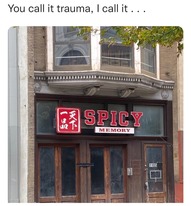
The image presents the storefront of a business called "Spicy Memory." The building appears to be an older structure, with a classical, somewhat ornate facade. The storefront itself is primarily dark wood and glass. The sign is divided into two sections: A red square on the left with what appears to be Chinese characters (possibly calligraphy) and the words "SPICY MEMORY" in a modern, bolder font, with "SPICY" above "MEMORY". There is a sign on the door and there is a visible security camera. The building is framed by a grey structural column on the left and some greenery on the right. The general impression is of a contrasting juxtaposition of traditional and contemporary aesthetics.
Foucauldian Genealogical Discourse Analysis
This image lends itself strongly to a Foucauldian reading. The very name "Spicy Memory" positions memory itself as a discourse. Foucault argued that discourse isn’t just language, but a system of power/knowledge that shapes how we understand the world. Here, "memory" isn't presented as a neutral, objective phenomenon, but as something potentially flavored—"spicy"—suggesting a level of intensity, perhaps even pain or discomfort.
- Genealogy: A genealogical approach would investigate the historical construction of the concept of “memory” and how it’s linked to ideas of trauma, identity, and even cuisine. What historical conditions led to the pairing of memory with a sensory experience like “spicy”? Perhaps it alludes to the saying "bitter-sweet memory".
- Power/Knowledge: The business, by naming itself this way, is performing a certain kind of authority on the concept of memory. It positions itself as a place where memory is actively experienced and potentially manipulated or re-interpreted. The security camera could be viewed as a technology of surveillance.
- Disciplinary Power: The contrast between traditional Chinese aesthetics and the bold, modern text could suggest a blurring of cultural boundaries and the imposition of certain interpretations of memory onto other cultures.
Critical Theory
This image prompts questions about the nature of truth and ideology.
- Ideology: The concept of “spicy memory” suggests a certain ideology – that memories are not simply recalled, but are constructed and potentially infused with emotional intensity and even pain. It could be seen as a commodification of trauma, offering an “experience” of potentially difficult emotions.
- Commodification: The fact that this is a business, a place to buy something related to memory, suggests that even deeply personal experiences like trauma can be turned into commodities within a capitalist system.
- The "Authentic" vs. The Simulated: Does "spicy memory" offer a genuine experience of remembering, or is it a simulation—a carefully curated and packaged experience designed to evoke certain emotions?
Postmodernism
The image is thoroughly postmodern in its aesthetic and conceptual playfulness.
- Juxtaposition and Fragmentation: The combination of Chinese characters, modern typography, and potentially culturally-loaded terminology ("spicy") creates a sense of fragmentation and a blurring of cultural boundaries.
- Intertextuality: The name "Spicy Memory" evokes multiple associations – with food, with emotions, with personal histories. It's a name that demands interpretation.
- The Death of the Author (or Original Meaning): The image, much like a postmodern text, resists a single, definitive interpretation. Its meaning is open-ended and contingent on the viewer's own experiences and interpretations.
Queer Feminist Intersectional Analysis
While not immediately obvious, a queer feminist lens can be applied:
- Reclaiming Pain: "Spicy" can be interpreted as a metaphor for a painful, yet empowering, experience. Queer and feminist thought often focuses on reclaiming experiences of pain and oppression and finding power within them. The business could be interpreted as a space for exploring and processing difficult emotions within a safe context.
- Challenging Normative Memory: The very act of presenting memory as "spicy" challenges the idea of memory as a simple, linear, objective recall of the past. Queer and feminist perspectives often challenge dominant narratives and highlight the ways in which memory is shaped by power dynamics and social contexts.
- Intersectionality: The Chinese characters introduce the possibility of complex cultural contexts and experiences. How do those intersect with the notion of ‘spicy memory’? Is it a claiming of cultural trauma or a commodification of it?
Note: It's important to remember that these are just possible interpretations. A single image can be viewed through multiple theoretical lenses, and the meaning is ultimately subjective. The strength of these interpretations depend on the context of the image (e.g., where it was found, what it was accompanying) and the viewer's own background and experiences.
simple-description (llama3.2-vision)
The meme features a photo of a restaurant called "Spicy Memory" with a red sign in the window. The sign has a warning symbol and the words "Spicy Memory" in bold, red letters. The text at the top of the image reads "You call it trauma, I call it..."
tesseract-ocr
| oi