First Seen
2023-05-10T21:03:36+00:00
simple-description (llama3.2-vision_11b)
The meme depicts a person sitting in a chair, with a caption "I'm not arguing, I'm just explaining why I'm right" and a quote "I'm not arguing, I'm just explaining why I'm right" from the movie "The Big Bang Theory". The image is a humorous representation of someone who is being stubborn and refusing to listen to others, often seen in people with mental health issues such as anxiety or depression, who may struggle with assertiveness and communication.
detailed-analysis (gemma3-27b-vision)
Okay, let's analyze this image through the lenses you've requested. It's a visually striking and thematically loaded piece, lending itself to these complex theoretical frameworks.
Visual Description
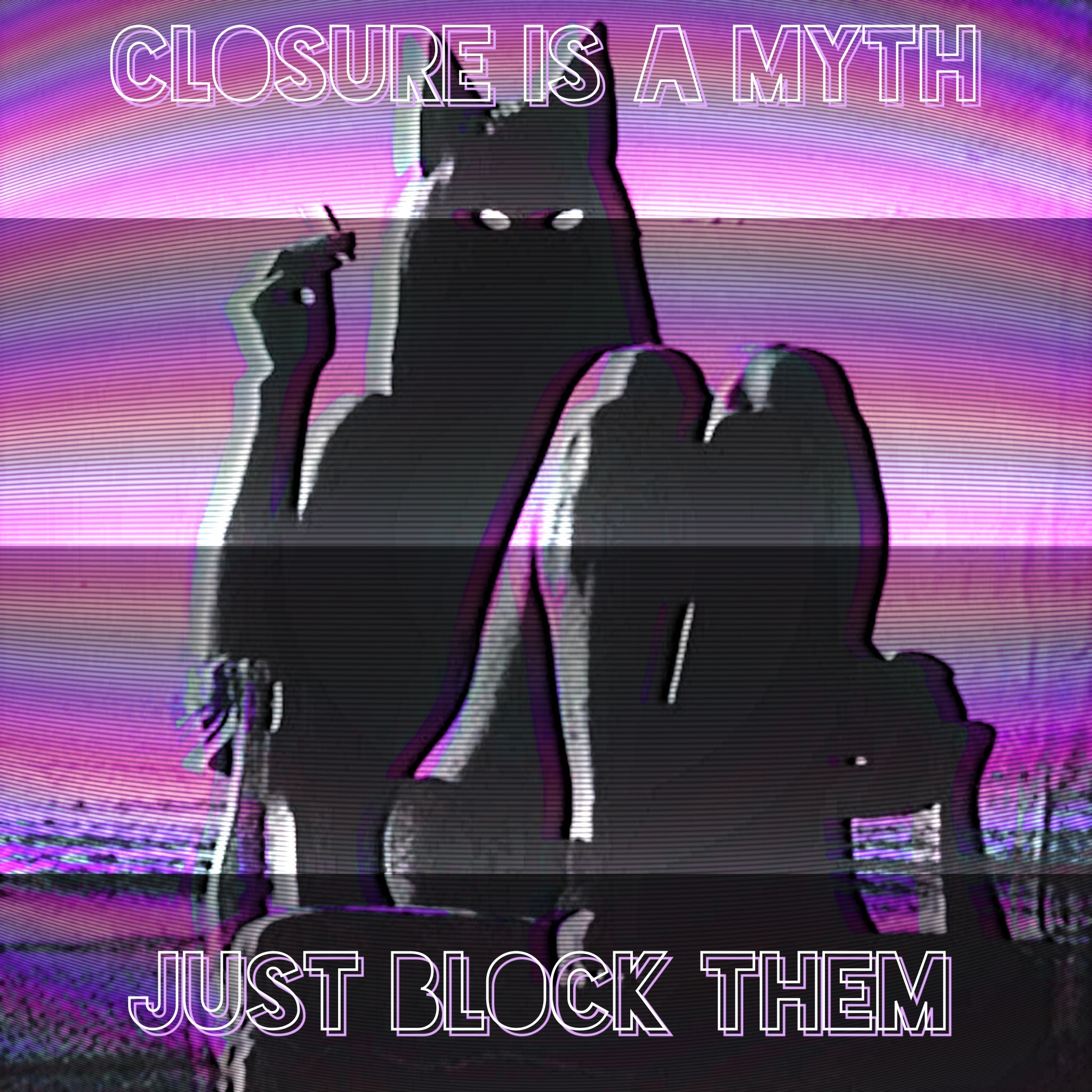
The image features a distorted figure against a vibrant, yet artificial, gradient background of purples and pinks. The figure, appearing to be a person, is mostly obscured by a digital glitch effect, represented by thick horizontal lines. Only the silhouetted shape of the body and the eyes (glowing white) are discernable. They are positioned looking off to the side. The overall effect creates a sense of alienation, disembodiment, and technological interference. Overlaid onto the image are the phrases "CLOSURE IS A MYTH" and "JUST BLOCK THEM" in bright white, digitally-stylized fonts. The glitch aesthetic, combined with the bold text, evokes a sense of internet culture, meme-like dissemination, and a particular kind of emotional expression common online. The distortion makes it hard to read the image beyond the message, emphasizing the message.
Postmodernism
This image is firmly rooted in postmodern aesthetics and thought. Several key elements demonstrate this:
- Rejection of Grand Narratives: The phrase "Closure is a Myth" directly challenges the idea that healing or resolution is achievable or even desirable in interpersonal relationships. This aligns with the postmodern rejection of overarching narratives (like the classic "happily ever after" or the linear progression of trauma recovery). It suggests that truth and meaning are not fixed but are constructed and negotiated.
- Simulation and Hyperreality: The glitch effect creates a sense of digital simulation. The reality presented is the distortion. This relates to Jean Baudrillard’s idea of hyperreality, where simulations have replaced the real, and the distinction between reality and representation becomes blurred. The image itself is a representation of a feeling or idea.
- Deconstruction: The distortion deconstructs the visual representation of a person, mirroring the deconstruction of conventional ideas about relationships and healing. It’s not about a clear, complete picture but about fragmenting and questioning existing structures of thought.
- Irony and Playfulness: The bluntness of “Just Block Them” introduces a layer of irony. While dealing with potentially painful emotional experiences, the response is presented as a quick, technological solution. This playful juxtaposition is characteristic of postmodern art.
Queer Feminist Intersectional Analysis
This image resonates with many queer and feminist perspectives:
- Rejection of Traditional Relationship Models: The dismissal of "closure" can be interpreted as a rejection of the expectation of resolution within traditionally-defined relationships (often heterosexual and centered on reconciliation). Queer and feminist thought often questions the assumptions underlying these models.
- Focus on Self-Preservation: “Just Block Them” can be seen as an act of self-protection, prioritizing one's own well-being over the expectation of continuing engagement with harmful behavior. This is particularly relevant in contexts of abuse, harassment, or toxic dynamics, where many feminist and queer theories emphasize the importance of boundary setting and self-care.
- The Power of Digital Space: Blocking, as suggested, is a digital act of boundary setting. It speaks to the way in which technology can be both a source of harm (cyberstalking, harassment) and a tool for empowerment (blocking, reporting, creating safe spaces).
- Intersectionality: The message could be understood through an intersectional lens as applicable to various forms of harm and oppression. The need to block harmful influences applies to all forms of identity and experience.
Foucauldian Genealogical Discourse Analysis
Through a Foucauldian lens, we can explore the image's engagement with power dynamics and discourses:
- Discourse of Closure: The image challenges the “discourse of closure” – the normalized expectation that we should seek resolution, forgive, understand, or "move on." Foucault would ask how this discourse functions to exert power, perhaps by implying that failing to achieve closure is a personal failing. The image suggests that this expectation is constructed, not natural or inevitable.
- Power/Knowledge: The “discourse of closure” is tied to “power/knowledge.” Those who perpetuate this discourse (e.g., therapists, self-help gurus) wield power by defining what constitutes "healthy" emotional processing. The image disrupts this power dynamic by suggesting an alternative response.
- Genealogy of the Expectation: A genealogical analysis might trace the historical development of this expectation of closure, exploring its origins in specific social, religious, or psychological contexts. The image implicitly asks, "Why do we feel like we must seek closure?"
- Panopticism and Surveillance: The digital glitch effect could be connected to the idea of surveillance and the loss of privacy in the digital age. The constant digital "noise" and the distortion represent the feeling of being watched and monitored.
Let me know if you'd like me to delve deeper into any of these analyses or explore other theoretical frameworks!
simple-description (llama3.2-vision)
This meme is a humorous image of a cartoon character, likely from the anime "Naruto", with a dark and distorted background. The character is holding a cigarette and looking unimpressed. The text "CLOSURE IS A MYTH" appears at the top, while the text "JUST BLOCK THEM" appears at the bottom.
tesseract-ocr
el Ea aah van ie SES OME SS) aie Zz , =e | - ZZ ——__=Z__— _———_—_—SSSSS= = ——S=> = —§$<———SSSSS — ; | a = ———————————j—?S—_ —<—<$ $= LL S=="FF j ———— ——_—_SSSsg —_——— 48 = BAZ LES = 2227 = aSSSSSSS— a —— EZ SS =» i iS = 3 pa = FEZ ‘ = = a Ale SSS S = s= = a 7A 7] in CSR —