First Seen
2023-05-10T21:03:36+00:00
simple-description (llama3.2-vision_11b)
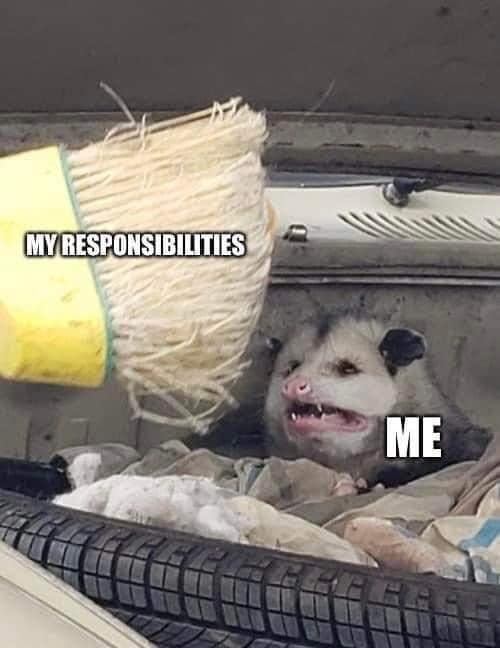
The meme is a humorous representation of the overwhelming feeling of responsibility that can come with mental health struggles. The image depicts a person being attacked by a giant, angry sponge labeled "Mental Health" with a caption "When you have to do all the work and no one else does". The text in the image emphasizes the sense of burden and isolation that can come with managing one's own mental health.
detailed-analysis (gemma3-27b-vision)
Okay, let's break down this meme using the requested theoretical lenses. It's a rich image for analysis!
Visual Description
The image is a photograph of an opossum seemingly trapped within the engine compartment of a vehicle. The opossum appears distressed, with its teeth bared, clinging to debris. Above the opossum, prominently placed, is a large spool of twine or rope. The image is labeled with text overlaid on the photo: "My Responsibilities" pointing to the twine and "Me" pointing to the opossum. The overall effect is one of overwhelming stress and being burdened beyond capacity. It's a classic meme format that relies on relatable feelings of being swamped.
Foucauldian Genealogical Discourse Analysis
This image is excellent fodder for a Foucauldian analysis.
- Discourse of Productivity/Responsibility: The "Responsibilities" (twine) represent a discourse imposed upon the subject (opossum/me). This discourse is not neutral; it’s a system of power/knowledge that defines what is considered "responsible" behavior. It’s about being tied to obligations. It’s implied that the "responsibilities" aren't natural or inherent, but constructed through societal expectations and norms.
- Power Relations & Subject Formation: The opossum's trapped and distressed state symbolizes how this discourse of responsibility shapes the subject. The opossum is not choosing to be entangled; it’s subjected to the force of the twine (and thus, responsibility). The power dynamic is clear: the responsibilities are external, dominating, and potentially destructive. This links to the idea of "subjectification" – how we become who we are through these power relations.
- Genealogical Exploration: A genealogical analysis could trace the historical development of the concept of "responsibility" - how it changed over time, and who benefited from its construction. What historically constructed meanings are tied to the twine and the opossum? What systems are in place to keep the opossum (and us) tied down?
- Panoptic Surveillance: While not explicit, the engine compartment could be seen as a subtle allusion to the panopticon. The "responsibilities" are always present, creating a feeling of constant monitoring and potential judgment.
Critical Theory
This image lends itself well to a Critical Theory interpretation, particularly drawing on the Frankfurt School:
- Alienation: The opossum is clearly alienated from a natural state. Trapped within the machinery of modern life, it embodies the alienation of the individual from their true self and from meaningful activity. Its distress is a direct result of being forced into an unnatural position.
- Commodification & Instrumental Rationality: The engine compartment represents the instrumental rationality of modern society – a world where everything is treated as a means to an end (in this case, the car's functionality). The opossum is an unintentional casualty, a disruption to the smooth functioning of the machine, and its wellbeing is irrelevant. It is “used” by, and becomes part of, the machine.
- Culture Industry & Mass Deception: The image can be viewed as a commentary on the “culture industry” and its perpetuation of unrealistic expectations. The overwhelming “responsibilities” symbolized by the twine are a product of a system that demands constant productivity and conformity, leaving individuals feeling overwhelmed and trapped. The meme itself is part of this cycle of representation, critiquing while also becoming consumed within the online culture.
Marxist Conflict Theory
From a Marxist perspective, this meme highlights class struggle and the exploitation of labor (though metaphorically):
- The Oppressed & the Oppressor: The opossum represents the working class, struggling under the weight of "responsibilities" (which can be read as the demands of capital). The twine/responsibilities represent the bourgeoisie, controlling the means of production and extracting labor.
- Alienation of Labor: The opossum's distress reflects the alienation of labor in a capitalist system. It is forced into a position that is unnatural and detrimental to its wellbeing, all for the benefit of the machine (capital).
- False Consciousness: The meme subtly critiques the acceptance of these overwhelming responsibilities as "normal." The opossum doesn’t question why it’s trapped, it just is. This can be interpreted as a metaphor for how individuals in a capitalist system often accept their exploitation without questioning the underlying power structures.
Postmodernism
This meme has strong postmodern elements:
- Fragmentation & Simulacra: The image fragments a coherent sense of reality. The opossum and the twine are juxtaposed in an absurd and illogical way, creating a sense of disorientation. The “responsibilities” are not real, tangible objects, but rather representations of abstract concepts, i.e., simulacra.
- Irony & Pastiche: The use of a distressed opossum as a metaphor for personal overwhelm is ironic and humorous. The meme is a pastiche of internet culture and relatable anxieties. The image doesn't offer solutions but rather acknowledges the absurdity of the situation.
- Deconstruction of Meaning: The meme deconstructs the traditional notion of "responsibility." It questions the inherent value of these obligations and highlights their potentially destructive consequences.
Queer Feminist Intersectional Analysis
This analysis will lean more towards how the image evokes feelings of being trapped and overwhelmed, drawing connections to marginalized experiences:
- Intersection of Oppression: The opossum's experience of being trapped can be read as a metaphor for the intersectional experiences of oppression faced by marginalized groups. Various forms of oppression (sexism, racism, homophobia, classism, etc.) can contribute to a feeling of being overwhelmed and trapped within systemic structures.
- Emotional Labor & Care Work: The “responsibilities” symbolized by the twine can represent the often-unacknowledged emotional labor and care work disproportionately carried out by women and other marginalized groups. The opossum is clearly bearing the weight of these obligations, and its wellbeing is being sacrificed.
- Breaking the Binary/Deconstructing "Normalcy": The image disrupts conventional notions of normalcy. The juxtaposition of a wild animal and mechanical components creates an unsettling effect that challenges the boundaries between nature and technology, and what it means to be “at home” or “safe.”
- Resilience & Resistance: While the opossum appears distressed, it is also clinging to life. This can be interpreted as a metaphor for the resilience and resistance of marginalized groups in the face of oppression.
Hopefully, these theoretical lenses provide a thorough and nuanced exploration of this meme! Let me know if you'd like me to elaborate on any particular point.
simple-description (llama3.2-vision)
The meme features a photo of an opossum with a terrified expression, captioned "me" and "my responsibilities". The opossum is surrounded by a mess of dirty laundry, trash, and other chaotic elements. The text "my responsibilities" is being thrown at the opossum by a broom, implying that the speaker's responsibilities are overwhelming and chaotic.
tesseract-ocr
ae” - ———4 ro SSS CESSES ieee 4 Se . rs Se = s — of pec “| ay ee 7 ty Fe ; “4g . IT ITE s 4