First Seen
2023-05-10T21:03:36+00:00
simple-description (llama3.2-vision_11b)
The meme is a humorous take on the struggles of mental health, specifically the feeling of being overwhelmed and unable to accomplish tasks due to procrastination. The image depicts a person with a messy room, surrounded by dirty dishes and laundry, with a caption that reads "I can do anything I want... I just don't want to do anything...". This meme pokes fun at the common experience of feeling overwhelmed and stuck, and the text is a relatable expression of the procrastination mindset.
detailed-analysis (gemma3-27b-vision)
Okay, here's a breakdown of the image using the requested theoretical lenses, applying each only where it's relevant.
Visual Description
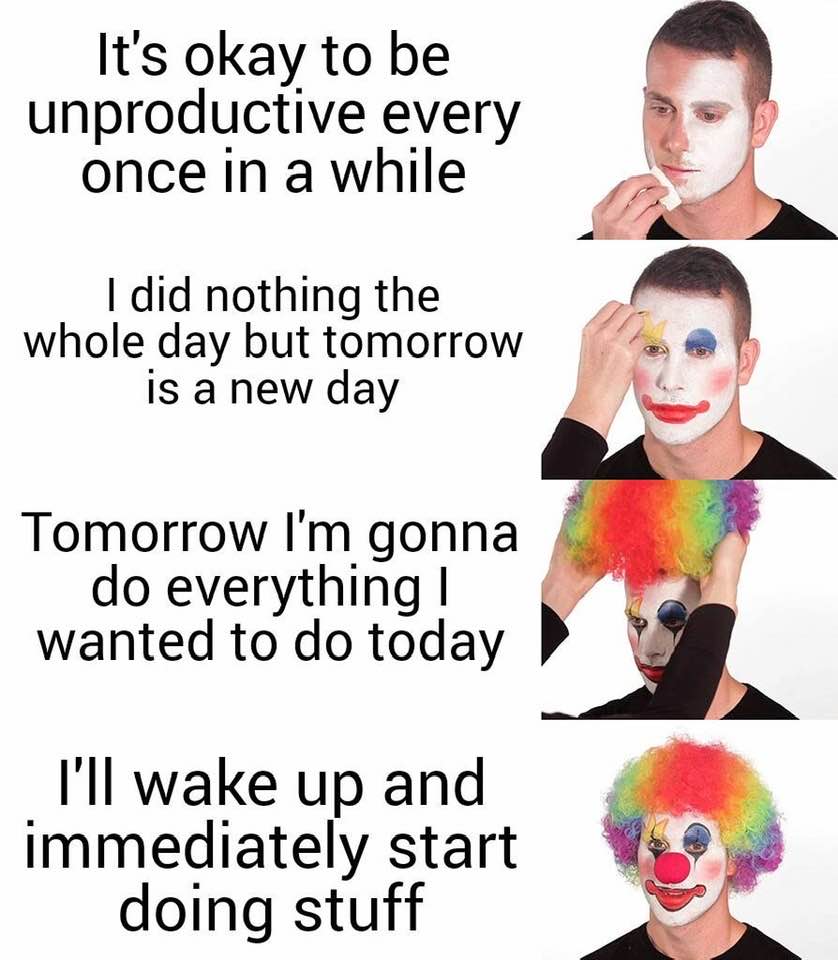
The image is a four-panel meme format, likely sourced from Twitter/X. It features a man progressively applying clown makeup in each frame. The text layered onto the image is a series of statements regarding procrastination and the promise of future productivity.
- Panel 1: A man, seemingly average-looking, with a slightly exasperated expression, is touching his forehead. Text: "It's okay to be unproductive every once in a while."
- Panel 2: The man is applying white face paint, beginning to transform into a clown. Text: "I did nothing the whole day but tomorrow is a new day."
- Panel 3: The man has applied more clown makeup (red lips, some colored details), looking slightly more unhinged. Text: "Tomorrow I'm gonna do everything I wanted to do today."
- Panel 4: The man is fully transformed into a clown, with a complete, exaggerated makeup look. Text: "I'll wake up and immediately start doing stuff."
The image relies on the juxtaposition of increasingly ridiculous visual imagery with familiar, self-deprecating internal monologue about procrastination.
Foucauldian Genealogical Discourse Analysis
This image is ripe for Foucauldian analysis. The core subject is productivity itself, as a discourse, a way of thinking and talking about value.
- Power/Knowledge: The meme subtly reveals the power/knowledge relationship around productivity. We've internalized the idea that doing is inherently good and not doing is bad. This isn't a natural truth, but a construct of modern, capitalist societies. The expectation to be constantly productive is linked to economic value – to be a ‘good’ worker, a ‘successful’ individual, one must be productive.
- Genealogy: The image hints at the historical development of this discourse. Originally, leisure and contemplation were valued. But with the rise of capitalism and the Protestant work ethic, idleness became associated with sin or failing. The constant push for self-optimization and “getting things done” is a result of this historical shift.
- Disciplinary Power: The underlying anxiety in the meme suggests the internalized sense of being monitored and judged for not being productive. Even when engaging in self-deprecating humor, the individual is implicitly acknowledging the expectations of the disciplinary system.
- The Clown as Disruptor: The man’s transformation into a clown can be interpreted as an act of resistance, or at least a symbolic disruption, to these norms. The clown embodies excess, absurdity, and a rejection of rational, productive behavior. It's a performance of non-conformity.
Critical Theory
This meme encapsulates a sense of alienation and anomie—themes central to Critical Theory.
- Commodification of Self: The pressure to be productive can be seen as a form of self-commodification. We're encouraged to treat ourselves as resources to be optimized, constantly seeking ways to improve our ‘human capital’.
- Ideology: The promise of "tomorrow" functions as an ideological fantasy, offering temporary relief from the guilt of procrastination while reinforcing the underlying system. It allows us to defer our anxieties about not being productive rather than addressing the root causes.
- False Consciousness: The meme could be interpreted as a form of "false consciousness." The humor obscures the deeper social forces that contribute to the experience of feeling pressured to be productive.
- The Illusion of Control: The belief that we can simply "wake up and immediately start doing stuff" is a way to maintain the illusion of control in a world where many factors are beyond our immediate influence.
Postmodernism
- Meta-Commentary: The meme is self-aware and meta-commentary on procrastination and self-deception. It’s not simply experiencing procrastination, but commenting on the experience itself.
- Deconstruction of Meaning: The image deconstructs the notion of a coherent, rational self. The transition to a clown highlights the absurdity and fragmentation of the modern identity.
- Simulacra & Simulation: The "promise of tomorrow" can be seen as a simulacrum – a copy without an original. It’s a fabricated hope that masks the underlying reality of procrastination.
- Irony and Playfulness: The meme relies heavily on irony and playfulness. The humor is a way to cope with the anxieties of modern life. The clown embodies a rejection of earnestness and a celebration of the absurd.
Let me know if you'd like me to expand on any of these points!
simple-description (llama3.2-vision)
This meme is a humorous commentary on the challenges of productivity. It features a series of images showing a person applying makeup and eventually transforming into a clown. The text accompanying the images reads: "It's okay to be unproductive every once in a while. I did nothing the whole day, but tomorrow is a new day. Tomorrow I'm gonna do everything I wanted to do today. I'll wake up and immediately start doing stuff." The meme pokes fun at the idea of making excuses for procrastination and the tendency to put off tasks until the next day.
tesseract-ocr
It's okay to be | unproductive every a= 1 once in a while a4 | did nothing the 2 whole day but tomorrow “Ce, @ f is anew day ne? , Tomorrow I'm gonna ’ doeverything!| ¢ +9 wanted to do today ¢ Tllwakeupand = @ immediately start Wy? doing stuff |