First Seen
2023-05-10T21:03:36+00:00
simple-description (llama3.2-vision_11b)
The meme is a play on the phrase "I'm not lazy, I'm just on energy-saving mode" and is replaced with "I'm not depressed, I'm just in my mental health comfort zone". It's a humorous way to poke fun at the idea that sometimes, taking care of one's mental health can feel like a comfort zone, but is often misunderstood as laziness.
detailed-analysis (gemma3-27b-vision)
Okay, let's break down the image and the accompanying phrase through several critical lenses. It’s a rich image that invites analysis.
Visual Description
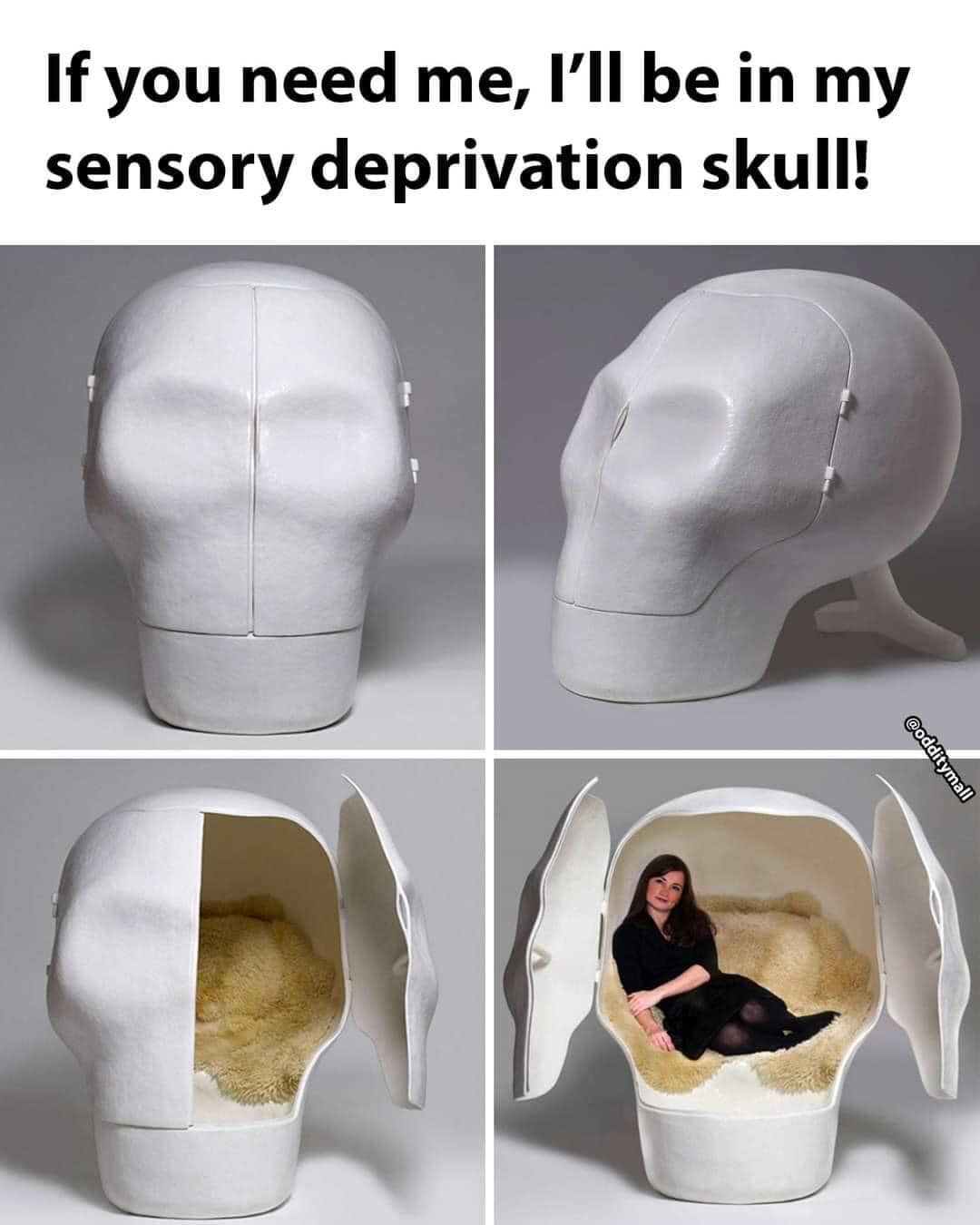
The image is a composite of four panels showing a large, white, egg-shaped structure resembling a skull, specifically the cranium. It's smooth and appears to be made of a molded material, possibly plastic or fiberglass.
- Panel 1 & 2: Close-ups of the exterior, emphasizing its smooth, almost featureless surface. The skull shape is immediately recognizable, though abstracted.
- Panel 3: Shows the structure hinged open, revealing a softly-lit, plush-lined interior, appearing cozy and sound-dampened.
- Panel 4: A person (appearing to be a woman with long dark hair) is entirely contained within the structure, sitting cross-legged, reading a book. The structure is large enough to encompass her entire body.
The phrase "If you need me, I'll be in my sensory deprivation skull!" accompanies the images, underscoring the intentionality of the enclosure as a retreat from external stimuli.
Foucauldian Genealogical Discourse Analysis
This image deeply resonates with Foucault's work, particularly his concepts of power/knowledge and the panopticon.
- Discipline and Self-Regulation: The "sensory deprivation skull" represents a self-imposed form of discipline. The person chooses to enter this space, creating their own form of control over their sensory input. This mirrors how modern power operates not just through overt force, but through internalizing norms and self-regulation.
- The Panoptic Gaze Turned Inward: The structure, while containing the individual, doesn’t necessarily observe them in the classic panoptic sense. However, the act of self-isolation is a form of surveillance— the individual is monitoring their own internal state, attempting to control their thoughts and feelings through environmental manipulation. This internal "gaze" becomes a mechanism of self-discipline.
- Genealogy of Self-Care/Wellness: Foucault encourages tracing the historical development of ideas. This "skull" can be seen as part of a modern "genealogy" of self-care and wellness, but with a dark, isolating twist. It’s an extreme example of prioritizing internal experience over external engagement. Tracing the history of concepts like "retreat," "sanctuary," or even "introversion" can highlight how these ideas have been shaped by power dynamics and social norms.
Critical Theory
The image prompts questions about the nature of the self and the impact of modern life on subjective experience.
- Alienation & the Fragmented Self: The self-imposed isolation within the "skull" can be read as a symptom of alienation – a sense of disconnection from society, others, and even oneself. It suggests a desire to escape the overwhelming stimuli and demands of contemporary life, leading to a fragmentation of the self.
- The Construction of Subjectivity: The "skull" isn't simply a neutral space; it actively shapes the person’s experience within it. This aligns with the critical theoretical understanding that subjectivity is not inherent but constructed through interactions with the environment and social structures. The skull is a tool to construct a particular kind of experience.
- Critique of Modernity: The image can be seen as a critique of the isolating and overwhelming conditions of modern life. It reflects a desire to escape the demands of productivity, communication, and social expectation, even if that escape means withdrawing entirely into oneself.
Postmodernism
The image embodies several key themes of postmodern thought.
- Simulacra and Simulation: The "skull" is not a literal skull, but a representation of one, a simulation of a protective enclosure. This relates to Baudrillard's concept of simulacra, where signs and symbols become detached from reality and create their own self-referential system. The experience within the skull becomes more about the idea of isolation than about actual isolation.
- Deconstruction of Boundaries: The structure blurs the boundaries between inside and outside, self and other, reality and representation. It challenges traditional notions of the body and the self as stable, coherent entities.
- Irony and Playfulness: The phrase "If you need me…" is ironic given the person's deliberate withdrawal. This playful subversion of expectation is a hallmark of postmodern aesthetics. It's not a serious declaration of unavailability, but a knowing commentary on the desire for escapism.
Queer Feminist Intersectional Analysis
While not immediately apparent, a Queer Feminist lens can offer interesting insights:
- Reclaiming Enclosure: Historically, women have been confined to domestic spaces, seen as a form of control. This structure appears to be another enclosure. However, the intentionality of this enclosure, chosen by the individual, could be seen as a re-appropriation of those restrictive spaces. The person is choosing to inhabit this space, reclaiming it as a site of self-care and agency.
- Negotiating Boundaries & Vulnerability: Entering the skull is an act of radical vulnerability. The person is intentionally limiting their sensory input, creating a space where they can be entirely themselves, away from external judgment or expectation. This aligns with feminist ideals of creating safe spaces and challenging societal norms.
- Non-Normative Space & the Body: The structure is an unusual and non-normative space, challenging traditional notions of how bodies should be situated and experienced. It could be seen as a form of body modification or experimentation, pushing the boundaries of what it means to inhabit a physical space.
It's important to note that these are just interpretations, and the image is open to multiple readings. The richness of the image and its accompanying phrase is precisely what makes it so compelling for critical analysis.
simple-description (llama3.2-vision)
This meme is a humorous take on a person's desire for sensory deprivation. The image shows a large, empty, and hollowed-out human skull with a soft, fluffy interior. The text at the top reads, "If you need me, I'll be in my sensory deprivation skull."
tesseract-ocr
If you need me, I'll be in my sensory deprivation skull! tL Va ' i ? (65 \ \ ! id %