First Seen
2023-05-10T21:03:36+00:00
simple-description (llama3.2-vision_11b)
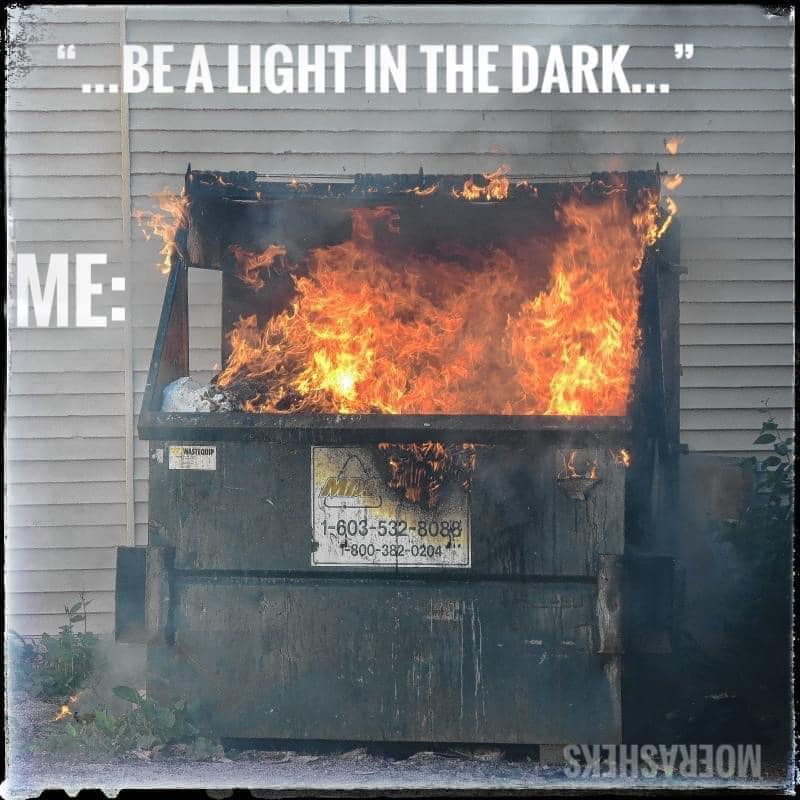
The meme is a play on the phrase "be the light in the dark" and is presented in a humorous way by juxtaposing it with a photo of a dumpster on fire. The image shows a dumpster engulfed in flames with the words "be the light in the dark" written above it, implying that even in the most chaotic and destructive situations, one can still be a source of hope and positivity.
detailed-analysis (gemma3-27b-vision)
Okay, here's an analysis of the image broken down into sections as requested, focusing on applicable theoretical lenses. Given the strong symbolic weight of the image, several frameworks do apply.
Visual Description
The image depicts a large metal dumpster engulfed in flames. The dumpster is dark gray, appearing somewhat weathered and dirty. Bright orange and yellow flames leap from the top, creating a stark contrast against the gray metal and the siding of a building visible in the background. The siding is a light, faded blue/gray, appearing to be from a modest residential or commercial building. A sticker with phone numbers is visible on the front of the dumpster. The overall composition is slightly grainy, giving it a raw, almost documentary feel. The image is framed by a dark border, and at the top, above the dumpster, are the words “...BE A LIGHT IN THE DARK…”, and the word “ME:” is to the left of the dumpster. There is text along the bottom edge of the image as well, but it is unclear. The immediate foreground is covered in foliage and other plants.
Foucauldian Genealogical Discourse Analysis
This image lends itself powerfully to a Foucauldian reading. The dumpster itself functions as a site of discourse, specifically discourse surrounding waste, disposability, and the societal mechanisms of categorization.
- Power/Knowledge: The dumpster represents a system of power/knowledge. It doesn’t simply hold waste; it defines what is considered waste, what is discarded, what is deemed no longer useful. The very act of categorizing something as “waste” is an exercise of power, determining its value (or lack thereof). The flames represent the forceful imposition of this categorization, a violent purification.
- Genealogy: Examining the "genealogy" of the dumpster reveals its historical evolution from open dumping to standardized containers, reflecting changing social norms around hygiene, efficiency, and the control of "unwanted" elements. The dumpster isn't a natural object; it’s a socially constructed artifact reflecting evolving power relations.
- Discipline & Normalization: The dumpster disciplines by creating a defined space for what doesn't "fit" within acceptable societal norms. The normalization of the dumpster as part of the urban landscape masks the often-brutal processes of disposability and the exclusion of unwanted elements.
- “Be a Light in the Dark…”: The phrase is ironic given the image. It implies self-sacrifice or inspiration, but is juxtaposed with destruction. Is this a critique of the expectation of constant “brightness” and the violence that occurs when things are deemed unworthy?
Critical Theory
This image is ripe for a Critical Theory interpretation, particularly in relation to the Frankfurt School's critiques of consumer culture and the “culture industry.”
- Commodification & Alienation: The dumpster embodies the disposability inherent in late capitalist culture. It represents the relentless cycle of consumption, obsolescence, and the dehumanizing effect of treating objects (and perhaps even people) as mere commodities. The items within the dumpster were once valued, but now they’re reduced to “waste.”
- Ideology & False Consciousness: The image questions the ideological forces that encourage endless consumption and the acceptance of waste as inevitable. It suggests that we are often unaware of the true cost of our consumer habits. The “light in the dark” phrase can be seen as a reinforcement of the capitalist ethos of self-improvement and constant striving, masking the systemic problems that create waste in the first place.
- Reification: The dumpster itself becomes a reified symbol of a system that prioritizes production and consumption over sustainability and human well-being. It’s a physical manifestation of abstract economic forces.
Marxist Conflict Theory
A Marxist analysis would highlight the inherent class conflict embodied in the image.
- Exploitation & Surplus Value: The "waste" in the dumpster represents the surplus value extracted from workers and resources. It's the residue of a system built on exploitation.
- Material Conditions & Class Struggle: The dumpster is a tangible manifestation of the material conditions of the working class. It often holds the discarded remnants of consumer goods enjoyed by a more privileged class. The flames could be interpreted as a symbol of class resentment or rebellion.
- Alienation: The sheer volume of waste represents a society alienated from the production of its own goods. The vast majority of people are distanced from the process of creating the items they discard.
- Contradictions of Capitalism: The image embodies the inherent contradictions of capitalism, specifically the tendency towards overproduction and the creation of waste despite widespread need.
Postmodernism
The image resonates with several key postmodern themes.
- Deconstruction & Simulacra: The dumpster disrupts traditional notions of value and meaning. What once had purpose is now reduced to a meaningless pile of debris. This is a deconstruction of the object’s original purpose. The flames can be seen as a hyperreality, an exaggerated representation of destruction.
- Fragmentation & Loss of Grand Narratives: The image reflects the fragmentation of contemporary life and the loss of overarching ideologies. The dumpster is a chaotic collection of fragments, reflecting a world devoid of unified meaning.
- Irony & Pastiche: The juxtaposition of the "light in the dark" phrase with the burning dumpster is deeply ironic. It suggests a critique of simplistic solutions and the hollow promises of self-help culture.
- The Death of the Author: The image prompts speculation about the intention of the artist, but ultimately, the meaning is open to interpretation by the viewer.
Queer Feminist Intersectional Analysis
While not as immediately apparent as the other theoretical lenses, a Queer Feminist Intersectional perspective can add valuable insights.
- Disposability & Marginalized Bodies: The imagery of "waste" and disposability can be powerfully linked to the ways marginalized bodies (women, people of color, queer individuals) are often treated as disposable within patriarchal and capitalist systems. The flames could represent the violence inflicted upon those deemed "unwanted."
- Reclaiming the Discarded: The act of burning the dumpster could be interpreted as a radical act of reclamation, a rejection of the systems that produce waste and discard people.
- Challenging Norms of Value: Feminist theory challenges the patriarchal valuation of labor and bodies. The dumpster can be seen as a symbol of the devaluing of care work, emotional labor, and the bodies that perform it.
- Intersectionality: The image doesn't explicitly represent intersectional identities, but it provides a framework for considering how the forces of waste and disposability disproportionately affect those at the intersections of multiple marginalized identities.
I hope this comprehensive analysis is helpful. Let me know if you would like me to expand on any particular theoretical lens or aspect of the image.
simple-description (llama3.2-vision)
This meme is an image of a dumpster on fire, with flames engulfing the top. The text "I'm not saying I'm going to hell, but I just burned my last 10 years of work" appears at the top of the image, but is not visible in the description. The image is captioned "I'm not saying I'm going to hell, but I just burned my last 10 years of work" and the text "...be a light in the dark..." is visible at the top of the image, but is not visible in the description.
tesseract-ocr
ae eee: —— Se ee 7 Es TT ea a apres — —-spaanaa 5 ———— _- i-_ia Tht net ial: ——-————| a Ae i ad ‘i : it ai \ 4 , P ae * op pein saints a Bas ye 7 Lee. \s | i ae ne vst - my i: a -———| | wean Me - i = ad — a ees re ed - % ee ey - 1-603-530-8088 | { —— 4 Ye i too; sepoane | } _ eas et ; ; — * is) 04 : a 0 ) 4 a a? jae oS Sala } i is oe ; i f 1 | oe : 4 SS Des ator eal: gat: SEC Teo a Pye | BLE . eee een PTE S BOUL