First Seen
2023-05-10T21:03:36+00:00
simple-description (llama3.2-vision_11b)
This meme is about the frustration of being misunderstood by others. The image shows a wizard who is supposed to be all-knowing, but his own words are coming back to haunt him. The text reads "I'm not arguing, I'm just explaining why I'm right" and "I'm not being dramatic, I'm just passionately expressing my feelings." The meme is poking fun at the idea that when someone is passionate about an issue, they're often misunderstood as being dramatic or argumentative, when in reality they're just trying to have a genuine conversation.
detailed-analysis (gemma3-27b-vision)
Okay, let's break down this image and its overlaid text through a few different theoretical lenses. It's a meme, so the interpretation will be somewhat layered.
Visual Description
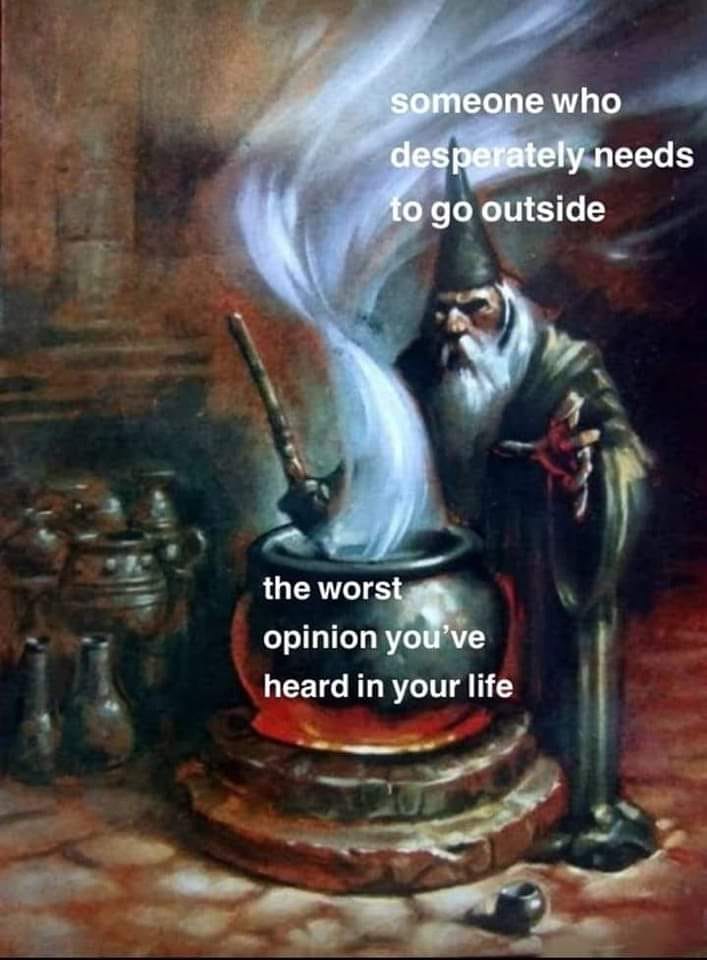
The image is a still from a fantastical, likely animated, scene. It depicts a powerful-looking, dark-haired figure (a wizard or sorcerer type) sitting on a floating platform, apparently speaking into a sphere. The figure is clothed in elaborate, dark robes and has a striking blue cloud of magical energy surrounding their head. The background suggests a regal, dimly lit interior (a throne room, perhaps). The color palette is rich and dramatic, with deep reds, blues, and blacks. A shadowy feline like figure is at the base of the platform. The image style suggests a late 20th or early 21st-century animation, potentially from a video game or anime. The overlaid text consists of two phrases: “someone who desperately needs to go outside” and “the worst opinion you’ve heard in life”.
Foucauldian Genealogical Discourse Analysis
This image/meme can be viewed through a Foucauldian lens by examining how the phrase "someone who desperately needs to go outside" functions as a discourse.
-
Power/Knowledge: The statement positions "going outside" as intrinsically good and remaining indoors as something problematic. This isn’t a natural truth; it's a socially constructed value. It taps into a discourse surrounding productivity, health (Vitamin D, fresh air), and social interaction. The statement implies that someone who doesn't conform to this norm (staying inside) is somehow deficient. The "worst opinion" component reinforces this; it implies a judgment of intellect or moral standing, linked to a disconnect from the "real world."
-
Genealogy: One could trace the historical evolution of this discourse. Historically, there’s been a tension between valuing solitude/contemplation (monasticism, intellectual pursuits) and valuing social participation/labor. The recent shift towards prioritizing constant activity and outdoor engagement is linked to consumer culture, the rise of wellness industries, and the pressure to "optimize" one's life.
-
Disciplinary Power: The statement subtly disciplines behavior. It doesn’t overtly command someone to go outside, but it creates a sense of social pressure and self-scrutiny. It encourages conformity to a particular lifestyle.
The image amplifies this discourse with the imposing figure. This is someone who clearly has power and is dispensing (negative) judgement. The visual cue of power enforces the judgement.
Critical Theory
This image/meme is ripe for analysis through a Critical Theory lens, particularly regarding the idea of cultural hegemony.
-
Hegemony: The idea that “going outside” is essential for well-being is not a neutral statement; it’s a dominant ideology that has become normalized. The meme challenges this by suggesting that someone's opinions are inherently “worst” because they may not align with this dominant lifestyle.
-
Ideology: The phrase masks the power structures that make it difficult for some people to go outside (disability, economic hardship, lack of safe spaces, mental health conditions). The meme glosses over these realities and presents going outside as a simple, universally accessible solution.
-
False Consciousness: Those who believe in the necessity of constant outdoor engagement might be unaware of how this belief serves to maintain systems of control and perpetuate societal norms. The meme can be seen as an attempt to expose this “false consciousness”.
Postmodernism
The meme itself is a classic example of postmodern culture:
-
Irony & Playfulness: The image and text create a humorous juxtaposition. The grandiose, fantastical figure delivering a mundane (and somewhat judgmental) statement is inherently ironic.
-
Deconstruction: The meme “deconstructs” the idea of expertise. Here, a figure of apparent wisdom is reduced to making a trivial, opinionated statement. This highlights the arbitrary nature of authority and knowledge.
-
Hyperreality: The meme blends a fantastical image with a contemporary internet trope, blurring the lines between “reality” and simulation. The image no longer exists as a simple depiction of a scene but as a meme with a life of its own online.
Queer Feminist Intersectional Analysis
This meme can be examined through an intersectional lens:
-
Accessibility: The demand for someone to "go outside" ignores the fact that public spaces are often not accessible or safe for everyone, especially for people with disabilities, people of color, LGBTQ+ individuals, and those experiencing mental health issues. The meme implicitly reinforces a norm that centers the experiences of able-bodied, privileged individuals.
-
Domesticity and Gender: Historically, women’s spaces have been largely confined to the domestic sphere. The insistence on “going outside” could be seen as a subtle reinforcement of patriarchal expectations for women to be visible and active in the public sphere. It ignores the valid reasons someone might choose to prioritize their home life.
-
Subversion: The meme can be read as a subversive critique of these norms, particularly if it's shared within communities that challenge these expectations. The contrast between the powerful figure and the trivial statement can be interpreted as a satire of societal pressures.
Let me know if you'd like me to elaborate on any of these analyses, or if you'd like me to approach the image from a different theoretical perspective.
simple-description (llama3.2-vision)
This meme features an image of a wizard stirring a cauldron, with text overlayed on top. The text reads: "someone who desperately needs to go outside" is written above the cauldron, while "the worst opinion you've heard in your life" is written inside it. The image is humorous because it implies that the wizard is brewing a potion that will reveal the most ridiculous or unpopular opinion someone has ever heard.
tesseract-ocr
z es ieone | Matele id . =) att fo ES go outside ea 4 ha . ! A b . _ 7 i aN Yor ¥) . a Ms ¥ i a - ‘ > . oa id al — the ‘a ae Cod oe Co) ia 5 heard in your life | . 4 rer a ay a i > Te . al ~~ 2 ew