First Seen
2023-05-10T21:03:36+00:00
simple-description (llama3.2-vision_11b)
The meme is a screenshot of a popular animated GIF, "When you're about to ask if everything's okay but you're not sure if you should," from the animated series "Adventure Time." The image shows Finn, a character from the show, looking concerned while his friend Jake is crying in the background. The text above the image reads "I'm fine" in a speech bubble, implying that the character is trying to reassure Finn that everything is okay, but is actually struggling with his emotions.
detailed-analysis (gemma3-27b-vision)
Okay, here's an analysis of the image/meme, broken down into sections based on the theoretical frameworks requested. Keep in mind that applying these frameworks is interpretive, and multiple readings are possible. I’ll also note when a framework doesn't meaningfully apply.
Visual Description
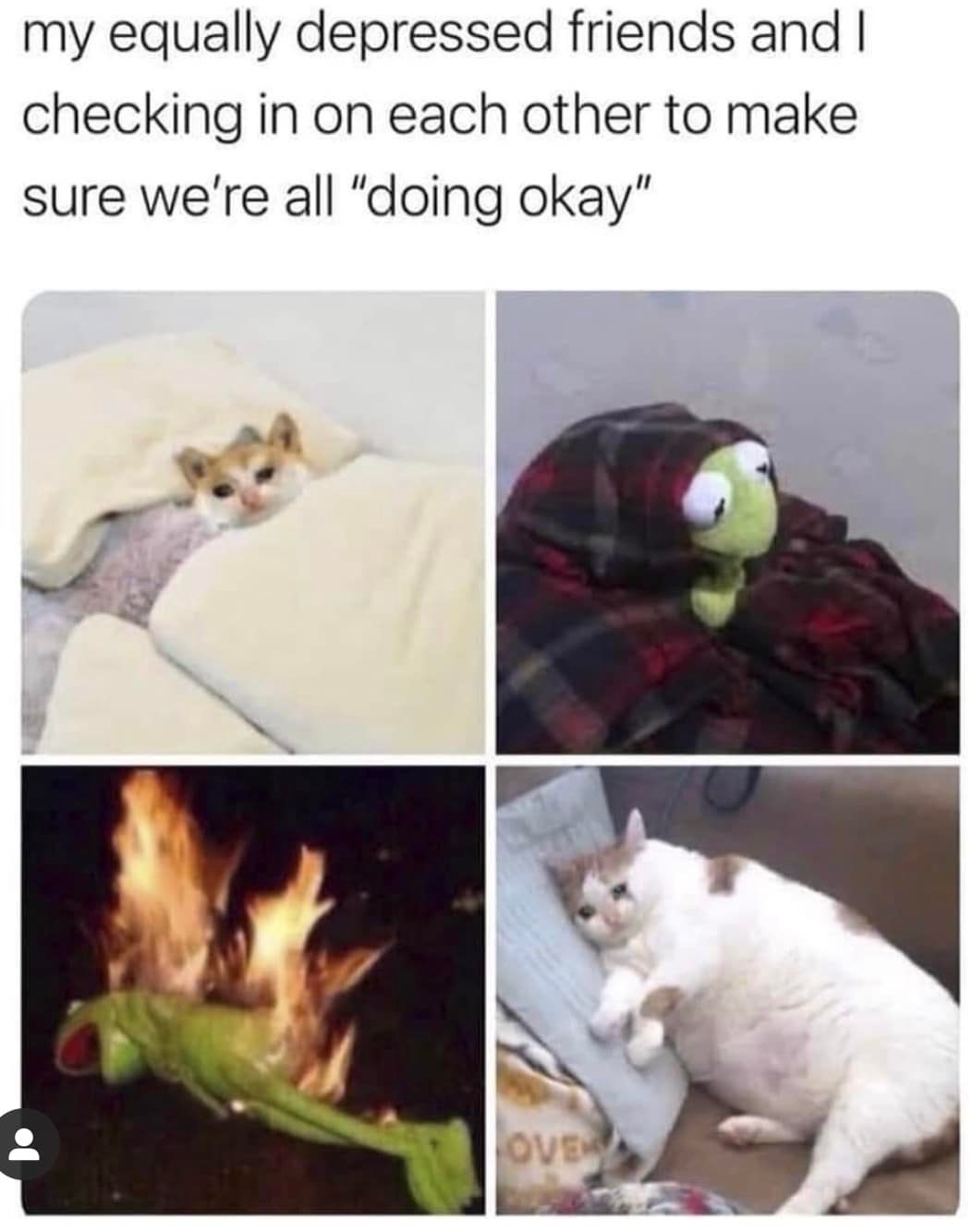
The image is a four-panel meme. All panels feature animals in positions suggesting sadness, resignation, or destructiveness.
- Top Left: A tabby cat is lying flat on its back, looking dejected or limp. It’s on a bed with plaid bedding.
- Top Right: A small green Kermit the Frog plush toy is lying on a heavily wrinkled red comforter or blanket, appearing "sunk" into the fabric.
- Bottom Left: A photo of a green pepper on fire, burning intensely.
- Bottom Right: A white cat is lying prone and stretched out in a box, with a small item that says "love" partially visible.
The text overlay reads: "my equally depressed friends and I checking in on each other to make sure we're all 'doing okay.'"
Foucauldian Genealogical Discourse Analysis
This meme is a potent example of how “depression” has become a discourse – a system of knowledge and power. Michel Foucault's genealogical method would examine how the concept of “depression” developed historically, how it’s been categorized, and how that categorization has created (and reinforced) power dynamics.
- Power/Knowledge: The very act of naming something “depression” (and accepting that name) creates a subject – the “depressed person” – that is then subject to medical, psychiatric, and social control. It's a way of categorizing and managing behaviors perceived as deviant.
- Discipline and Normalization: The meme’s humor arises from the acknowledgement of shared suffering and the ironic use of quotation marks around “doing okay”. This suggests a shared understanding that the usual metrics for “normal” wellbeing are not being met, and the acknowledgment is an act of resistance. The discourse around mental health, while often helpful, can also normalize certain expressions of pain and categorize others as problematic.
- Genealogy: Tracing the development of the diagnostic category of "depression" shows how social, cultural, and political forces have shaped what is considered a legitimate (or illegitimate) form of suffering. The images show a kind of "performative" depression.
Critical Theory
Applying Critical Theory (drawing from Frankfurt School thinkers like Adorno, Horkheimer, and Marcuse) reveals that this meme is a symptom of broader societal alienation and the erosion of genuine connection.
- Culture Industry: The meme itself is a product of the culture industry, a form of standardized, mass-produced entertainment designed to pacify and control. It provides a momentary release of tension by acknowledging shared suffering but doesn’t address the underlying causes.
- Reification: The "depression" being described can be seen as a reification – an abstract concept that obscures the concrete conditions creating the suffering. The meme doesn’t delve into the causes – the systemic pressures, economic anxieties, social isolation, etc. – that contribute to feelings of depression.
- Alienation: The meme speaks to a sense of alienation from authentic experience and connection. The irony of checking in while acknowledging shared unhappiness highlights a feeling of being disconnected from meaningful support and genuine emotional exchange.
Marxist Conflict Theory
While not the primary focus, a Marxist reading can see the meme as indirectly connected to material conditions and class struggle.
- Alienation from Labor: The feelings of sadness and disconnection could be linked to the alienating effects of capitalist labor – the sense of powerlessness, meaninglessness, and isolation experienced by workers in a system that prioritizes profit over wellbeing.
- Ideology: The meme subtly reinforces the ideology that individual "mental health" is the primary problem, rather than addressing systemic issues that contribute to widespread unhappiness.
- Commodity Fetishism: While a stretch, the meme itself becomes a commodity—a shareable piece of content—that functions as a symbolic representation of shared suffering.
Postmodernism
A postmodern reading highlights the meme’s self-referentiality, irony, and skepticism towards grand narratives.
- Irony and Parody: The meme is inherently ironic. The phrase “doing okay” is deliberately juxtaposed with images of intense unhappiness. This reflects a postmodern distrust of sincerity and a penchant for playful deconstruction.
- Deconstruction of Meaning: The meme challenges the notion that "doing okay" has a fixed or objective meaning. The images demonstrate that emotional states are fluid, subjective, and often contradictory.
- Simulacra and Simulation: The meme could be seen as a simulacrum – a copy without an original. It represents a feeling of detachment from authentic experience, where emotions are mediated through images and online communication.
Queer Feminist Intersectional Analysis
This framework provides a nuanced understanding of how multiple forms of oppression intersect to contribute to emotional distress.
- Intersectionality: The meme doesn't explicitly address intersectionality. However, it's important to consider how experiences of depression are shaped by factors like gender, race, class, sexual orientation, and ability. For example, the pressures and stigma surrounding mental health may differ significantly for marginalized groups.
- Challenging Normative Emotionality: The meme’s acceptance of shared sadness and unhappiness can be seen as a rejection of normative expectations of positivity and resilience, which are often imposed on women and LGBTQ+ individuals.
- Solidarity and Connection: The meme celebrates a sense of solidarity and mutual support among friends. This can be understood as a form of resistance against social isolation and the pressures of individualism.
I hope this detailed breakdown is helpful! Let me know if you'd like me to elaborate on any particular aspect of the analysis.
simple-description (llama3.2-vision)
This meme is a humorous take on the idea of checking in with friends who are feeling down or depressed. The image shows a series of cat pictures with humorous captions, but the main text is: "my equally depressed friends and I checking in on each other to make sure we're all 'doing okay'". The image is a lighthearted way to poke fun at the idea that even when we're feeling down, we still want to check in with our friends to make sure we're all doing okay.
tesseract-ocr
my equally depressed friends and | checking in on each other to make sure we're all “doing okay” i. hs p ‘ | es : 7. * , a a di * SS ws t 2 9 PR) = baa ,