First Seen
2023-05-10T21:03:36+00:00
simple-description (llama3.2-vision_11b)
The meme is a humorous take on the struggles of mental health, specifically anxiety and overwhelm. It features a character from the movie "Inside Out" (Riley) sitting at a desk with a thought bubble, looking frustrated and overwhelmed. The text above the character reads "When you have a low-dopamine task and you're already feeling anxious" and below it says "This is my brain and it hates me".
detailed-analysis (gemma3-27b-vision)
Okay, here's an analysis of the meme, broken down into sections as requested, focusing on where the theoretical frameworks apply—and importantly, acknowledging where they don’t.
Visual Description
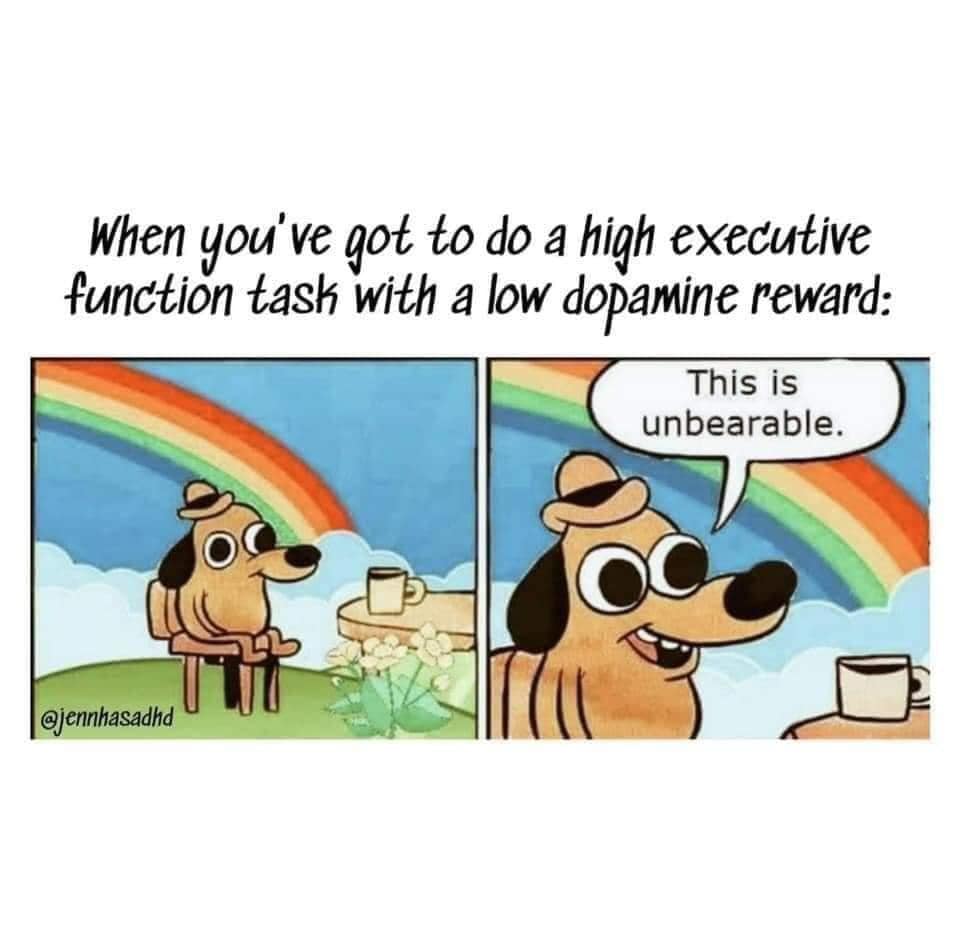
The image is a two-panel meme utilizing the popular "Swole Doge vs. Cheems" format. In the first panel, "Swole Doge" (a muscular Shiba Inu) is depicted standing in front of a rainbow, holding a cup, and seemingly engaged in a mildly positive or neutral activity. The second panel features "Cheems" (a small, somewhat downtrodden Shiba Inu) in the same setting, looking distressed and uttering the text "This is unbearable." A coffee cup is present in both panels, as if Cheems needs the coffee to persevere through the task. The meme is framed with the caption: “When you’ve got to do a high executive function task with a low dopamine reward.” The username @jcnnhsadhd is at the bottom of the image.
Foucauldian Genealogical Discourse Analysis
This meme is a powerful example of how discourses surrounding neurodiversity (particularly ADHD) have shifted and been produced through time.
- Discourse of "Normalcy": Traditionally, the expectation was that all individuals could engage in tasks requiring executive function (planning, organization, task initiation) regardless of internal motivation. Any difficulty was framed as a moral failing or a lack of willpower.
- Emergence of Neurodiversity: The rise of the neurodiversity movement (and a greater understanding of conditions like ADHD) introduced a different discourse. It frames difficulties in executive function not as deficits, but as differences in neurological processing. This shifts the blame from the individual to the mismatch between the task demands and the individual’s neurological profile.
- Power/Knowledge: The meme exemplifies Foucault’s concept of power/knowledge. The language of “executive function” and “dopamine reward” are technical terms derived from the medical/psychological establishment. They represent a specific way of understanding the brain and behavior. The meme’s popularity shows how this knowledge circulates and is internalized, shaping how individuals understand their own struggles.
- Genealogy of the Problem: The meme historicizes the experience of struggle with tasks. It demonstrates a shift in the language and framing of difficulties, from a moral failing to a neurological explanation.
Critical Theory
The meme can be interpreted through a critical lens, specifically focusing on the idea of alienation.
- Alienation from Labor: While the "task" in the meme isn't explicitly defined, the depiction of unbearable drudgery evokes the concept of alienated labor, rooted in the work of Marx but expanded upon by the Frankfurt School. The task lacks intrinsic reward. It is performed not for enjoyment or fulfillment, but simply to complete it. This creates a sense of disengagement and meaninglessness.
- Instrumental Reason: The focus on "executive function" and "dopamine reward" exemplifies the critique of instrumental reason (Horkheimer & Adorno). The meme highlights how tasks become reduced to their function (getting things done) rather than being connected to broader values or human flourishing.
- The Culture Industry: One could argue the meme itself is a product of the culture industry, a means of acknowledging and commodifying experiences of alienation. While it offers a moment of shared understanding, it doesn’t necessarily address the root causes of the problem.
Marxist Conflict Theory
The meme, while not a direct example of class conflict, can be viewed as reflecting the impact of capitalist structures on individual experiences.
- Commodification of Productivity: Capitalism prioritizes productivity above all else. Tasks are often framed in terms of their economic value, rather than their intrinsic worth. This can lead to a disconnect between individuals and their labor. The lack of "dopamine reward" suggests that the task lacks any personal meaning or satisfaction, it's purely for external validation/gain.
- Exploitation of Neurological Differences: The meme implicitly suggests that the demands of a capitalist work environment (and even everyday life) may be particularly challenging for individuals with neurological differences. The system isn't designed to accommodate varying cognitive profiles.
- Internalization of Pressure: The meme reflects an internalized pressure to perform, even in the absence of motivation. This pressure is a product of a system that equates self-worth with productivity.
Postmodernism
The meme embodies several postmodern tendencies:
- Deconstruction of Meaning: The meme deconstructs the idea of a singular, objective "meaning" of work or task completion. The experience of unbearable drudgery is subjective and depends on internal neurological processes.
- Fragmentation of Experience: The contrast between "Swole Doge" and "Cheems" represents a fragmentation of experience. There's a disconnect between the idealized self (capable of tackling any task) and the reality of internal struggle.
- Irony and Parody: The meme utilizes irony and parody. It playfully acknowledges the absurdity of forcing oneself to do unpleasant tasks while also highlighting the real struggles of those with neurological differences.
Queer Feminist Intersectional Analysis
This is the least directly applicable framework, but it's worth considering.
- Neurodiversity as a Site of Otherness: Those with neurological differences are often marginalized and "othered" in society. The meme can be seen as a form of solidarity and recognition of these experiences.
- Intersectional Vulnerability: Those with neurological differences may experience compounded vulnerability if they also belong to other marginalized groups (e.g., based on race, gender, sexual orientation, socioeconomic status). This is not explicitly addressed in the meme, but it’s important to acknowledge.
- Challenging Normative Productivity: The meme subtly challenges the normative expectation that everyone should be able to engage in "productive" activity in the same way. It recognizes that different people have different needs and capacities.
Important Note: These are interpretations. A meme is a cultural artifact, and its meaning can be fluid and open to multiple readings. The frameworks above provide lenses through which to analyze the meme, but they are not necessarily the intended meanings.
simple-description (llama3.2-vision)
The meme is a humorous illustration of a dog sitting in front of a desk, looking unenthusiastic about a task. The text "When you've got to do a high executive function task with a low dopamine reward" appears above the image, and the dog is shown saying "This is unbearable" in a speech bubble. The image is likely meant to poke fun at the struggles of completing tasks that require a lot of mental effort, especially when they don't offer a sense of reward or satisfaction.
tesseract-ocr
When you've got to do 4 high executive function task with a low dopamine reward: , unbearable. ey Gere. Mie es