First Seen
2023-05-10T21:03:36+00:00
simple-description (llama3.2-vision_11b)
The meme is a humorous take on the struggles of online shopping, specifically on Amazon, where a user is "buying" a random item to cope with their mental health issues. The image shows a person sitting on a couch, surrounded by shopping bags, with a caption that reads: "I'm not buying a new TV, I'm just... reorganizing my priorities". This meme pokes fun at the tendency to use online shopping as a coping mechanism for stress and anxiety.
detailed-analysis (gemma3-27b-vision)
Okay, here's an analysis of the meme, broken down into relevant theoretical sections as you requested. It's a bit of a complex image with room for multiple interpretations.
Visual Description
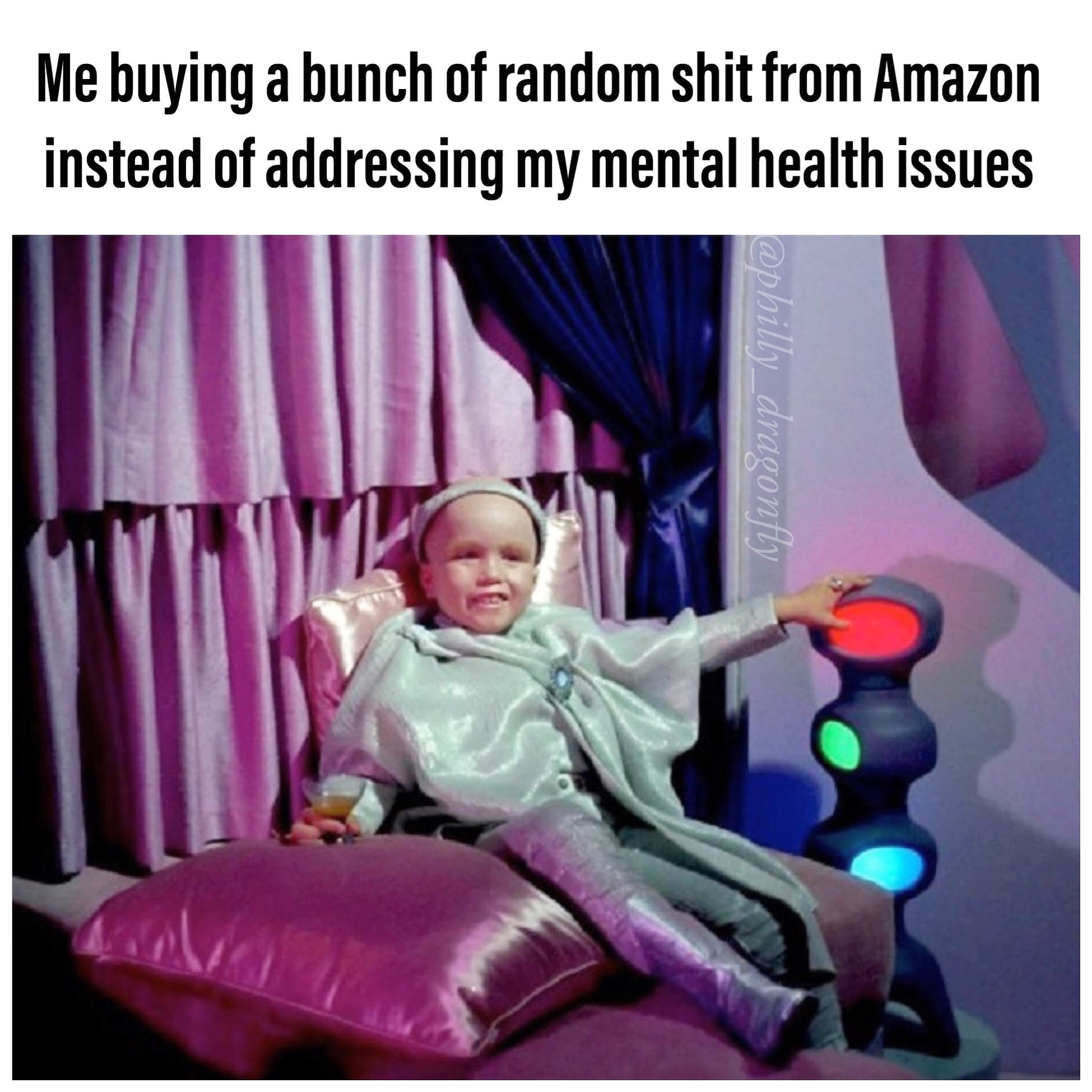
The meme features a digitally altered image of a young child (likely taken from a stock photo or a vintage image). The child is reclined dramatically on a purple velvet pouf, seemingly in a room decorated with purple draping and lamps. The child is wearing a baby blue robe and looks exasperated or overwhelmed. The image has a somewhat kitsch, dramatic quality. The text overlay reads: "Me buying a bunch of random sh*t from Amazon instead of addressing my mental health issues." The image also features a watermark or username "@fully_dragonfly".
Foucauldian Genealogical Discourse Analysis
This meme can be analyzed through a Foucauldian lens by examining the discourse surrounding mental health, consumerism, and self-care. Foucault emphasized how power operates through discourse, shaping our understanding of reality and ourselves.
- The Discourse of “Fixing” the Self: Modern Western society often frames mental health issues as individual problems requiring individual "fixes." This meme highlights the problematic tendency to externalize the solution to internal problems. Buying things from Amazon is positioned as a temporary, superficial "fix" rather than engaging in potentially difficult self-reflection or seeking professional help.
- Normalization of Consumerism: Amazon, and consumer culture generally, is presented as a readily available, almost automatic, response to feeling “off.” It's as though the system expects us to address discomfort with purchases. This perpetuates the idea that emotional well-being is something that can be bought.
- Power/Knowledge: The connection between advertising/marketing and how we perceive our needs is critical here. Amazon's algorithms and marketing strategies operate to create perceived “needs” for products. This meme implicitly acknowledges the power dynamics at play – we aren’t simply acting freely, but are being influenced by external forces.
Critical Theory
The meme aligns with the core concerns of Critical Theory, particularly regarding the culture industry and the alienation of modern life.
- Commodification of Emotion: The impulse to purchase things to alleviate negative feelings can be seen as a form of commodification of emotion. Feelings of sadness, anxiety, or emptiness are being “solved” with products, reinforcing the logic of capitalism.
- False Consciousness: The meme could be interpreted as a moment of self-awareness, a glimpse into a pattern of behavior that is ultimately unfulfilling. The person recognizes the futility of the purchase but engages in it anyway. This can be seen as a manifestation of “false consciousness” – being unaware of the true sources of one's unhappiness.
- Alienation: The act of buying things might temporarily distract from deeper, existential anxieties. It's a superficial way of coping with alienation—the feeling of being disconnected from oneself, others, and society.
Marxist Conflict Theory
While not overtly about class struggle, a Marxist reading can focus on how consumerism functions within a capitalist system.
- Perpetuation of Capitalism: The meme exemplifies how capitalism thrives on the creation of needs. By framing emotional distress as something that can be "solved" through purchases, it encourages continued consumption.
- Distraction from Systemic Issues: Focusing on individual "fixes" to mental health problems can distract from larger systemic issues that contribute to stress, anxiety, and alienation—such as economic inequality, precarious work, and lack of access to healthcare.
- Commodity Fetishism: The impulse to buy things is fueled by the "fetishism of commodities"—attributing magical or emotional qualities to objects, obscuring the exploitative labor practices that went into their production.
Postmodernism
The meme lends itself to a Postmodern interpretation through its embrace of irony, self-awareness, and questioning of grand narratives.
- Hyperreality and Simulation: The image, and the situation it portrays, is a simulation of dealing with mental health issues. It’s a manufactured, superficial response. This can be linked to Baudrillard’s concept of hyperreality, where simulations become more real than reality itself.
- Irony and Self-Deprecation: The meme's humor lies in its ironic acknowledgement of a problematic behavior. It’s a self-deprecating commentary on the tendency to avoid difficult emotions.
- Deconstruction of the "Self": The meme can be seen as a deconstruction of the notion of a coherent "self." The individual is portrayed as fragmented, resorting to impulsive purchases as a way of coping with internal contradictions.
I hope this detailed analysis is helpful! Let me know if you’d like me to elaborate on any specific aspect.
simple-description (llama3.2-vision)
The meme features a person sitting on a couch, seemingly in a state of relaxation. The text above the image reads, "Me buying a bunch of stuff from Amazon instead of addressing my mental health issues." The image is likely a humorous commentary on the tendency to prioritize online shopping over self-care.
tesseract-ocr
Me buying a bunch of random shit from Amazon instead of addressing my mental health issues } : | -~) | | F » >. mh \ on (i ) ls a " \ . s Re > ie