First Seen
2023-05-10T21:03:36+00:00
simple-description (llama3.2-vision_11b)
The meme is a humorous take on the concept of mental health and the pressures of modern life. It's a relatable and lighthearted way to poke fun at the idea that we're all just trying to survive, and that sometimes that means embracing our own absurdity. The text "I'm not lazy, I'm just on energy-saving mode" is a clever way to describe the feeling of being overwhelmed and just needing to take a break.
detailed-analysis (gemma3-27b-vision)
Okay, let's break down this Twitter post, "We seldom admit the seductive comfort of hopelessness…" through the lenses you've requested. We'll only include sections where the text lends itself to that analysis.
Visual Description
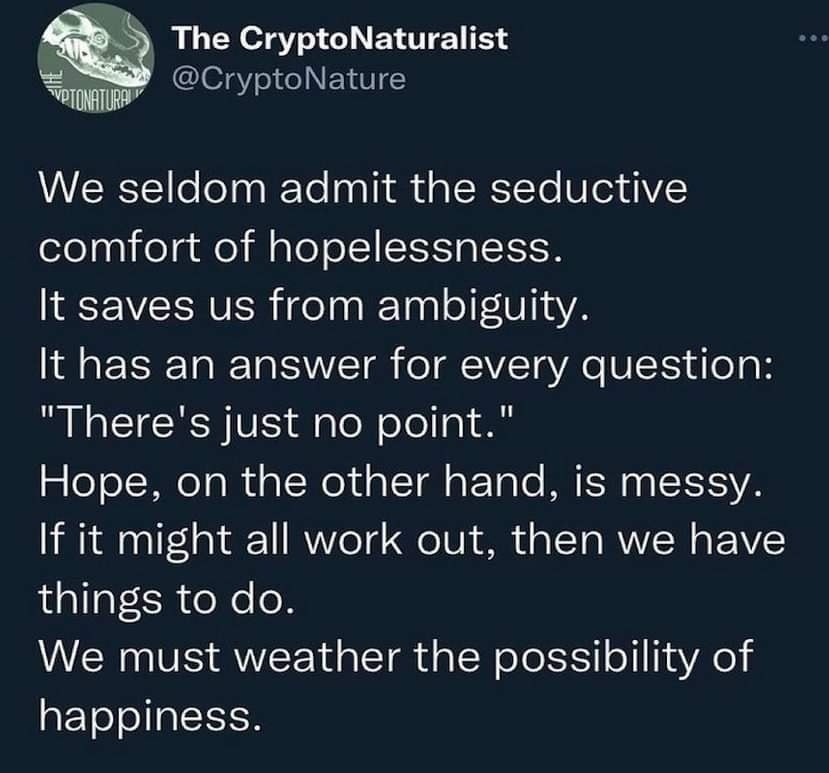
The image is a screenshot of a Twitter post. The profile picture is an illustration of a person wearing a helmet that appears to be built from natural elements (leaves, branches, perhaps flowers). This suggests a connection to nature, or a persona that blends technology with the natural world. The profile name is “CryptoNaturalist.” The handle is @CryptoNature. The text is a short block of prose, composed of several sentences. The overall aesthetic is one of introspective, slightly melancholic digital expression.
Postmodernism
This text very readily fits within a Postmodern framework. Several aspects contribute to this:
- Rejection of Grand Narratives: The statement implies a rejection of traditional, optimistic “narratives of progress” or belief in inherent meaning. Instead of striving toward a meaningful goal, there's an acknowledgement of the appeal of not striving. This dismantles the idea of a linear, purposeful existence.
- Ambiguity and Relativism: The comfort found in hopelessness is precisely because it resolves ambiguity. The statement explicitly links hopelessness to an escape from the messy, uncertain nature of existence. Postmodernism favors ambiguity and rejects the idea of fixed truths or definitive answers.
- Deconstruction of Values: The implied contrast between the "comfort" of hopelessness and the "mess" of hope deconstructs the traditional value assigned to hope as inherently good. It suggests that even negative emotions or states can be seductive and offer a kind of perverse satisfaction.
- The Power of Discourse: The very articulation of the comfort of hopelessness performs a kind of discursive act. It normalizes, validates, and even glamorizes a previously stigmatized emotional state.
Critical Theory
This text offers fertile ground for a Critical Theory analysis, particularly as it relates to the concept of resignation and its social implications.
- False Consciousness & Resignation: The "comfort of hopelessness" can be interpreted as a form of passive acceptance of systemic issues. If one believes "there's no point" in striving for change, this can serve as a mechanism for maintaining the status quo. This can be seen as a form of "false consciousness", where individuals internalize beliefs that are not in their best interests.
- Critique of Optimism as Complicity: The statement suggests that perhaps too much optimism can be problematic. If we automatically believe things will get better, we may be less likely to actively challenge injustice or work towards positive change. The text implicitly criticizes a passive, complacent form of hope.
- The Social Construction of Emotion: The text acknowledges that emotions aren’t just internal states; they are shaped by social forces and discourses. The "seductive comfort" of hopelessness isn’t simply an individual feeling; it’s a feeling that is cultivated by a world often characterized by disillusionment and powerlessness.
- Power dynamics: The admission of hopelessness is an admission of the futility of attempting to challenge the status quo. It's a recognition of overwhelming forces that stifle agency.
Foucauldian Genealogical Discourse Analysis
A Foucauldian approach would be interested in the history of how hopelessness became a “comfortable” concept, and the power dynamics inherent in that shift.
- Genealogy of Hopelessness: Instead of asking why people feel hopeless, Foucault would ask how hopelessness became a normalized, even desirable, state. What historical and social forces have contributed to this? This might involve tracing the rise of cynicism, disillusionment, or the erosion of faith in institutions.
- Discursive Formation: The text itself is a part of a larger discourse surrounding pessimism and despair. A Foucauldian analysis would examine how this discourse is produced, disseminated, and consumed. What institutions, media, or social groups are involved in constructing this narrative?
- Power/Knowledge: The statement implies that the knowledge of hopelessness is a source of power. By accepting the “truth” that there’s no point, one is freed from the burden of striving or the potential for disappointment. This could be seen as a subtle form of self-regulation.
- Subjectivation: The text suggests how hopelessness functions as a process of "subjectivation"—how it shapes individual identities and ways of being in the world. It positions hopelessness as a kind of "truth" that one can internalize and live by.
In Summary
The tweet, seemingly simple, touches on complex ideas related to societal narratives, power, and the human condition. It is highly amenable to analysis through Postmodern and Critical Theory lenses, particularly regarding the normalization of hopelessness as a response to systemic issues and the deconstruction of traditional values. The Foucauldian approach provides a framework for understanding the historical and discursive forces that contribute to the comfort found in hopelessness.
Let me know if you'd like me to expand on any of these points, or explore other theoretical frameworks!
simple-description (llama3.2-vision)
The meme is a humorous commentary on the concept of hope. It begins with a quote that acknowledges the seductive nature of hope, but then subverts it by stating that hope is actually a mess, and that it's not a reliable or stable thing. The final line, "We must weather the possibility of happiness," is a poignant and thought-provoking conclusion.
tesseract-ocr
a The CryptoNaturalist 2 ad @CryptoNature We seldom admit the seductive comfort of hopelessness. It saves us from ambiguity. It has an answer for every question: "There's just no point." Hope, on the other hand, is messy. If it might all work out, then we have things to do. We must weather the possibility of happiness.