First Seen
2023-06-08T02:44:45+00:00
simple-description (qwen3.5_2b-q8_0)
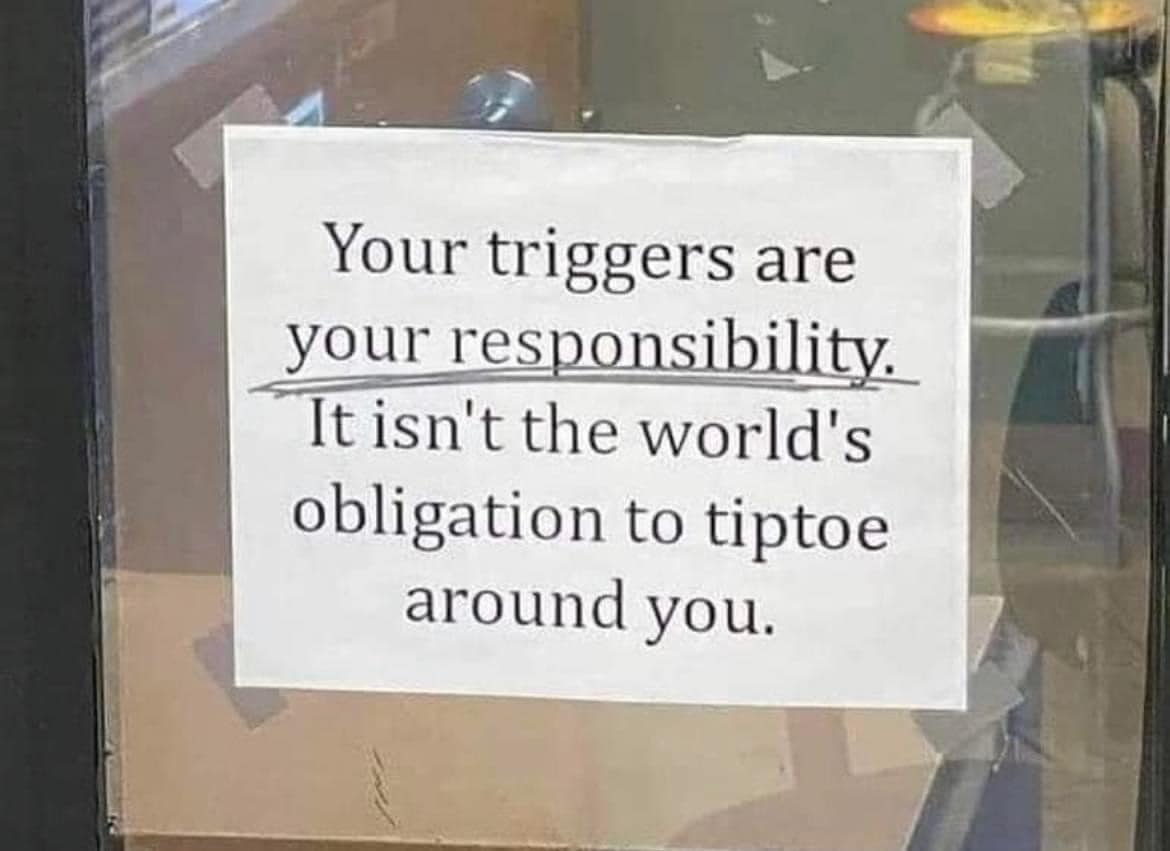
In the context of mental health, this meme refers to triggering (often associated with trauma responses or PTSD). It suggests that when a person experiences a triggering situation—such as a specific memory or a strong emotional reaction—it is their job to manage that response. It implies that the rest of the world doesn't need to try to avoid the person or change the environment because the problem lies within the individual.
simple-description (llama3.2-vision_11b)
The meme is a humorous take on the concept of "emotional labor" in mental health, where individuals are expected to manage their emotions and respond to others' needs without prioritizing their own well-being. The image shows a sign that reads, "Your anxiety is not my responsibility. Your depression is not my responsibility. Your trauma is not my responsibility. Your emotions are not my responsibility. Your mental health is not my responsibility." This text is often used to set boundaries and prioritize one's own emotional needs in relationships.
detailed-analysis (gemma3-27b-vision)
Okay, here's an analysis of the image provided, broken down into sections based on the requested theoretical frameworks. I will only include sections that feel genuinely applicable, as some lenses aren't a strong fit.
Visual Description
The image shows a small, white, rectangular piece of paper affixed to a glass surface, likely a window or door. The paper appears slightly crinkled, and the adhesive is visible along the edges, suggesting it’s a hastily-placed notice. The text, printed in black, reads: "Your triggers are your responsibility. It isn’t the world’s obligation to tiptoe around you.” The setting is somewhat blurry in the background but suggests an interior space. The lighting is a bit uneven. The message is direct, and its presentation is stark.
Foucauldian Genealogical Discourse Analysis
This message is a prime example of how discourses of responsibility operate to shape subjects and normalize certain behaviors. A Foucauldian lens allows us to analyze the power dynamics embedded within the statement.
- Discourse of Self-Responsibility: The message positions “triggers” – which stem from trauma or past experiences – not as societal contributions or systemic issues, but as individual problems. It frames dealing with those triggers as the sole responsibility of the person experiencing them. This is a discourse that has become prominent in the last few decades, often linked to concepts of “resilience” and “self-help.”
- Genealogical Roots: A genealogical inquiry could trace the historical development of this discourse of individual responsibility, noting how it's become increasingly dominant, possibly as a way to de-politicize trauma and mental health. Historically, trauma was often viewed as something requiring societal response and care. The shift to individual responsibility can be seen as a shift in power, away from collective care and towards individual coping.
- Normalization & Discipline: The statement disciplines individuals by implying that seeking accommodation or support for triggers is somehow unreasonable or demanding. It reinforces a norm of "toughness" and self-reliance. The "tiptoeing" metaphor subtly frames requests for consideration as burdensome and excessive.
- Power/Knowledge: This statement embodies the Foucaultian concept of power/knowledge. The very definition of what constitutes a "trigger" and the appropriate response to it is shaped by dominant power structures. By placing the onus solely on the individual, the statement reinforces the existing power imbalance.
Critical Theory
From a critical theory perspective, the message exemplifies how seemingly neutral statements can reinforce existing power structures and obscure systemic issues.
- Ideology: The statement operates as an ideological construct. It presents a particular worldview—one that prioritizes individual accountability over collective responsibility—as if it's simply “common sense.” It normalizes the idea that individuals, rather than societal factors, are responsible for navigating potentially harmful environments.
- Dominant Narrative: The statement reinforces a dominant narrative that minimizes the impact of trauma, particularly in the context of larger social injustices. It suggests that individuals should "deal with it" instead of challenging the systems that contribute to their trauma.
- Critique of Reason: A critical theorist might point out the instrumental reason at play – the statement seeks to optimize social interactions by minimizing the perceived "burden" on others. This efficiency comes at the cost of empathy and social justice.
Queer Feminist Intersectional Analysis
This message is particularly problematic when viewed through a queer feminist intersectional lens.
- Disproportionate Impact: The demand for individuals to bear the responsibility for their triggers disproportionately affects marginalized groups. People with marginalized identities (e.g., LGBTQ+ individuals, people of color, disabled people, survivors of abuse) are more likely to experience trauma due to systemic oppression and discrimination. Asking them to solely manage their triggers ignores these systemic factors.
- Re-Traumatization: For survivors of trauma, this message can be re-traumatizing. It echoes the language of victim-blaming and invalidates their experiences. It implies that their trauma is a personal failing rather than a result of harm inflicted upon them.
- Intersectionality: The statement lacks an intersectional understanding of trauma. Trauma is not a monolithic experience. It is shaped by multiple intersecting identities and forms of oppression. The statement assumes a universal experience of trauma, ignoring how it is compounded by factors like race, gender, sexuality, and class.
- Social Justice: A queer feminist analysis highlights the importance of creating safer and more inclusive environments. This requires collective responsibility – a willingness to accommodate others and challenge harmful behaviors, not simply demand that individuals "deal with it" on their own.
I hope this detailed analysis is helpful. Let me know if you'd like me to elaborate on any of these points.
simple-description (llama3.2-vision)
The meme is a humorous take on the concept of personal responsibility. A white sheet of paper is stuck to a glass door with a handwritten note that reads: "Your triggers are your responsibility. It isn't the world's obligation to tiptoe around you."
tesseract-ocr
eC Sa: a Your triggers are [t isn't the world's | | obligation to tiptoe | around you.