First Seen
2023-08-24T18:01:38+00:00
simple-description (qwen3.5_2b-q8_0)
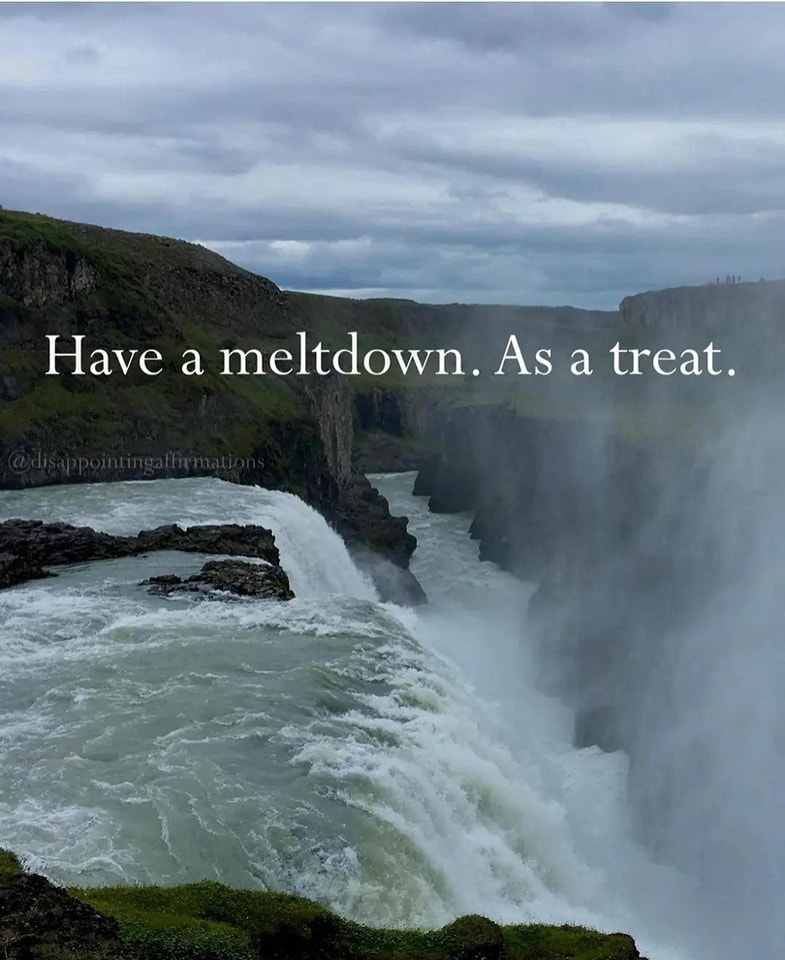
This meme uses a visually overwhelming, stormy landscape featuring a roaring waterfall to symbolize a moment of high intensity or crisis in life. The text "Have a meltdown. As a treat." is a self-deprecating joke suggesting that emotional outbursts should be enjoyed as an indulgence rather than seen as a tragedy. The tiny text "@disappointingaffirmations" indicates that the creator uses these confusing, funny slogans as a coping mechanism or a way to connect with others who struggle with mental health.
simple-description (llama3.2-vision_11b)
The meme is a play on the phrase "have a meltdown" but replaces it with "have a meltdown" and adds "as a treat". This is a humorous take on the idea that having a meltdown can be a fun and exciting experience, rather than a stressful one.
detailed-analysis (gemma3-27b-vision)
Okay, here’s an analysis of the image and text, broken down into the sections you requested, focusing on how those theoretical frameworks apply.
Visual Description
The image depicts a powerful waterfall cascading over dark, jagged cliffs. The water is churning and turbulent, appearing foamy and white against the dark rock. The surrounding landscape is comprised of rolling green hills and a stormy, overcast sky. The color palette is largely dominated by shades of gray, green, and white, contributing to a dramatic and somewhat melancholic atmosphere. The overall impression is one of raw natural power and the potential for chaotic force. There is a text overlay reading "Have a meltdown. As a treat." in white font.
Foucauldian Genealogical Discourse Analysis
The phrase "Have a meltdown. As a treat." offers a fascinating subject for Foucauldian analysis. Traditionally, “meltdowns” are seen as indicative of a lack of control, of a failure to adhere to norms of emotional regulation. They signify a breakdown in the individual's ability to perform the 'normal' self.
Foucault’s work illuminates how such terms – 'meltdown', 'emotional regulation', 'normal' – aren’t neutral descriptions, but products of discourse – systems of power/knowledge that construct our understanding of the self and deviance. Historically, medicine and psychology have pathologized emotional extremes, casting them as symptoms of illness requiring correction. This is a form of biopower – power exercised over life and bodies.
However, the statement inverts this logic. It reframes the meltdown not as a negative event needing suppression, but as a treat - something pleasurable, deserved, even empowering. This represents a genealogical disruption – a challenging of the historical construction of "sanity" and "emotional control". It suggests a desire to dismantle the power structures that demand constant self-regulation and an embrace of uncontained emotion. It invites us to question the conditions that have led us to internalize the need for control, and suggests a potentially subversive act in releasing it.
Critical Theory
The image and text tap into key tenets of Critical Theory, specifically those relating to alienation and the repressive nature of modern society. The powerful, uncontrollable waterfall visually embodies the forces of nature that have been suppressed or commodified in modern life.
The statement "Have a meltdown. As a treat." can be seen as a critique of the performative nature of emotional labor. In capitalist societies, individuals are often expected to manage their emotions to fit societal expectations and maintain productivity. This requires constant self-monitoring and suppression of ‘negative’ emotions. The message suggests a rebellion against this expectation, a permission to experience the full spectrum of human emotion without guilt or self-censorship. The idea of a “treat” is ironic, as genuine emotional release is often not permitted or valued within societal structures.
Marxist Conflict Theory
While not a direct expression of class conflict, there’s a subtle tension at play. The image can be interpreted as representing a release of the pent-up frustrations caused by the alienating conditions of capitalist labor. The waterfall, as a force beyond control, can be seen as analogous to the underlying resentment and rage that simmer beneath the surface of a society structured around exploitation.
The "treat" aspect could be a form of psychological self-care – a way to cope with the stresses of a system that prioritizes profit over human well-being. It's a momentary indulgence, a brief respite from the constant pressure to perform and conform. It's also a small act of defiance – a refusal to internalize the shame associated with emotional vulnerability.
Postmodernism
The image and text embody several key elements of postmodern thought.
- Deconstruction: The phrase "Have a meltdown. As a treat." deconstructs traditional notions of mental health and emotional regulation. It undermines the binary opposition of ‘sanity’ vs. ‘insanity’, suggesting that ‘meltdowns’ are not necessarily negative experiences.
- Irony and Parody: The juxtaposition of "meltdown" (typically a negative term) with "treat" is inherently ironic. It mocks the seriousness with which society often approaches emotional issues.
- Rejection of Grand Narratives: The statement rejects the idea that there is a single, correct way to experience or manage emotions. It embraces the subjective and fluid nature of human experience.
- Simulation: The pairing of the powerful image of natural chaos with a human-created phrase can be seen as a commentary on the constructedness of reality. The waterfall is "real" but its connection to the "treat" is a manufactured, simulated meaning.
Queer Feminist Intersectional Analysis
The message can be read through a queer and feminist lens as a rejection of normative emotional expectations imposed upon marginalized genders. Women and queer individuals are often socialized to be ‘nurturing’, ‘calm’, and ‘stable’, and expressing anger or vulnerability can be seen as ‘hysterical’ or ‘unacceptable’.
The phrase "Have a meltdown. As a treat" is a radical act of self-permission. It affirms the right to experience the full spectrum of emotions, without apology or shame. It challenges the patriarchal structures that seek to control and repress female/queer expression. The association of the meltdown with a "treat" reclaims a space of pleasure and liberation. It’s an invitation to reject the pressure to be ‘strong’ and embrace the vulnerability and messiness of human existence.
Importantly, it's an intersectional point because the constraints on emotional expression are not uniform. Women of color, disabled women, and other marginalized groups face additional layers of oppression that can further limit their ability to express themselves authentically. The message speaks to the universal desire for freedom and self-acceptance, but it's particularly resonant for those who have been systematically silenced and marginalized.
Hopefully, this detailed analysis provides a thorough interpretation of the image and text through various theoretical frameworks. Let me know if you'd like me to elaborate on any specific point.
simple-description (llama3.2-vision)
This meme is a humorous image of a serene, natural landscape with a waterfall. The text overlayed on the image reads, "Have a meltdown. As a treat." The phrase is likely meant to be ironic, suggesting that having a meltdown (a stressful or emotional breakdown) could be a welcome, relaxing experience, much like a treat.
tesseract-ocr
Have a meltdown. As a treat er - = e a Se s = ox = og & ae a i ana ‘se <q