First Seen
2023-09-04T21:40:42+00:00
simple-description (qwen3.5_2b-q8_0)
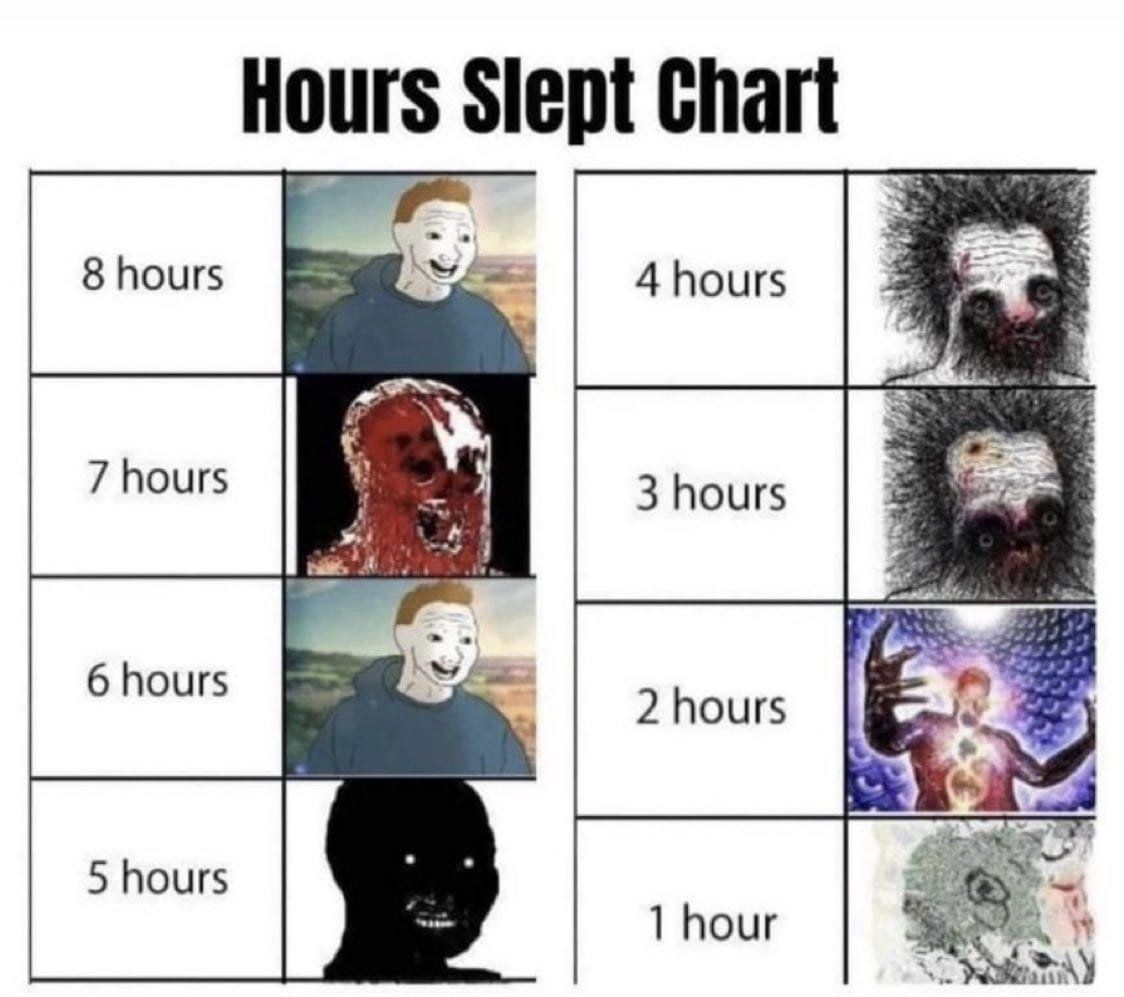
This meme is a satirical chart that connects sleep duration to mental health struggles using internet memes. On the left, it depicts the 'happy few' of the internet, showing Dave Guggenheim smiling at 8 hours and 6 hours of sleep, but also a dark, shadowy figure at 5 hours and a sick face at 7 hours, suggesting that even a good amount of rest isn't always safe. On the right, it portrays the 'bad sleep' reality, where sleeping just 4 hours results in 'ghosting,' 3 hours is worse, 2 hours brings spiritual karma, and 1 hour leads to sickness, emphasizing that sleep deprivation is a major mental health crisis.
simple-description (llama3.2-vision_11b)
The meme is a humorous representation of the struggle to get enough sleep. The image shows a person's sleep schedule, with the hours of sleep they get each night, ranging from 0 to 10 hours. The text "I'm not lazy, I'm just on energy-saving mode" is a witty commentary on the common experience of feeling tired and sluggish, but not necessarily lazy.
detailed-analysis (gemma3-27b-vision)
Okay, here’s an analysis of the image, broken down into the sections you requested, with notes on applicability. It's a deeply strange image, so some analyses will be more robust than others.
Visual Description
The image is a grid labelled "Hours Slept Chart." It presents a correlation between hours of sleep and progressively more disturbing, unsettling digital art. The grid is a 4x3 arrangement.
- 8 hours: A smiling man in a blue sweater, rendered in a very simplistic, almost crude style, reminiscent of early internet memes.
- 7 hours: A disturbing image of a heavily distorted, red-toned face with exaggerated features and a grim expression.
- 6 hours: Another rendition of the smiling man from the "8 hours" image, appearing to be slightly distorted.
- 5 hours: A completely black, silhouette-like figure, almost a void.
- 4 hours: A highly textured, black-and-white image of a creature with long hair, a menacing expression, and piercing eyes.
- 3 hours: A dark, grainy image of a distorted face with hollow eyes and teeth.
- 2 hours: A brightly colored, chaotic image of a demonic/grotesque figure in a dynamic pose.
- 1 hour: A monochromatic sketch of a distorted face with a vacant expression.
The images’ progression is the key visual element, moving from seemingly normal to increasingly terrifying. The style varies significantly, hinting at different digital art techniques.
Foucauldian Genealogical Discourse Analysis
This image can be read through a Foucauldian lens by considering the discourse of sleep, exhaustion, and anxiety in contemporary digital culture.
- Historical Context: The meme format itself is a genealogy—a tracing of how ideas evolve. The initial “smiling man” evokes early internet humor and a relative innocence. The shift to monstrous imagery reflects an escalation in internet aesthetics.
- Power/Knowledge: The image establishes a power/knowledge relationship. It suggests that a lack of sleep creates (or at least reveals) a monstrous, disturbed state. It positions the "normal" (well-rested) as the desirable/safe, and the exhausted as monstrous. This reinforces a societal pressure to optimize sleep (and, more broadly, self-optimization) as a moral imperative.
- Disciplinary Practices: The meme implicitly disciplines through suggestion. It implies that those who don't sleep enough are becoming something “other”—something frightening. This connects to Foucault's idea of power not as simply repressive, but also as productive—it shapes individuals through the creation of norms and anxieties.
- Archaeology: The meme can be considered an archaeology of anxiety. As the hours of sleep decrease, more grotesque imagery is displayed. This reflects the increasingly pervasive anxieties about productivity, mental health, and the relentless demands of modern life.
Critical Theory
The image lends itself well to a critical theory analysis focused on the alienating effects of late capitalism.
- Alienation: The progression of images can be seen as a visual metaphor for alienation. The initial "normal" image of the sleeping man represents a (perhaps idealized) connection to the self and the world. As sleep decreases, the images become increasingly monstrous and disconnected. This can be interpreted as a reflection of the dehumanizing effects of a system that prioritizes productivity over well-being.
- Commodity Fetishism: The meme itself is a commodity, circulating within the digital economy. This ties into the broader issue of how we fetishize productivity and “success” at the expense of our physical and mental health. The meme ironically benefits from the very conditions of exhaustion it depicts.
- The Spectacle: The image can be linked to Debord's concept of "the spectacle," where images mediate our experience of reality. The monstrous imagery isn’t necessarily a reflection of internal reality, but a hyper-saturated representation of the anxiety produced by a society obsessed with performance.
Marxist Conflict Theory
This is where the application is weaker, but a Marxist reading is still possible.
- Class Anxiety: The meme could be interpreted as indirectly reflecting the anxieties of the precariat—those in insecure and precarious employment. The exhaustion depicted in the images is often a consequence of working long hours in low-paying jobs. The monster imagery could be seen as a projection of the anger and frustration felt by those who are exploited by the capitalist system.
- False Consciousness: The meme's humor could be seen as a form of "false consciousness"—a way of deflecting from the underlying systemic issues that cause sleep deprivation and anxiety. By framing the issue as an individual problem (not getting enough sleep), it obscures the role of capitalist exploitation.
Postmodernism
The meme heavily relies on postmodern characteristics.
- Fragmentation and Pastiche: The images vary greatly in style and artistic technique, embracing a fragmented and pastiche aesthetic. It mixes crudely drawn memes with digitally rendered horror, rejecting any sense of a unified artistic vision.
- Simulacra and Simulation: The images can be seen as simulacra—copies without originals—that refer to anxieties about exhaustion and mental health but lack a genuine connection to the real thing. They are representations of representations.
- Irony and Parody: The juxtaposition of the mundane (hours slept) with the terrifying is inherently ironic. The meme parodies the anxieties of modern life while simultaneously feeding into them.
- Deconstruction: The meme could be seen as deconstructing the idea of “normal” sleep. By associating decreasing sleep with increasingly monstrous imagery, it challenges the normative expectations surrounding rest.
Queer Feminist Intersectional Analysis
This section is complex and requires more speculative interpretation, but connections can be made.
- The Body and Monstrosity: The monstrous imagery can be read as representing marginalized bodies that are often perceived as "other" or "monstrous" by dominant culture. The meme implicitly equates exhaustion and anxiety with these perceived "otherness."
- Gendered Expectations of Productivity: The pressure to be productive is often disproportionately felt by women and gender non-conforming individuals. The meme could be seen as reflecting the exhaustion that results from constantly navigating patriarchal expectations.
- Intersectional Exhaustion: For individuals facing multiple forms of oppression (based on race, class, gender, sexuality, disability, etc.), the exhaustion is compounded. The meme could be read as a metaphor for the cumulative toll of systemic discrimination.
- Reclaiming the Monstrous: A more radical interpretation might see the monstrous imagery as a form of reclaiming agency. By embracing the "monstrous" within, individuals can challenge normative expectations and assert their right to exist outside of the confines of a patriarchal, capitalist system.
Let me know if you'd like me to elaborate on any of these analyses.
simple-description (llama3.2-vision)
This meme is a humorous chart that compares the amount of sleep someone gets to the quality of their mental and physical state. The chart has a series of images, each representing a different amount of sleep, from 1 hour to 8 hours. The text "8 hours" is at the top of the chart, and each subsequent image is labeled with a corresponding amount of sleep, from "1 hour" to "8 hours".
tesseract-ocr
a Saas Pie aa ~ Le. N < h a) vas ) 3hours | Sameera Ps) toned 3 se Pk. 6 hours NS ae | | 2hours | ials \ -_ * RO Vo. js 5 ae see 5 hours > ~ a 1 hour ey SC ee