First Seen
2024-03-20T00:48:04.457795+00:00
simple-description (qwen3.5_2b-q8_0)
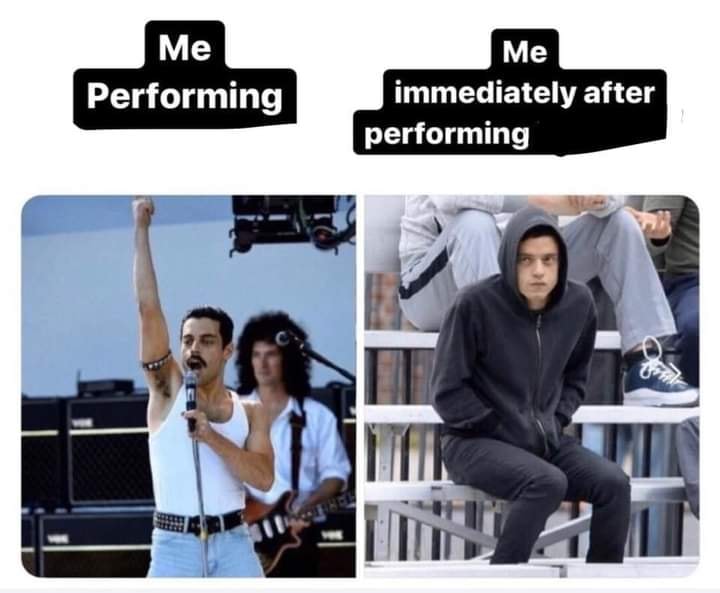
This meme humorously satirizes the emotional crash that often follows high-energy social activities. On the left, a performer is fully immersed in a loud, passionate moment, while on the right, the same individual sits on bleachers looking cold and disconnected—a visual representation of the "down" feeling that many people feel. The text "Me Performing" and "Me immediately after performing" frames the contrast, showing how a short burst of passion can lead to a sudden feeling of emotional exhaustion.
simple-description (llama3.2-vision_11b)
The meme is a humorous representation of the anxiety and self-doubt that can come with performing in front of an audience. The image juxtaposes two contrasting scenes: one of a confident, energetic performer (likely Freddie Mercury) and another of a nervous, awkward individual (likely a fictional character). The text "Me: Performing / Me: Immediately After Performing" highlights the emotional shift from excitement to anxiety, showcasing the mental health struggles that can come with performing in public.
detailed-analysis (gemma3-27b-vision)
Okay, let's break down this meme through a series of theoretical lenses. I'll organize it by the sections you requested, only including those that are applicable and offering analysis for each.
Visual Description
The meme is a two-panel comparison.
-
Panel 1 (Performing): Features a photo of Freddie Mercury (lead singer of Queen) in full performance mode. He's on stage, dressed in a white tank top, white jeans, and a matching belt, clutching a microphone. He’s raising his arm in a powerful pose, seemingly in the midst of engaging with an audience. Stage lighting and equipment are visible in the background. The image conveys energy, exuberance, and charisma.
-
Panel 2 (Immediately After): Shows a hooded figure slumped against what appears to be stadium seating. The figure is in shadow, obscuring most facial features. The pose is withdrawn, slumped, and tired. The body language is a stark contrast to the first image, evoking a sense of exhaustion and retreat. The hoodie and shadows contribute to a sense of anonymity and internal retreat.
Foucauldian Genealogical Discourse Analysis
This meme provides a rich space for Foucauldian analysis, focusing on the construction of "self" and power dynamics.
-
Discourses of Performance & Exhaustion: The meme juxtaposes two discourses. One is the discourse of the performer – constructed through expectations of charisma, showmanship, emotional labor, and spectacle. This is a "productive" discourse in Foucault’s terms, as it produces a certain type of subject (the charismatic performer). The other is the discourse of post-performance exhaustion – a less visible, less socially valued experience. This isn’t necessarily a “counter-discourse” but a shadow-discourse that reveals the cost of performing.
-
Power/Knowledge: The performer embodies power in the first panel – the power of spectacle, of capturing an audience, of projecting a desired image. However, this power is not inherently oppressive; it's embedded in the systems of entertainment, audience expectation, and the constructed role of the performer. The second panel exposes the cost of maintaining that power—the depletion of energy, the need for retreat. There is a power imbalance within the self – a struggle between the performer self and the exhausted self.
-
Genealogy of the Performing Self: Tracing the history of the "performer" reveals a shifting construction—from ancient bards to modern celebrities—each iteration shaped by social and political forces. The meme suggests that the contemporary expectation of constant "on-ness" and "performing" (even in everyday life) is particularly draining.
Critical Theory
This meme can be viewed through a Critical Theory lens, focusing on social structures, alienation, and the commodification of self.
-
Alienation: The stark contrast between the two images suggests a form of alienation – a separation of the "performing self" from the "authentic self." The performer becomes a role, an image, something separate from the internal experience. The exhausted figure represents the attempt to reclaim that internal experience after the performance is over. This evokes aspects of Marx's concept of alienation, but extended to the performance of self rather than labor.
-
Commodification of Self: In a capitalist culture, the self often becomes a commodity – something to be presented, curated, and sold. The performer in the first panel embodies this commodification – their image and energy are "products" consumed by an audience. The second panel can be seen as a temporary rejection of this commodification – a moment of reclaiming the self from the demands of the market.
Postmodernism
The meme reflects several core themes of postmodern thought:
-
Simulacra & Simulation: The first panel arguably presents a "simulacrum" of self – a constructed image that increasingly obscures the “real” self. The performer is playing a role, and this role becomes increasingly detached from any underlying authenticity. The exhausted figure represents a fleeting glimpse behind the curtain of simulation.
-
Fragmentation of Self: The meme visually represents a fragmented self – a self divided between the demands of performance and the need for internal retreat. The postmodern subject is often depicted as decentered, fragmented, and lacking a stable core identity.
-
Irony & Meta-commentary: The meme itself is ironic. It acknowledges the performative nature of everyday life, and the exhaustion that often accompanies it. The juxtaposition of the two images is a meta-commentary on the act of self-presentation.
Let me know if you'd like me to explore any of these lenses in greater detail, or if you'd like me to consider any other theoretical frameworks!
tesseract-ocr
Me YC Performing immediately after performing ~~ a “hen i : : = :
simple-description (llama3.2-vision)
The meme is a humorous comparison between two contrasting images. The first image shows Freddie Mercury, the lead singer of Queen, in a triumphant pose, with the caption "Me: Performing". The second image shows a person sitting on a bench, looking dejected, with the caption "Me: Immediately after performing".