First Seen
2025-04-09T19:54:35.244670+00:00
simple-description (qwen3.5_2b-q8_0)
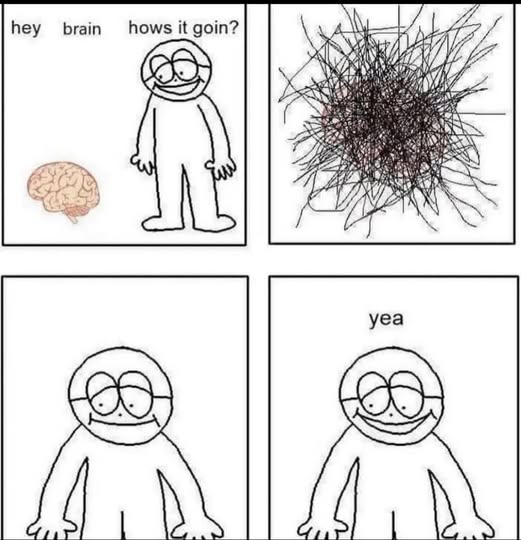
This meme uses simple visual metaphors to convey the feelings of emotional overwhelm and stress. The top section shows a person asking a blank, anxious figure, "hey brain hows it goin'?" and then a chaotic scribble, representing a stressful or exhausting day. The bottom panels depict the mind accepting its burden, looking tired but finally relieved to agree "yea," which signifies a deep sense of validation that it is okay to feel stressed and understand others' struggles.
detailed-analysis (gemma3_27b-it-q8_0)
Okay, let's break down this meme from the perspective of mental health, exploring it through several theoretical lenses.
Visual Description
The meme is a four-panel comic with a simple, minimalist drawing style.
- Panel 1: A simple drawing of a brain alongside a human-like figure with a large, unnervingly cheerful smile and prominent, circular eyes. Text above reads "hey brain hows it goin?".
- Panel 2: The human figure remains the same, but instead of the brain, there's a dense, chaotic scribble of black lines that completely fills the space. It represents a tangled, overwhelming mess.
- Panel 3: The figure maintains the same expression, seemingly unfazed.
- Panel 4: The figure continues with the same unchanging expression, and the text simply states "yea."
The juxtaposition of the simple, almost childlike drawing style with the complex and chaotic image in the second panel is striking. The unwavering, unnerving cheerfulness of the figure is a key element.
Foucauldian Genealogical Discourse Analysis
From a Foucauldian perspective, this meme can be understood as a commentary on the discourse surrounding mental health, and specifically, how we "normalize" internal turmoil.
- Power/Knowledge: Foucault argues that power operates through discourse – the systems of thought, language, and practice that produce knowledge. The expectation to report on one's mental state ("Hey brain, how's it going?") itself is a product of modern psychiatric discourse. The 'good' patient is one who acknowledges and communicates their inner state, even if that state is chaos.
- Genealogy: Tracing the history of the “well-being check” reveals its origins in medical/psychiatric practices where 'diagnosis' and categorization are key. The meme critiques the expectation that we can easily articulate and understand (or have understood by others) the complexities of our inner experience.
- Internalization of Norms: The figure's cheerful acceptance ("yea") demonstrates the internalization of these norms. It's a kind of self-surveillance. We are conditioned to appear functional and "okay," even when our internal reality is anything but. The cheerfulness is a mask, a performance of normalcy demanded by the discourse. It suggests a resignation to the internal chaos, a learned helplessness in trying to "fix" it. The meme reveals how the expectations of discourse can lead to a dissociation between inner and outer experiences.
Critical Theory
Critical Theory, focused on challenging power structures and dominant ideologies, allows us to interpret this meme as a critique of societal expectations surrounding emotional labor and resilience.
- Repressive Tolerance: The meme reveals a form of repressive tolerance toward internal suffering. Society often demands that individuals maintain a positive façade, even while experiencing intense emotional distress. The cheerfulness is a performance of this tolerance, hiding the underlying turmoil.
- Alienation: The disconnect between the 'brain' (the chaotic scribble) and the figure represents a sense of alienation from one's own internal experience. The person is detached from the reality of their inner world, forced to present a stable exterior.
- Ideology & False Consciousness: The cheerful response may represent a false consciousness, a state where individuals accept the dominant ideology (the need to appear “okay”) without recognizing how it perpetuates their suffering. The figure is unknowingly complicit in the system that demands their emotional suppression.
Postmodernism
From a Postmodern lens, the meme challenges the very notion of a coherent, stable self.
- Deconstruction of Meaning: The chaotic scribble “deconstructs” the idea of a well-defined, easily understood “brain.” Postmodernism rejects the idea of inherent, universal meaning. The brain isn’t a single, unified entity but a fragmented, unstable mess.
- Simulation & Hyperreality: The figure’s unwavering smile can be seen as a simulation of emotional well-being. It's a performance, a surface-level appearance that lacks genuine depth. The meme suggests we live in a hyperreality where signs (the smile) have become detached from the reality they represent (actual emotional state).
- Rejection of Grand Narratives: Postmodernism challenges grand narratives, like the idea of "mental health" as a clearly definable and solvable problem. The meme presents a reality where mental chaos is simply there, accepted with a shrug ("yea"), rather than something that needs to be "fixed" according to a pre-determined narrative.
In summary, this meme is a potent, albeit darkly humorous, commentary on the pressures, expectations, and complexities of navigating mental health in a society that often demands conformity and suppresses genuine emotional expression. It resonates because it reflects a lived experience of internal chaos masked by a performance of normalcy.
simple-description (llama3.2-vision_11b)
The meme is a humorous representation of the frustration and overwhelm that can come with trying to explain complex mental health concepts to others. The image depicts a person asking "how does it work?" and the response is a jumbled mess of lines and symbols, implying that the person's brain is a tangled web of thoughts and emotions that can't be easily explained. The text "it's like this" is a nod to the common experience of feeling like you're trying to explain something complex, but it's just a jumbled mess of thoughts.
detailed-analysis (gemma3-27b-vision)
Okay, let's break down this four-panel meme with the requested theoretical lenses. It's a surprisingly rich little image!
Visual Description
The meme employs a very minimalist, deliberately crude drawing style. A stick figure with oversized, circular glasses and a simple body stands on a white background. In the first panel, a small, cartoonish brain is also present, with the text "hey brain hows it goin?". The second panel dramatically shifts: the space around the stick figure fills with a dense, chaotic tangle of black lines, appearing like a storm of thought or anxiety. The third and fourth panels return to the simple stick figure, now with an increasingly wide, unnerving smile and the single word "yea" appearing in the final panel. The style is reminiscent of internet “cursed images” and the aesthetic of early webcomics. The use of crudity contributes to the raw, unedited feel, emphasizing the internal experience.
Foucauldian Genealogical Discourse Analysis
This meme readily lends itself to a Foucauldian analysis, particularly focusing on the "discourse" of mental health and the construction of "normal" thought.
- Power/Knowledge: The meme subtly critiques the expectation that we should be able to know what’s going on inside our own minds. The initial question, "Hey brain, how's it goin?" implies a belief in transparent self-awareness. The subsequent panel demonstrates the impossibility of truly knowing or controlling the internal landscape. This challenges the power structures of self-help discourse which promises 'unlocking' or 'mastering' the brain.
- Genealogy: A genealogical approach would trace the historical development of how we talk about and understand "normal" thinking. The image suggests that the idea of a coherent, rational internal life is a construct—a result of specific discourses shaping our perceptions. The chaotic tangle could represent the vast, unstructured nature of thought prior to being categorized and rationalized.
- Discipline/Surveillance: While not explicitly visible, the meme touches on the idea of self-discipline—the pressure to manage one's thoughts and emotions. The “yea” suggests a performance of normalcy, a masking of the internal chaos. The individual is surveilling themselves, and performing a palatable response despite the internal turmoil.
Critical Theory
From a Critical Theory perspective (drawing on the Frankfurt School), this meme can be seen as an expression of alienation and the fragmentation of the self in late capitalism.
- Commodification of the Self: The question "how's it goin?" can be interpreted as a demand for 'productivity' – a constant need to assess and optimize one's own internal state to remain functional within a capitalist system. The chaotic internal state represents a resistance to this constant self-optimization.
- Reason and Instrumental Rationality: The expectation of a rational response from the brain implies a privileging of reason. The tangled chaos is a rebellion against that imposed structure, suggesting that true experience is often messy, non-linear, and resistant to categorization.
- Alienation: The individual's disconnect between internal experience (the tangled chaos) and external presentation ("yea") exemplifies alienation—a separation from one's authentic self. The individual is forced to perform a role—appearing "okay"—despite internal struggle.
Postmodernism
The meme deeply aligns with postmodern sensibilities, specifically the deconstruction of fixed meanings and the celebration of fragmentation.
- Rejection of Grand Narratives: The meme undermines the “grand narrative” of a coherent, rational self. It suggests that internal experience is not a story with a clear beginning, middle, and end, but a jumbled, fragmented mess.
- Simulation and Hyperreality: The "yea" can be seen as a simulation—a performance of normalcy that masks the underlying chaos. It’s a form of hyperreality, where the signifier ("yea") has become detached from any stable signified (authentic emotional state).
- Deconstruction of the Subject: The meme destabilizes the concept of a unified, stable self. The image suggests that the “self” is not a fixed entity but a fluid, fragmented collection of thoughts, emotions, and experiences.
Note: The other lenses (Marxist Conflict Theory, Queer Feminist Intersectional Analysis) don't feel as directly applicable to this particular meme. While these theories could be stretched to offer interpretations, they feel less inherent to the image's core message. The meme is more centrally concerned with the interiority of experience, the instability of the self, and the pressures of social expectation.
simple-description (llama3.2-vision)
The meme is a simple, hand-drawn comic strip featuring a character with a blank expression. The character is asked "how's it going?" by another character, and responds with a crude drawing of a brain and the phrase "it's going".