First Seen
2023-05-10T20:59:59+00:00
simple-description (llama3.2-vision_11b)
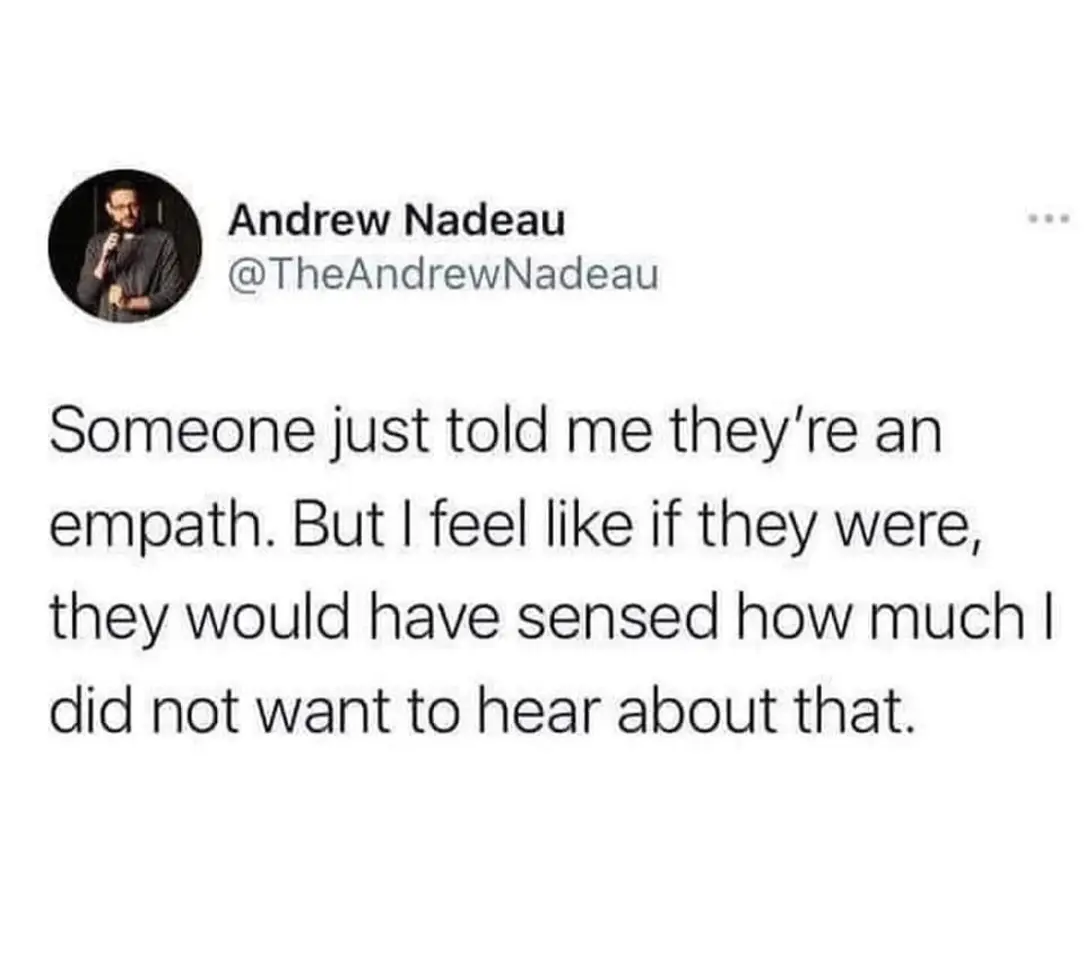
The meme is a humorous take on the emotional struggle of being an empath, someone who deeply feels and understands others' emotions. The text reads: "Someone just told me they're an empath. But I feel like if they were, they'd have sensed how much I didn't want to hear about that." This meme pokes fun at the idea that empaths are supposed to be highly attuned to others' emotions, but in this case, the speaker is frustrated that the empath is not picking up on their own emotional distress.
detailed-analysis (gemma3-27b-vision)
Okay, let's break down this Twitter post by Andrew Nadeau through the requested theoretical lenses.
Visual Description
The image is a screenshot of a Twitter post. A circular profile picture featuring a man in a suit in front of a dark background is visible on the left. Beside this is the Twitter handle "@TheAndrewNadeau". Beneath the handle, the text of the tweet is visible: "Someone just told me they're an empath. But I feel like if they were, they would have sensed how much I did not want to hear about that." The overall aesthetic is minimal and typical of a social media post. The image is a digital capture and carries the implication of immediate, direct communication.
Foucauldian Genealogical Discourse Analysis
This tweet provides a good entry point to discuss the discourse surrounding “empathy” and the construction of the "empath" as a subject position. Foucault would be interested in how the concept of "empathy" has been constructed over time, by whom, and what power dynamics are embedded within this construction.
- Construction of the 'Empath': The tweet subtly critiques the performance of empathy. The author isn't questioning the validity of empathy itself, but the way the person declared their empathy, implying a self-proclaimed title rather than demonstrated understanding. Foucault would argue this declaration is a way of positioning oneself within a specific (and potentially self-serving) power dynamic. The claim of being an "empath" relies on a modern discourse of self-help and emotional intelligence.
- Power/Knowledge: The tweet suggests a mismatch between the knowledge (claiming empathy) and the power to correctly read social cues. The author implicitly asserts their own ability to perceive the other's lack of sensitivity. It’s a subtle power play.
- Genealogy: A genealogical investigation might trace the emergence of the "empath" as a recognizable identity category. When did this term become popularized? What social conditions fostered its rise? How has it been used in different contexts (therapy, new age movements, online communities)?
Critical Theory
From a Critical Theory perspective (drawing from the Frankfurt School), this tweet touches on the anxieties and alienation of contemporary life.
- Instrumental Reason: The author’s sarcastic response could be seen as a rejection of the commodification of emotion. The other person is presenting their 'empathy' as a tool for connection, but the author views it as a superficial performance, devoid of genuine understanding. This resonates with Adorno and Horkheimer’s critique of the “culture industry,” where even emotional experiences become standardized and manipulated.
- Authenticity & Inauthenticity: The tweet highlights a tension between authentic connection and the performativity of emotional labor. The author implies the person is claiming empathy without genuinely exhibiting it. This raises questions about the value of authenticity in a society that often prioritizes surface-level interactions.
- Alienation: The author’s response suggests a sense of alienation and distrust. They are unable to find genuine connection with the other person, leading to a sarcastic and dismissive reaction. This reflects the broader themes of alienation and fragmentation that are central to Critical Theory.
Postmodernism
Postmodernism thrives on deconstruction, irony, and challenging grand narratives. This tweet embodies several postmodern elements:
- Meta-Commentary: The tweet is about a statement about empathy, rather than a direct engagement with empathetic behavior itself. This meta-level commentary is a hallmark of postmodern thought.
- Irony & Sarcasm: The sarcasm is central. The author doesn't directly condemn empathy; they highlight the contradiction between the claim and the perceived lack of sensitivity.
- Rejection of Essentialism: The tweet implicitly questions the idea of a stable, inherent "empath" identity. It suggests that empathy is a fluid, contextual performance rather than a fixed attribute. There's a playful dismantling of the concept.
- Challenge to Authenticity: The author subtly suggests that the act of declaring empathy undermines its very essence. This aligns with postmodern skepticism towards claims of authenticity.
Queer Feminist Intersectional Analysis (Least Applicable, but possible connections)
While less direct, a Queer Feminist Intersectional lens can be applied, primarily through the lens of emotional labor and vulnerability.
- Emotional Labor: The "empath" position can be seen as performing emotional labor, expected to absorb and respond to others' feelings. The author’s response suggests resistance to this expectation, a refusal to participate in that labor.
- Vulnerability & Boundaries: The author’s dismissal could be interpreted as a defense of their own emotional boundaries. They are asserting their right to not have their emotional space invaded or manipulated.
- Power dynamics: The statement could be viewed as the author’s implicit assertion of power against an individual attempting to establish emotional control.
Let me know if you'd like a deeper dive into any of these theoretical perspectives.
simple-description (llama3.2-vision)
The meme is a quote from a Twitter post by Andrew Nadeau. It says that someone just told him they're an empath, but he feels like they would have sensed how much he didn't want to hear about it.
tesseract-ocr
&) Andrew Nadeau @TheAndrewNadeau Someone just told me they're an empath. But | feel like if they were, they would have sensed how much | did not want to hear about that.