First Seen
2023-05-10T21:03:36+00:00
simple-description (llama3.2-vision_11b)
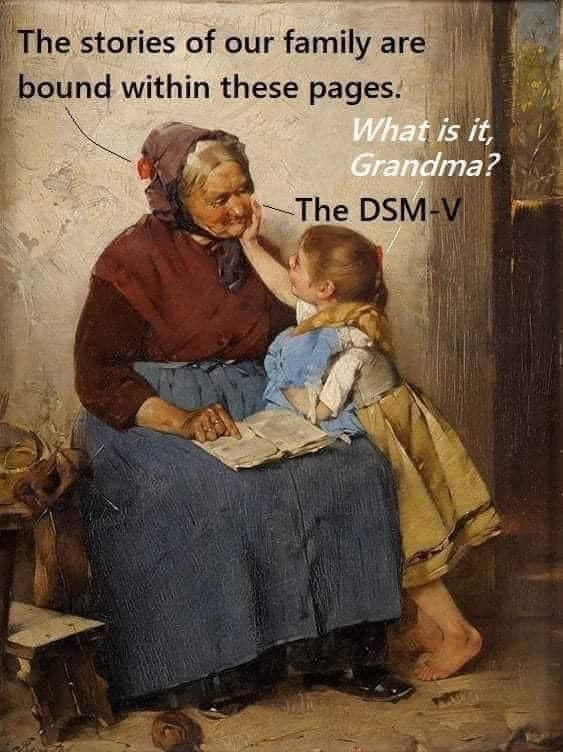
This meme is a play on the common phrase "I'm reading a book" in a mental health context. The image shows a person sitting on a couch with a book, but the text "I'm reading a book" is replaced with "I'm reading the DSM-5" (a reference to the Diagnostic and Statistical Manual of Mental Disorders, a guide used to diagnose mental health conditions). The punchline is that the person is actually reading the manual, implying that they are trying to self-diagnose, which is a common but often misguided approach to understanding mental health.
detailed-analysis (gemma3-27b-vision)
Okay, here's an analysis of the image, broken down into the requested theoretical frameworks, and only including sections where the framework is applicable. Because the image is fairly traditional in subject matter and lacks immediate, explicit indicators of queer identity or direct economic conflict, some sections will be less developed than others.
Visual Description
The image depicts a sentimental scene from the late 19th or early 20th century. An elderly woman, presumably a grandmother, is seated, and a young child (granddaughter) is looking up at her with apparent curiosity. The grandmother is holding what appears to be a family album or a collection of letters/documents.
The color palette is muted and warm, leaning towards browns, blues, and creams. The light source seems to be coming from the left, illuminating the faces of the figures and creating shadows that enhance the sense of intimacy. The setting appears to be a simple, domestic interior.
The grandmother is dressed in traditional clothing, including a head covering. The child is also clothed in period attire. The composition is focused on the interaction between the two figures, emphasizing the transmission of stories and history from one generation to the next. The grandmother's hand gently rests on the child's head, creating a feeling of tenderness and care.
Foucauldian Genealogical Discourse Analysis
The image is compelling when considered through a Foucauldian lens, particularly given the text "What is it, Grandma?" superimposed onto the artwork. The "it" to which the child refers could be seen as the very construction of "family history" as a discourse.
Genealogy: This image can be viewed as a node in a long genealogy of how families have created and maintained their narratives. The image itself is a representation of this ongoing process of constructing a familial past. Consider the practices of keeping albums, writing letters, and oral storytelling. These are not neutral acts. They produce a certain version of the family's history, inevitably excluding other narratives and voices.
Power/Knowledge: The grandmother, as the keeper of the family stories, holds a position of power in this interaction. She is the one who defines what constitutes the family's history. The knowledge she possesses isn't objective; it's shaped by her own experiences, biases, and the dominant social norms of her time. The child's question indicates a lack of access to this power/knowledge. She's asking to be inducted into this family discourse.
Disciplinary Practices: The transmission of family history, while seemingly benign, can function as a form of subtle social control. By internalizing the narratives of the past, the child learns what is considered acceptable behavior, what values are important, and what role she is expected to play within the family structure.
In the context of the superimposed text "The DSM-V," one could argue that family narratives also contribute to the construction of "normality" and "abnormality" as defined by psychiatric classifications like the DSM. Family stories often reinforce societal expectations about gender, sexuality, and mental health, potentially pathologizing those who deviate from these norms.
Critical Theory
The image lends itself to analysis through a Critical Theory framework, specifically focusing on the reproduction of ideology and the social construction of the family.
Ideology & False Consciousness: The idyllic depiction of family life can be seen as reinforcing a dominant ideology that glorifies traditional family structures and downplays potential power imbalances or conflicts within the family. The image might mask histories of trauma, oppression, or silenced voices. The child’s innocent questioning is a moment before the full indoctrination into the family’s ideological framework.
Social Construction of the Family: The image does not simply reflect the family; it constructs it. It reinforces the idea that the family is a natural, stable, and harmonious unit, when in reality, families are constantly changing and are shaped by social, economic, and political forces.
The imposition of “The DSM-V” frames the family history with a diagnostic lens, suggesting the potential for hidden traumas, mental health issues, or “deviations” that are classified and categorized by modern psychiatric frameworks. This highlights how societal norms and diagnostic criteria can influence the narratives constructed within families.
Postmodernism
The superposition of the text “The DSM-V” onto the image creates a deliberate clash of historical contexts and theoretical frameworks, a hallmark of postmodernist practice.
Deconstruction: The image's surface sentimentality is deconstructed by the presence of the DSM-V, a modern diagnostic tool. The viewer is invited to question the "truth" of the family history depicted. What hidden narratives might be revealed through a psychiatric lens? What is not being said?
Fragmentation & Loss of Grand Narratives: The image acknowledges the loss of a monolithic, unifying "grand narrative" of family life. The DSM-V represents a shift towards fragmented, individualized understandings of mental health and subjective experience, contrasting with the idealized, cohesive family depicted in the artwork.
Intertextuality: The image deliberately combines two distinct texts: the visual narrative of the artwork and the theoretical framework of the DSM-V. This creates a layered meaning that invites the viewer to engage in a critical dialogue between the two.
The "Truth" of Representation: The image highlights the constructed nature of reality and the impossibility of capturing a "true" representation of the past. The family history depicted is inevitably filtered through subjective experience and shaped by power dynamics.
I hope this breakdown is helpful. Let me know if you'd like me to elaborate on any of these points or explore other theoretical frameworks.
simple-description (llama3.2-vision)
This meme is a play on the phrase "The stories of our family are bound within these pages" from a famous book. However, the image shows an old woman and a young girl, with the old woman saying "The stories of our family are bound within these pages" and the girl responding with "What is it, Grandma? The DSM-V" (DSM-V is a reference to the Diagnostic and Statistical Manual of Mental Disorders, which is a book of medical and psychological disorders).
tesseract-ocr
e = ar Ww ¥ i Em m he stories of our family are |) 2 _ bound within these pages: oe } c ae e — WE aD St) The DSM i F i i E, Hl 4 a Af ™ i Bs / ca. | ek Sand a aN Bas MS \ a SS x A a iiss sta zs