First Seen
2023-05-10T21:03:36+00:00
simple-description (llama3.2-vision_11b)
This meme is a screenshot of a character from the TV show "Star Trek: The Next Generation" with a quote about the book "Dune" by Frank Herbert. The quote is often used in a humorous or ironic way to express that something is overly complex or pretentious.
detailed-analysis (gemma3-27b-vision)
Okay, let's break down this image of Gul Dukat from Star Trek: Deep Space Nine through the lenses you've provided.
Visual Description
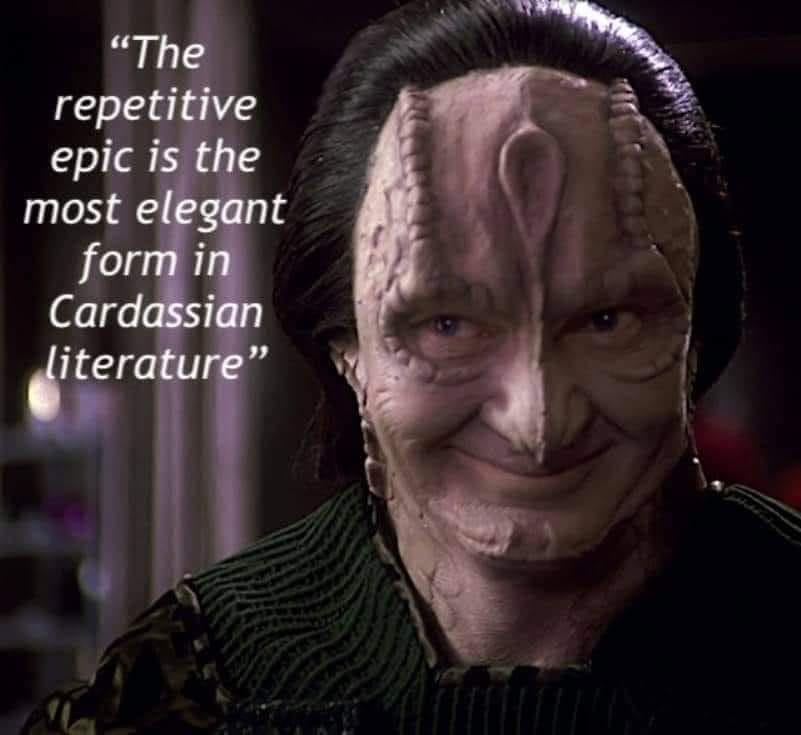
The image features a close-up of Gul Dukat, a Cardassian character known for his complex and often villainous role in the Deep Space Nine series. He’s in a dimly lit interior, likely a refined setting within a Cardassian space station or a formal gathering. His face is prominently displayed, showcasing his characteristic Cardassian features: ridged forehead, pronounced cheekbones, and a subtly smirking expression. He is wearing a dark, textured uniform or garment. The background is blurred, with hints of purple and blue lighting, suggesting an atmosphere of elegance and power. A white text overlay presents a quote attributed to him: “The repetitive epic is the most elegant form in Cardassian literature.”
Foucauldian Genealogical Discourse Analysis
This image and the quoted statement lend themselves well to a Foucauldian approach. Foucault would be interested in how the "discourse" of Cardassian literature, as expressed by Dukat, produces and is produced by power relations.
- Power/Knowledge: Dukat's assertion isn't a simple literary critique; it's a declaration of authority and a shaping of Cardassian cultural identity. He's defining what is valued (repetition, epic scale) and, in doing so, defining what is not valued. This shapes the understanding of Cardassian history, morality, and self-perception.
- Genealogy of "Cardassian Literature": A genealogical analysis would trace the history of how this preference for “repetitive epics” came to be. What historical circumstances, political structures, or cultural needs fostered this aesthetic? Perhaps the Cardassian Empire’s emphasis on rebuilding after a collapse, a need to solidify a narrative of resilience, or a glorification of conquest.
- Disciplinary Power: The preference for a particular form (repetitive epic) could be seen as a form of cultural "discipline." It enforces a way of thinking, narrating, and remembering the past. Those who deviate from this aesthetic might be marginalized or seen as "un-Cardassian." Dukat's assertion isn't about art, it’s about control.
Critical Theory
We can apply Critical Theory to deconstruct the meaning behind Dukat's statement.
- Ideology: The declaration about Cardassian literature is an ideological statement. It promotes a particular vision of Cardassian culture, one that prioritizes grandeur, historical narrative, and potentially, justification of past actions (like the Occupation of Bajor).
- Hegemony: Dukat, as a high-ranking Cardassian official, represents the dominant power structure. His pronouncements contribute to the establishment of hegemony – the cultural and political dominance of the Cardassian elite. By presenting this aesthetic preference as universal truth, he naturalizes the values of the ruling class.
- Deconstruction: We can deconstruct the concept of the “repetitive epic” itself. What does “repetition” signify? Is it a way to reinforce power, avoid confronting difficult truths, or create a sense of stability through ritual? Is the emphasis on "epic" a form of historical aggrandizement that obscures the experiences of the conquered?
Marxist Conflict Theory
From a Marxist perspective, Dukat’s statement reveals much about Cardassian societal structure and its inherent conflicts.
- Class and Cultural Production: Who creates these “repetitive epics”? Are they commissioned by the Cardassian elite to legitimize their power? Are they accessible to all Cardassians, or are they reserved for the ruling class? The statement implies a cultural sphere controlled by those in power.
- Historical Materialism: The preference for repetitive epics may connect to the Cardassian Empire's material conditions. Their need to rebuild after the Obsidian Order's activities or the need to maintain control over conquered territories could drive the need for a narrative reinforcing the Empire's strength and its past glory.
- Ideological Justification of Oppression: A focus on "epic" narratives can serve to gloss over the injustices and exploitation inherent in the Cardassian Empire. It constructs a grand narrative that obscures the suffering of those colonized or oppressed. The "repetition" could be a means of continually reinforcing a self-serving narrative.
Postmodernism
While Dukat himself is a representative of a rigidly hierarchical society, his statement and the character's overall nature can be analyzed through a postmodern lens.
- Meta-Narratives: Dukat's claim is a meta-narrative – a grand story about Cardassian culture that attempts to explain its values and identity. Postmodern thought challenges such grand narratives, suggesting they are often constructed, exclusionary, and fail to capture the complexity of reality.
- The Simulacrum and Simulation: The "repetitive epic" could be seen as a simulacrum – a copy without an original. It’s a representation of Cardassian identity that has become detached from any authentic historical experience. The repetition reinforces the illusion of a cohesive and meaningful culture.
- Deconstruction of Authority: Postmodernism questions all forms of authority. Dukat's confident pronouncement can be seen as a performance of authority, but a postmodern analysis would reveal the constructed and contingent nature of his claim.
Queer Feminist Intersectional Analysis
This is the least directly applicable lens, but we can find points of entry.
- Power Dynamics and Representation: Cardassian society, as depicted in Deep Space Nine, is distinctly patriarchal and hierarchical. A queer feminist perspective would examine how Cardassian literature, and the preference for “epic” narratives, potentially reinforces traditional gender roles and excludes marginalized voices (those of women, LGBTQ+ individuals, or conquered peoples).
- Intersectionality of Oppression: The “repetition” of epic narratives may serve to erase the experiences of those who have been oppressed by the Cardassian Empire. The voices of the Bajoran people, for example, are likely marginalized in these Cardassian-centric narratives.
- Challenging Grand Narratives: Queer and feminist thought often challenges grand narratives that claim to represent universal truths. A queer feminist analysis would deconstruct the “Cardassian epic” as a tool of patriarchal and imperial power.
Hopefully, this breakdown provides a multi-faceted analysis of the image and Dukat’s statement, viewed through various theoretical lenses. Let me know if you'd like me to delve deeper into any of these perspectives!
simple-description (llama3.2-vision)
This meme features a photo of a character from the Star Trek: The Next Generation series, specifically the Klingon warrior K'Ehler, with a sarcastic expression. The text "The most elegant thing in the universe is a well-designed database" is overlaid on the image. The quote is attributed to a character, but the specific character is not identified.
tesseract-ocr
a aah Zs x 3 a ee rs ‘ most elegant NG 4 \ al : he ee Cardassi 290) 009 | . |