First Seen
2023-05-10T21:03:36+00:00
simple-description (llama3.2-vision_11b)
The meme features a photo of a person with a shocked expression, captioned "I can smell the desperation". The image is likely from a TV show or movie, but the context is not provided. The meme is humorous because it implies that the person is so desperate that they can "smell" it, which is a humorous exaggeration.
detailed-analysis (gemma3-27b-vision)
Okay, here's an analysis of the image broken down into the requested sections. Note that some sections may be limited due to the scope of what can be inferred from a single image. I'll indicate where a deeper contextual understanding would be necessary for a fuller analysis.
1. Visual Description
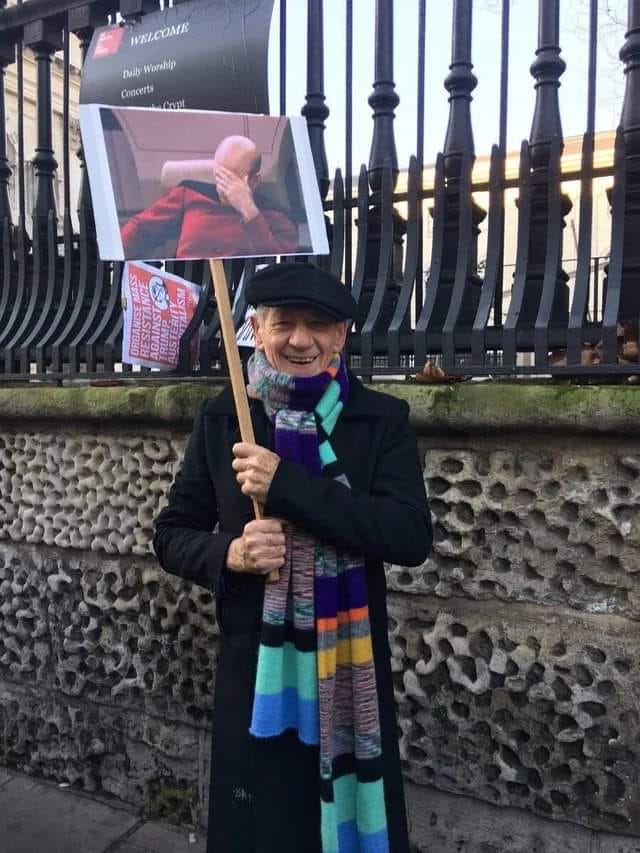
The image depicts an older man standing outside what appears to be a church or public building with ornate black wrought-iron fencing. He's holding a protest sign. He's dressed in dark clothing, with a very vibrant, patterned scarf around his neck. He is smiling at the camera. The sign features a portrait of Pope Francis. Underneath the Pope’s portrait, the sign reads "Welcome" and "Daily Worship." Lower down, there are smaller, harder-to-read words possibly reading "Concerns." The reverse side of the sign features text that reads, “Organised Resistance Against Trump Putin Fascism”. The background shows a glimpse of a building with light-colored stone/brickwork. The setting appears to be an urban environment, possibly in the UK or Europe, given the architectural style. The day appears to be overcast and slightly grey.
2. Foucauldian Genealogical Discourse Analysis
This image is rich for a Foucauldian analysis, focusing on the discourse surrounding religion, political authority, and resistance.
- Power/Knowledge: The sign creates a juxtaposition of religious iconography (the Pope) and political protest (anti-Trump, Putin, Fascism). This demonstrates how power is not solely repressive but productive. The image links religious authority (the Pope, representing a historical and moral system) with a contemporary political stance, forming a discourse where both entities are utilized as tools in a broader anti-fascist agenda. The individual is actively constructing a meaning around the Pope, rather than simply accepting a pre-defined one.
- Genealogy of Resistance: The sign isn’t merely about current politics. The reference to “Fascism” invokes a historical lineage of political movements and their inherent power structures. It implies that present-day concerns are connected to a historical genealogy of oppression. The act of protesting itself is a discursive practice, a way of contesting established power relations.
- Subject Formation: The man holding the sign is positioned as a subject engaged in active resistance. He's not simply a passive observer; he’s performing resistance through the visual act of displaying the sign. His appearance (older man, vibrant scarf) contributes to the construction of his identity within this discursive field.
- Normalization/Counter-Normalization: The sign’s wording "Welcome" implies that the man is offering the Pope's presence as a counter-narrative, presenting the Pope's supposed stance against authoritarianism as a kind of ‘norm’ that should be recognized.
3. Critical Theory
- Ideology & Counter-Ideology: The image immediately presents a clash of ideologies. The sign subverts the traditional ideological role of religious figures as neutral or apolitical. By linking the Pope to anti-fascist resistance, it challenges the dominant narrative that religion and politics are separate spheres. The man is actively producing a counter-ideology—a challenge to existing power structures through a re-imagining of religious authority.
- Culture Industry & Spectacle: While it's not a mass-produced image, the act of holding the sign becomes a performance, a form of public spectacle. It’s an attempt to interrupt the “flow” of everyday life and draw attention to a political message. The scarf might be viewed as an aesthetic element, intentionally used to create a memorable visual impact.
- Rationality & Enlightenment: The man's protest can be framed as an act of asserting reason and challenging what he perceives as irrational forces (Trump, Putin, Fascism). This links to Enlightenment ideals of resisting tyranny and upholding universal values.
- Critique of Authority: The image is inherently critical of established forms of authority, both political and potentially religious. It suggests a questioning of power structures and a demand for accountability.
4. Marxist Conflict Theory
From a Marxist perspective, this image can be understood as a manifestation of class struggle and ideological conflict.
- Superstructure & Base: The sign represents an element of the superstructure (ideas, beliefs, culture) responding to the base (economic and material conditions). The anti-fascist message implies a struggle against oppressive economic and political systems that maintain class inequalities.
- Ideological Struggle: The image embodies an ideological struggle between opposing forces. The man is actively challenging the dominant ideology of the ruling class (represented by Trump and Putin) and promoting a counter-ideology based on anti-fascism.
- False Consciousness: The act of protesting can be seen as an attempt to raise class consciousness and break through false consciousness—the acceptance of ideologies that serve the interests of the ruling class.
- Alienation: The opposition to the regimes mentioned on the sign hints at the alienation of the man holding the sign from their systems.
5. Postmodernism
A postmodern reading highlights the deconstruction of traditional meanings and the fluidity of identity.
- Deconstruction of Grand Narratives: The image challenges “grand narratives” such as the inherent goodness of religious authority or the inevitability of political systems. It suggests that meanings are not fixed but are constantly being negotiated and re-interpreted.
- Simulacra & Hyperreality: The sign itself could be seen as a simulacrum—a copy without an original. The image of the Pope is a representation, a mediated reality that shapes our understanding of religion and authority.
- Fragmentation of Identity: The vibrant scarf and the combination of religious and political imagery suggest a fragmentation of identity, a rejection of singular, fixed categories. The man is presenting a complex, multi-layered persona.
- Subjectivity & Interpretation: A postmodern reading emphasizes the subjectivity of interpretation. The meaning of the sign is not inherent in the image itself but is constructed by the viewer based on their own experiences and beliefs.
6. Queer Feminist Intersectional Analysis
This analysis would require greater contextual information about the man and his motivations to be fully developed. However, some points can be made:
- Intersectionality: While not immediately visible in the image, the anti-fascist message implicitly connects to the fight against all forms of oppression, including those based on gender, sexuality, race, and class. Fascism historically targets marginalized groups, so resistance to it is inherently intersectional.
- Challenging Normative Structures: The juxtaposition of religion and politics could be seen as a challenge to normative power structures that often exclude or oppress marginalized communities.
- Embodied Resistance: The man's physical presence and act of protesting represent a form of embodied resistance—a direct challenge to systems of power through his physical body and self-expression.
Important Note: These analyses are interpretations based on a single image. A more comprehensive understanding would require additional information about the context in which the image was taken, the man's motivations, and the broader socio-political landscape.
simple-description (llama3.2-vision)
The meme features a photo of a person (Dennis) from the TV show "The Good Place" with his face in his hands, as if overwhelmed. The image is captioned "When you finally understand the 3-4-5 triangle rule in geometry". The meme is likely used to express frustration or confusion when faced with a complex or difficult concept.
tesseract-ocr
. : | MA. wil ‘aia B , | . Z 4 it o ne ot a ee i ( yn | | if WU co if ey eee eee - ae ce rie a eae witintnititiel a een b een , sighs a Se. "9 epee PS Rak Ars * is Geet ee Lo Gare, OK Sy ig A | os SSeS peal HRS ERS *, me ». y ba . % wy hi RAN P59.