First Seen
2023-05-10T21:03:36+00:00
simple-description (llama3.2-vision_11b)
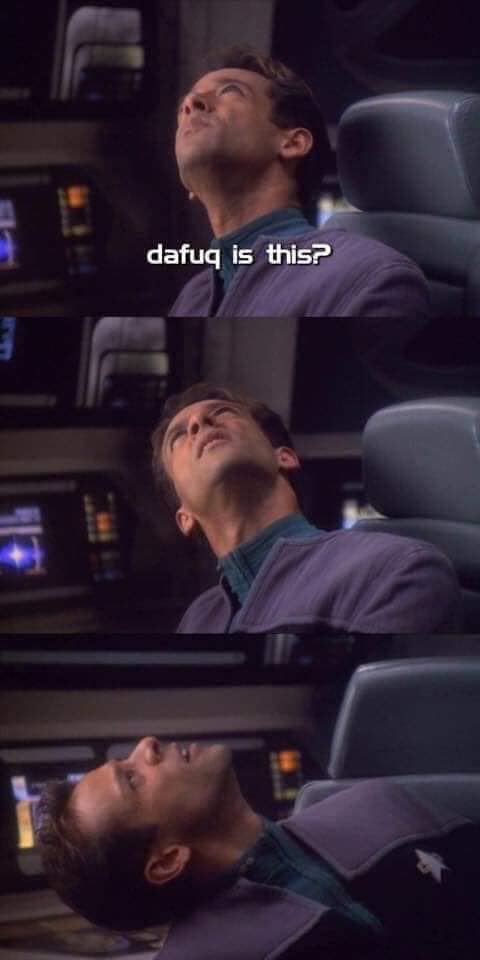
This meme is a screenshot from the TV show "Star Trek: Discovery," featuring a character's confused reaction to a seemingly nonsensical phrase. The character, Saru, is shown looking puzzled and responding with "...what?" to the phrase "D'...on't. D'...on't. D'...on't." The meme is likely being used to express confusion or bewilderment at a situation or phrase that doesn't make sense.
detailed-analysis (gemma3-27b-vision)
Okay, here's an analysis of the image, broken down into relevant theoretical frameworks. Given the nature of the image (a screen capture from Star Trek: Voyager with a meme caption), some sections will be more robust than others.
Visual Description
The image is a vertical multi-panel meme consisting of three screenshots from the science fiction television show Star Trek: Voyager. Each panel features the same actor, Robert Duncan McNeill, playing Lieutenant Tom Paris, staring upwards with varying degrees of disbelief and bewilderment. He's wearing a purple uniform, typical of Starfleet officers, and seated in a futuristic-looking chair on what appears to be the bridge of the Voyager spaceship. The background is dark, with the blurred lights and consoles typical of a sci-fi set. Each panel shows a slightly different angle of his face and a progression of his expression—from initial confusion to mounting incredulity, and finally, to a full-on, head-thrown-back expression of disbelief. Overlaid on the image is the text "dafuq is this?". The overall effect is humorous, meant to convey a sense of utter bewilderment.
Foucauldian Genealogical Discourse Analysis
This image lends itself interestingly to a Foucauldian reading. The phrase "dafuq is this?" immediately establishes a disruptive questioning of established norms. Foucault, in his work on power/knowledge, would see this as an initial move to deconstruct the taken-for-granted assumptions that govern our understanding. The scene itself, taken from a space opera, represents a constructed "reality" – a carefully crafted system of signs and meanings presented as a coherent world.
The image, therefore, can be seen as a metacommentary on the construction of narratives, even those within entertainment. The question isn't about the literal meaning of something within the Voyager universe, but rather a meta-question about the very act of meaning-making and the power structures that dictate what is considered "normal" or "understandable" within any given discourse. The image challenges the viewer to question the assumptions inherent in the narrative of Star Trek (and by extension, any grand narrative). The "disbelief" displayed by Paris can be seen as a microcosm of the "archaeological" process of uncovering the underlying power relations that shape our world.
Critical Theory
Applying Critical Theory, the image can be analyzed as a critique of the "spectacle" (as described by Debord). The Star Trek universe, while often progressive in its ideals, is nonetheless a constructed reality presented for consumption. The "dafuq is this?" caption, applied to a moment within this constructed reality, represents a rupture in that spectacle.
The image is almost a reflexive critique of the very act of watching— a character questioning the absurdity of the situation they're in, mirroring the viewer questioning the logic of the show itself. It is a moment that breaks the fourth wall, even if unintentionally. This questioning, in turn, highlights the ideological work that the show performs— the ways in which it reinforces certain values and power structures under the guise of entertainment. The image can be interpreted as a form of resistance to the passive consumption of media, inviting the viewer to critically engage with the text rather than simply accepting it at face value.
Postmodernism
The image strongly embodies postmodern sensibilities. The juxtaposition of a serious science fiction scene with the deliberately crude and vernacular caption ("dafuq is this?") exemplifies the postmodern fondness for pastiche and the mixing of high and low culture. The humor derives from the incongruity – the subversion of the normally stoic and dignified aesthetic of Star Trek with the language of internet meme culture.
This also speaks to the postmodern distrust of grand narratives. Star Trek, despite its utopian aspirations, is still a narrative—a constructed system of meaning. The image, by questioning that reality, deconstructs the possibility of any singular, objective truth. The "disbelief" expressed by the character is a rejection of the idea that there is a coherent, rational order to the universe— or, at least, to the universe presented within the show. The emphasis on subjective experience—the character's internal reaction to the situation—is also a hallmark of postmodern thought.
Let me know if you'd like me to explore any of these frameworks in greater depth, or if you'd like me to focus on a different theoretical lens!
simple-description (llama3.2-vision)
This meme is a screenshot from the TV show "Star Trek: Discovery" where the character Sarif Kader (played by David B. Sides) has a facial expression of shock and confusion. The text "daruq is this?" appears on the screen, implying that the character is questioning the situation he is in. The meme is likely used to express surprise or confusion in a humorous way.
tesseract-ocr
ae oa | 1 . ai | > a tape i Sf a A