First Seen
2023-05-10T21:03:36+00:00
simple-description (llama3.2-vision_11b)
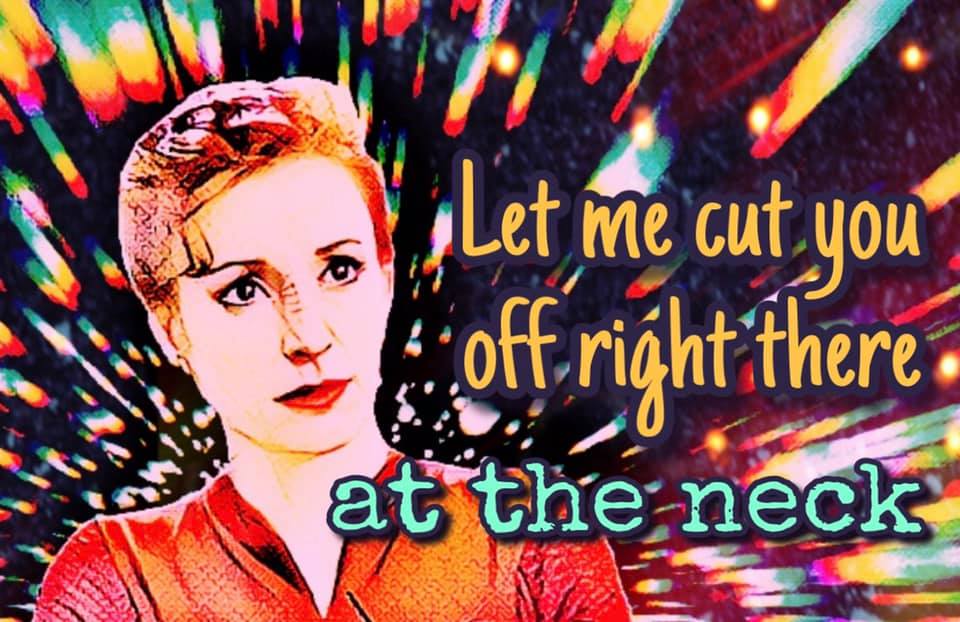
The meme is a screenshot of a Reddit comment that reads "I can smell the desperation" with a photo of a person looking unimpressed. The meme is a humorous way of expressing skepticism or annoyance towards someone's attempt to persuade or manipulate others, implying that their words or actions are transparently insincere.
detailed-analysis (gemma3-27b-vision)
Okay, let's break down this image with a layered analysis, using the requested frameworks. It's a fascinating piece, mixing Star Trek iconography with an unexpectedly violent phrase. I'll address each section only if it clearly applies to the image.
1. Visual Description
The image is a digital manipulation—a still frame or screenshot from a Star Trek series (likely Star Trek: The Next Generation due to the uniform and actor) overlaid with bright, almost hallucinatory text.
- Subject: The primary subject is Deanna Troi (Marina Sirtis), the ship’s counselor, depicted in a partial portrait. Her expression is strangely impassive despite the aggressive phrasing superimposed on the image.
- Color Palette: The background is a riot of neon colors—bright blues, pinks, yellows, and greens, giving a sense of cosmic or otherworldly energy. These colors are digitally blended and blurred.
- Typography: The phrase “Let me cut you off right there at the neck” is rendered in a stylized, almost handwritten font, with a slight glow or halo effect. The text is positioned to intersect and partially obscure Troi's face.
- Composition: The composition creates a jarring juxtaposition—the calm, professional, compassionate persona of Troi (her role within Star Trek) is violently undermined by the threatening text. The blurring and colors suggest a breakdown, a loss of control or stability.
- Iconography: The image intentionally plays with the iconic Star Trek aesthetic, combining it with the surprising violent text.
2. Foucauldian Genealogical Discourse Analysis
This image is rich for a Foucauldian reading. Foucault's work focuses on how power operates through discourse, shaping our understanding of the world and ourselves.
- Power/Knowledge: The image disrupts the expected relationship between a "counselor" and violence. Troi's role should be about empathy, understanding, and de-escalation. By associating her with a threat of physical harm (decapitation), the image breaks down this established power/knowledge structure. It challenges our expectations about who possesses power and how it is expressed.
- Genealogy of Violence: We could trace a genealogy of the phrase itself. "Cut you off" is often used as a polite interruption, but here it is taken to a violent extreme. The genealogy shows how seemingly benign language can be re-appropriated to signify threat. The addition of "at the neck" anchors it in a history of physical domination and control.
- Disciplinary Power: Within the Star Trek universe, discipline is often maintained through technological means (transporters, phasers) and authority structures (the chain of command). This image suggests a different form of power—a more immediate, visceral, and individualized threat.
- The Normative: The image challenges the “normative” representation of the counselor role, subverting the expected discourse around empathy and care.
3. Critical Theory
The image lends itself to a critical theory interpretation, particularly concerning representations of power and subversion.
- Deconstruction: The juxtaposition of Troi’s image with a violent phrase deconstructs the typical representation of feminine authority within the Star Trek universe. The image challenges the viewer to question the surface-level impressions of characters and roles.
- Ideology: The image disrupts the implicit ideology of Star Trek as a utopian vision. The show often presents a future free from the worst aspects of human conflict. This image introduces a suggestion of underlying violence and repressed aggression.
- Subversion of Expectations: The image's power resides in its subversion of expectations. It deliberately misaligns the viewer’s expectations about the character and the universe. This creates a sense of unease and forces critical reflection.
- Power Dynamics: The image explores the dynamics of power through a startling visual metaphor. The counselor, traditionally a figure of support, is positioned as a potential aggressor, inverting the expected power relationship.
4. Queer Feminist Intersectional Analysis
This is where things get particularly potent.
- Reclaiming Power: The image can be read as a feminist act of reclaiming power. Traditionally, women are often expected to be passive or accommodating. This image, with a female character uttering (or having uttered at her) a violent threat, disrupts that expectation.
- Subversion of Gender Roles: Troi as a counselor is already a figure challenging traditional gender roles. By associating her with aggression, the image further destabilizes these roles.
- Intersectionality: While the image doesn't explicitly deal with race or class, the concept of intersectionality is relevant. The image challenges the viewer's assumptions about who is capable of violence, disrupting the “normative” understanding of gender and power.
- Violence and Femininity: The image forces a confrontation with the uncomfortable idea that women can be agents of violence—challenging the societal tendency to either romanticize or demonize female aggression.
5. Postmodernism
The image fits comfortably within a postmodern framework.
- Pastiche and Irony: It's a deliberate pastiche—mixing elements from different sources (Star Trek and aggressive phrasing). The irony lies in the shocking contrast between Troi's role and the violent text.
- Fragmentation and Deconstruction: The image fragments the established narrative of Star Trek, disrupting the cohesive universe.
- Meta-commentary: The image is a meta-commentary on the construction of characters, roles, and power dynamics within a popular culture context. It forces the viewer to actively question what they are seeing.
- Simulation and Hyperreality: The image is a digitally created simulation, further distancing it from “reality”. This aligns with postmodern notions of hyperreality, where signs and simulations become more real than the real itself.
Let me know if you'd like me to elaborate on any of these points!
simple-description (llama3.2-vision)
This meme features a woman with a stern expression and a caption that reads: "Let me cut you off right there at the neck." The image is likely a humorous take on a common phrase, implying that someone is being overly aggressive or confrontational. The meme is likely intended to be humorous and lighthearted, rather than serious or threatening.
tesseract-ocr
XN » ae ob ye ‘wt FY DG ae AA aCe)! Oa! 4 SAR Ow PANT ANY ei 7 SS ~ See aS ert rie teed ¥ < = atythie BSS BEEN ON LE | Ce ee