First Seen
2023-05-10T21:03:36+00:00
simple-description (llama3.2-vision_11b)
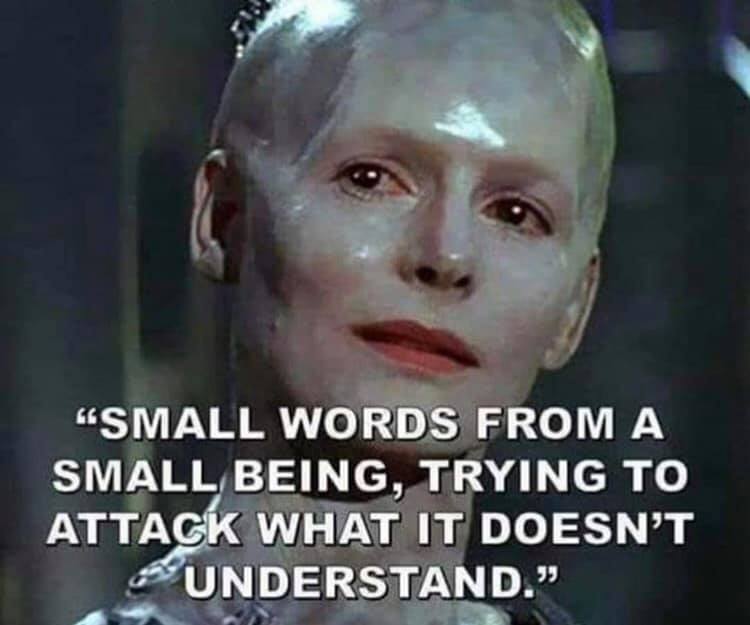
The meme is a humorous image featuring a character from the Star Trek franchise, Data, with a caption that pokes fun at the idea of a character being unable to understand sarcasm. The image is likely to be humorous for those familiar with the character and the concept of sarcasm.
detailed-analysis (gemma3-27b-vision)
Okay, let's analyze the image and quote through the requested theoretical lenses.
Visual Description
The image features a close-up of the character Agent Smith from The Matrix. He is a pale, almost ghostly figure with slicked-back white hair and a dark suit. His expression is one of intense disdain, bordering on contempt. His lips are a deep, striking red, contrasting with his pale skin. The lighting is stark, emphasizing the lines of his face and creating a sense of coldness and power. The quote overlaid on the image reads: “Small words from a small being, trying to attack what it doesn’t understand.” The image heavily emphasizes Agent Smith’s detached and superior demeanor, suggesting a power imbalance and a lack of empathy.
Foucauldian Genealogical Discourse Analysis
This image and quote are incredibly rich for a Foucauldian analysis. Agent Smith embodies a discourse of control and surveillance. His words aren't simply statements, but tools to enforce a particular 'truth' within the Matrix.
- Power/Knowledge: Smith's line reflects a belief that "understanding" is power. The "small being" (presumably Neo, or humanity generally) is dismissed not for what they say, but for their perceived lack of comprehension—and therefore, lack of right to challenge. This connects directly to Foucault’s idea that power isn't just repressive; it produces knowledge and defines what is considered legitimate.
- Discipline & Normalization: Smith's condemnation of ‘small words’ can be seen as an attempt to normalize a specific kind of discourse – one rooted in the logic of the Matrix, its systems, and its assumed authority. Any deviation from this norm is seen as a threat to the established order.
- Genealogy: A genealogical approach would trace the history of this belief – the construction of a system of power that values 'understanding' as a prerequisite for legitimate speech. Where did the idea that “small beings” must be silenced originate within the Matrix's logic? What historical practices solidified this power dynamic?
Critical Theory
From a Critical Theory perspective (drawing on the Frankfurt School), the image speaks to issues of domination and ideology.
- Ideology: Agent Smith's statement is a clear articulation of the Matrix's ideology—a system of beliefs that maintains its power. He is reinforcing the idea that the Matrix is the ultimate authority, and any attempt to question it is inherently futile.
- Dominant Narrative: The image highlights the imposition of a dominant narrative. Smith seeks to silence dissenting voices (the “small being”) by labeling them as ignorant or unworthy.
- False Consciousness: The 'small being' that Agent Smith is referring to (presumably humanity) can be seen as existing in a state of 'false consciousness,' unaware of the true nature of their reality. Agent Smith’s words are an attempt to reinforce this state, preventing them from recognizing their own oppression.
Marxist Conflict Theory
A Marxist analysis sees this image as a direct representation of class struggle, though the 'class' is defined differently than in traditional capitalism.
- Oppressor and Oppressed: Agent Smith represents the bourgeoisie (the ruling class), while the "small being" (humanity) represents the proletariat (the oppressed class).
- Control of Means of Production (of Reality): The Matrix itself can be seen as the means of production – it produces reality. Agent Smith, as an agent of the Matrix, controls this production and seeks to suppress any challenges to it.
- Class Consciousness: The quote demonstrates a clear attempt to prevent the development of class consciousness among the 'small beings'. Agent Smith wants to keep humanity docile and unaware of their exploitation within the Matrix.
- Ideological Control: The emphasis on 'understanding' and 'comprehension' is a form of ideological control, used to justify the existing power structure.
Postmodernism
A postmodern lens sees the image as a questioning of grand narratives and objective truth.
- Rejection of Meta-Narratives: The Matrix itself is a meta-narrative – a totalizing system of explanation. Agent Smith, by dismissing the 'small being's' attempt to challenge it, is upholding this grand narrative.
- Deconstruction of Power: The quote highlights the arbitrary nature of power. Agent Smith doesn't rely on logic or evidence to justify his authority; he simply asserts it based on a perceived superiority in 'understanding'.
- Simulacra and Simulation: The Matrix is a prime example of Baudrillard's concept of simulacra and simulation – a hyperreality where the distinction between the real and the artificial has collapsed. Agent Smith is a product of this hyperreality, and his words are divorced from any genuine meaning.
Queer Feminist Intersectional Analysis
This is a more complex application, but still relevant.
- Power Dynamics and Silencing: The quote speaks to broader patterns of silencing marginalized voices. Agent Smith's dismissal of the 'small being' parallels how societal power structures often invalidate the experiences and perspectives of those who are deemed 'other.'
- Intersectional Oppression: The "small being" can be seen as representing all marginalized identities (based on gender, race, class, sexuality, etc.). The Matrix, like other oppressive systems, operates through multiple layers of power, creating unique forms of oppression for different groups.
- Subversion & Resistance: Neo (and other potential resistance leaders) represent a challenge to these power dynamics. By questioning the Matrix, they disrupt the established order and open up possibilities for liberation. Agent Smith’s words are an attempt to crush that potential.
- Non-conformity and "Othering": Smith is implicitly framing dissent as an undesirable departure from the norm. This is similar to how non-conforming bodies and identities are often demonized and marginalized in patriarchal and heteronormative societies.
Let me know if you’d like me to elaborate on any of these theoretical frameworks, or apply them further to specific aspects of the image/quote.
simple-description (llama3.2-vision)
This meme features a still image of the character "The Borg" from the Star Trek franchise, known for its robotic and emotionless demeanor. The text overlayed on the image reads: "Small words from a small being, trying to attack what it doesn't understand." The quote is likely a humorous commentary on the character's lack of understanding of human emotions and the futility of its own attempts to understand them.
tesseract-ocr
oe ge ( i ¥ 3 jf “SMALL WORDS FROM yy SMALL BEING, TRYING TO Rae eau DOESN’T INID! ~ ” ¥ UNDERSTAND.