First Seen
2023-05-10T21:03:36+00:00
simple-description (llama3.2-vision_11b)
This meme is a humorous commentary on the ease of finding false information online. It features a screenshot of a Google search result with a title "I'm not arguing, I'm just explaining why I'm right" and a description of a user's search query "I'm not arguing, I'm just explaining why I'm right". The meme is poking fun at the tendency to rely on online sources to support one's opinions, even when those sources are inaccurate.
detailed-analysis (gemma3-27b-vision)
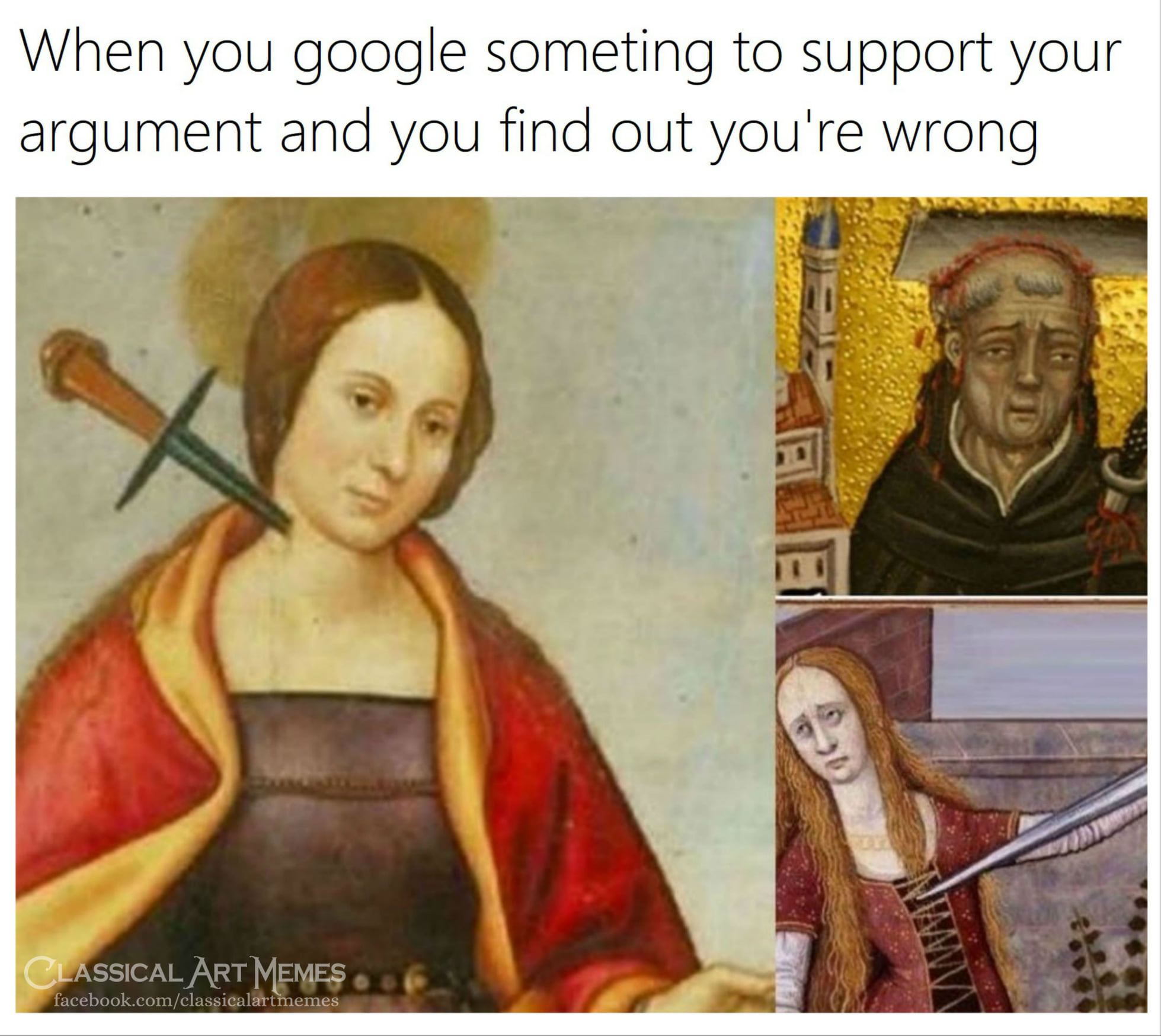
Okay, here's an analysis of the meme, broken down into sections as requested. The meme utilizes images of historical artwork to depict the feeling of discovering you're wrong after looking for supporting evidence online.
Visual Description
The meme features three images of Renaissance artwork.
-
Main Image: A portrait of Saint Lucy, a Christian martyr, is prominently displayed. She has a melancholic expression and is holding a sword, which signifies her martyrdom. She is dressed in red, and a golden halo surrounds her head.
-
Top Right: A rather stern-looking portrait of a monk or priest. He has a red head covering and a serious expression.
-
Bottom Right: A white marble sculpture bust of a woman.
The images are juxtaposed with text: “When you google something to support your argument and find out you’re wrong.” The overall effect is meant to be humorous, connecting the feeling of being proven incorrect to the historical and slightly tragic depictions of these figures.
Postmodernism
This meme is profoundly postmodern in its approach.
- Pastiche & Intertextuality: The meme relies on "sampling" art history, taking these images out of their original context and re-purposing them for a completely different, contemporary meaning. It creates a new "text" (the meme) through the juxtaposition of disparate elements.
- Deconstruction of Meaning: The meme destabilizes the "authentic" meaning of these religious works. They're no longer solely about faith, suffering, or devotion. Instead, they function as visual metaphors for the common experience of being wrong, thus undermining the traditional authority of the art itself.
- Simulation and Hyperreality: The meme points to the way our access to information (via Google) can create a "simulation" of knowledge. We seek evidence to support our pre-existing beliefs, but that evidence can be misleading or misinterpreted, leading to a feeling of being confronted with a reality that challenges our perception. The search for evidence online becomes detached from any “real” truth.
Critical Theory
While not deeply reliant on a specifically Frankfurt School approach, the meme touches on elements of critical theory.
- Ideology Critique: The meme can be interpreted as a critique of the way individuals cling to beliefs even when presented with contradictory evidence. The search for online validation serves to reinforce pre-existing ideologies rather than fostering genuine inquiry.
- The Role of Representation: The images themselves are representations of historical and religious figures. The meme subverts these representations, turning them into symbols of everyday frustration, thus highlighting how meaning is constructed rather than inherent.
Foucauldian Genealogical Discourse Analysis
A Foucauldian reading focuses on the discourse surrounding these images and how power operates through them.
- Power/Knowledge: The meme subtly highlights how our search for information online is never neutral. Google’s algorithms, search rankings, and the curated information we encounter are all imbued with power relations. The "knowledge" we find is not objective truth, but a construct shaped by these power dynamics.
- Genealogy of the "Wrong" Feeling: A genealogical approach might ask: How has the feeling of being "wrong" been historically constructed? The meme implies that our modern anxiety around being incorrect (and the compulsive need to "prove" ourselves right) is a product of specific historical and cultural forces. The act of searching for information online has become a new way of policing “truth” and managing the discomfort of being incorrect.
Limitations
While the meme could be stretched to fit Marxist or Queer Feminist Intersectional analyses, those readings feel less natural and would require a significantly more forced interpretation. The primary strength of the meme lies in its postmodern and critical theory implications, as outlined above.
Let me know if you'd like me to elaborate on any of these points or explore a different angle!
simple-description (llama3.2-vision)
This meme is a humorous take on the concept of "I'm right, you're wrong" arguments. The image features a medieval-style illustration of a woman holding a sword and a caption that reads: "When you Google something to support your argument and you find out you're wrong." The meme pokes fun at the idea that people often use online resources to validate their opinions, only to discover that their assumptions are incorrect.
tesseract-ocr
When you google someting to support your argument and you find out you're wrong 4 = 2 Be iq = [= = ~~ if » gi | Be h =) = ’ Neat, b ‘ . J : — Lah. a | | * \N ig : ; k, \e os