First Seen
2023-05-10T21:03:36+00:00
simple-description (llama3.2-vision_11b)
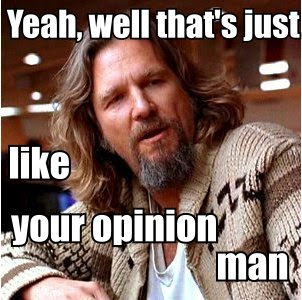
The meme is a screenshot of a person with a confused expression, captioned "I'm not arguing, I'm just explaining why I'm right...". The meme is used to express a sense of superiority or condescension, implying that one is so knowledgeable or informed that they don't need to engage in debate or discussion, but rather simply explain their own perspective as fact.
detailed-analysis (gemma3-27b-vision)
Here's a breakdown of the image, employing relevant theoretical frameworks where applicable.
Visual Description
The image is a meme featuring Jeff Bridges as "The Dude" from the film The Big Lebowski. He is shown in a medium close-up, looking slightly askew with a partially open mouth, giving an impression of casual dismissal or passive agreement. He has long, flowing hair and a full beard. He's wearing a patterned sweater-cardigan and a white t-shirt. The image is a still from the film, suggesting an indoor setting. The text overlaid on the image reads "Yeah, well that's like your opinion man," in a large, bold, white font with a black outline. The equals sign is included, indicating a playful dismissal of differing perspectives. The overall aesthetic is informal, humorous, and slightly ironic.
Postmodernism
This meme is very resonant with postmodern themes. Specifically:
- Rejection of Grand Narratives: The phrase "your opinion, man" is a direct dismantling of any claim to objective truth or universal understanding. It suggests that all knowledge is subjective and constructed. There is no 'right' answer, just individual perspectives.
- Relativism: The meme actively embraces the idea that all viewpoints are equally valid. Even if one disagrees, it is presented as just an opinion.
- Irony & Playfulness: The casual delivery of this philosophical statement through a pop culture icon and meme format utilizes irony. It's not a serious treatise on epistemology, but a playful acknowledgment of its complexities.
- Deconstruction: The meme deconstructs the idea of a rational argument. By reducing any statement to "your opinion," it undermines the very foundations of logical discourse.
Foucauldian Genealogical Discourse Analysis
Michel Foucault’s concept of discourse is relevant here. Consider:
- Power/Knowledge: The meme functions as a discourse that asserts a particular power dynamic. By dismissing an argument as “just your opinion,” the speaker (and by extension, anyone utilizing the meme) positions themselves as having no need to engage with that argument. It’s a subtle way to exert power through intellectual dismissal.
- Genealogy of Truth: A Foucauldian reading might examine how the concept of "opinion" itself has been historically constructed. What conditions allowed for the proliferation of this phrase as a means to end discussion? How has the assertion of subjectivity been used to both liberate and silence?
- Discursive Formations: The meme utilizes a very specific discursive formation – a playful, ironic assertion of subjectivity – as a means of policing discourse. It's a way of saying, "I don't need to justify my own beliefs, and neither do you," which shuts down productive dialogue.
Critical Theory
From a Critical Theory perspective, particularly influenced by the Frankfurt School:
- The Culture Industry: The meme can be seen as a product of the culture industry. It’s a widely disseminated piece of popular culture that reinforces a certain way of thinking.
- Commoditization of Ideas: The meme commodifies a complex philosophical concept (subjectivity, relativism) by reducing it to a easily shareable image.
- False Consciousness: The meme might contribute to a kind of "false consciousness" by implying that all opinions are equally valid, even if some are based on misinformation, prejudice, or lack of critical thinking. It avoids any need to engage with complex issues and potentially reinforces existing power structures.
It's important to note that the meme is often used ironically, which complicates a strictly critical reading. However, the potential for reinforcing apathy or intellectual laziness is still present.
It's vital to note that applying these complex theoretical frameworks to a meme is, in a way, over-analysis. The image's power lies in its simplicity and immediate recognizability. However, these frameworks can reveal the underlying assumptions and cultural forces that shape even seemingly trivial forms of communication.
simple-description (llama3.2-vision)
The meme features a photo of actor Jeff Bridges from the 2008 film "The Big Lebowski". The image is captioned with the phrase "Yeah, well, that's just, like, your opinion, man", which is a famous line from the movie. The meme is likely referencing the character's laid-back and sarcastic tone, while also poking fun at the idea that people often take themselves too seriously.
tesseract-ocr
Yeah, well that's just -/®@ = oe TC | B ee LV" MOTI a EL