First Seen
2023-05-10T21:03:36+00:00
simple-description (llama3.2-vision_11b)
The meme is a screenshot of a Reddit user named "d0x0" with a caption of "d0x0: I'm not arguing, I'm just explaining why I'm right". The image is a humorous representation of someone being overly confident and argumentative, with the text "d0x0: I'm not arguing, I'm just explaining why I'm right" implying that the person is not listening to others and is only focused on proving their own point of view.
detailed-analysis (gemma3-27b-vision)
Here's an analysis of the image broken down into the requested theoretical frameworks. Not every framework applies cleanly, so I'll indicate where that's the case.
Visual Description
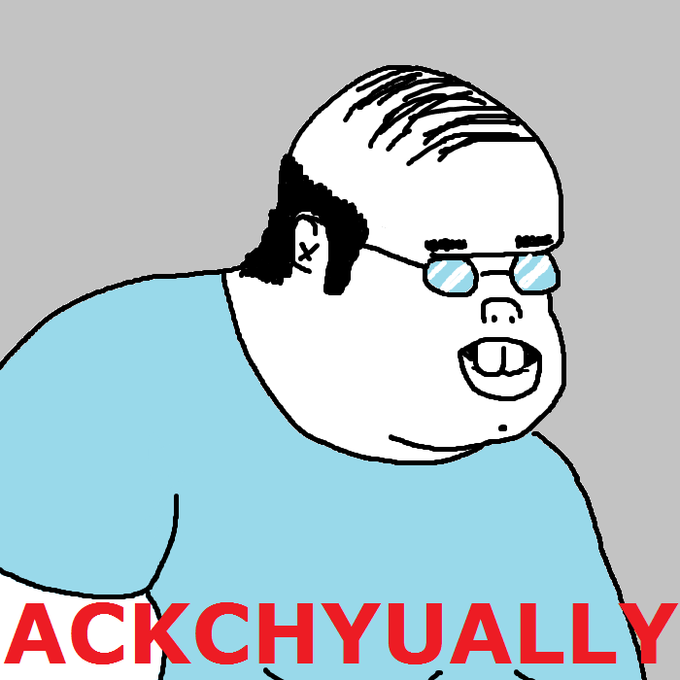
The image is a crudely drawn, cartoonish portrait of a man, likely intended as a meme. The man is pale-skinned, with a receding hairline and sparse hair. He wears large, blue-rimmed glasses and has a noticeably oversized head and prominent, protruding lips. The drawing style is intentionally simplistic and unflattering, prioritizing exaggeration for comedic effect. He's depicted wearing a light blue shirt. Superimposed across the bottom of the image in large, bold, red lettering is the phrase "ACKCHYUALLY," a deliberately misspelled and internet-slang version of "Actually." The overall impression is one of exaggerated condescension and pedantry.
Foucauldian Genealogical Discourse Analysis
This image functions as a powerful site for examining the discourse of “correctness” and “knowledge.” Foucault's genealogical method looks at the historical emergence of concepts and power relations. Here, “ACKCHYUALLY” represents the assertion of a particular, often trivial, “truth” over another. The man's exaggerated features – the large head implying inflated intellect, the glasses signifying a focus on "seeing" the "right" answer, and the exaggerated mouth poised to deliver the correction – represent the power dynamic inherent in asserting that truth.
This is not simply about being correct; it’s about establishing authority through the act of correction. The misspelling and its internet origin demonstrate how this power dynamic has migrated to online spaces. The image doesn’t trace the history of correction itself, but rather illustrates the present manifestation of that impulse—a self-satisfied, even aggressive, assertion of knowledge. It embodies the concept of episteme, where knowledge isn’t neutral, but tied to power and social control. The meme's popularity stems from its recognition of this pattern of behavior, making it a metacommentary on the way knowledge is wielded.
Critical Theory
From a Critical Theory perspective (specifically drawing from the Frankfurt School), this image can be seen as a symptom of a wider cultural trend towards instrumental rationality. The man’s focus on correcting minor points (symbolized by the internet slang misspelling) highlights a narrow, technical focus on “correctness” at the expense of broader understanding or empathy.
The image can be interpreted as a critique of the culture industry and its emphasis on surface-level details and trivial pursuits. The act of correcting, divorced from any meaningful context, becomes an end in itself. This aligns with Adorno and Horkheimer's concept of identity thinking, where individuals rigidly adhere to preconceived notions and resist alternative perspectives. The meme's success relies on the widespread recognition of this pattern—the frustration with those who prioritize being "right" over understanding.
Marxist Conflict Theory
While the image isn’t explicitly about class conflict, a Marxist reading can consider it through the lens of cultural hegemony. The man represents an individual attempting to exert dominance through intellectual superiority. The act of "ACKCHYUALLY" functions as a subtle form of social control, enforcing a particular way of understanding the world.
The meme's popularity could be seen as a counter-hegemonic response – a collective mockery of those who attempt to wield knowledge as a tool of domination. It suggests a resistance to being condescended to or lectured. While not a direct challenge to economic power structures, it critiques a specific form of ideological control – the control over narrative and interpretation.
Postmodernism
From a Postmodern perspective, the image revels in irony and parody. The crudely drawn style, the intentional misspelling, and the overall exaggeration are hallmarks of postmodern aesthetics. The image deconstructs the notion of objective truth by presenting correctness as a performative act, a way of signaling one’s own intellectual superiority.
The meme embraces simulacra – representations of representations – with the phrase "ACKCHYUALLY" itself becoming a symbol of online pedantry. It suggests that truth is not a fixed entity, but rather a construct created through language and social interaction. The image acknowledges the fragmentation of knowledge and the loss of grand narratives, highlighting the absurdity of clinging to trivial details.
Queer Feminist Intersectional Analysis
This is the least directly applicable framework. However, a queer feminist reading could interpret the image as a representation of toxic masculinity. The man's assertive, condescending posture and his need to “correct” others can be seen as embodying traditional masculine traits associated with dominance and control.
The image might be seen as a critique of how knowledge is often presented as objective and neutral, while in reality, it is often shaped by patriarchal norms and power dynamics. The “ACKCHYUALLY” act can be interpreted as a subtle assertion of authority, reinforcing existing power imbalances. However, this is a less strong reading, as the image does not explicitly engage with issues of gender or sexuality.
It's important to remember that these are just interpretations, and the image can be analyzed through many different lenses. The strength of each reading depends on the viewer's own theoretical framework and critical perspective.
simple-description (llama3.2-vision)
The meme features a cartoon image of a man with a scowling expression, wearing a blue shirt and glasses. The image is captioned with the phrase "I can explain why I'm not working" in a sarcastic tone, implying that the person is making an excuse for not doing their job.
tesseract-ocr
scdeuvuany