First Seen
2023-05-10T21:03:36+00:00
simple-description (llama3.2-vision_11b)
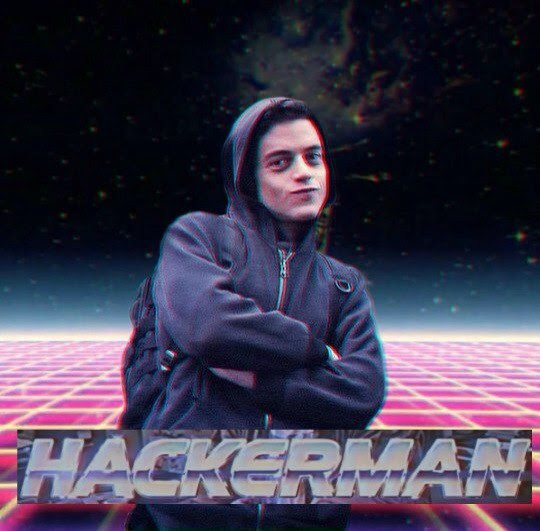
The meme is an image of a person in a hoodie with a caption "I can smell the desperation".
detailed-analysis (gemma3-27b-vision)
Okay, let's break down this image through the requested theoretical lenses. It's a fairly loaded visual, so we'll be able to hit a number of these points.
1. Visual Description
The image features a portrait of a person with dark hair and facial hair, wearing a dark hooded sweatshirt and a backpack. The person's arms are crossed. They appear to be positioned against a digitally rendered background. This background consists of a grid of pink and purple lines extending to the horizon, simulating a digital landscape, topped with a vast, star-filled black sky. The image is stylized with a glitch-like distortion effect, causing color separation and a sense of pixelation around the figure. Large text, reading "HACKERMAN," is overlaid across the bottom in a metallic-looking, embossed font. The aesthetic leans heavily into 80s/90s retro-futurism and cyberpunk visual tropes.
2. Postmodernism
This image is steeped in postmodern sensibility. Several key characteristics are present:
- Hyperreality & Simulation: The digitally created background doesn't represent a "real" place but a simulation of a place. This aligns with Jean Baudrillard's concept of hyperreality, where the signs and symbols of reality become more real than reality itself. The viewer is presented with a fabricated world.
- Pastiche & Intertextuality: The overall style—the glitch effect, the retro-futuristic aesthetic, the "HACKERMAN" text—is a pastiche of cyberpunk imagery. It doesn’t originate a new style but appropriates and remixes existing visual signifiers. It references films like Tron, Blade Runner, and the early internet aesthetic.
- Irony & Playfulness: The word "HACKERMAN" itself is arguably ironic. It deliberately infantilizes and diminishes the concept of hacking, reducing it to a childish, playful act. It's self-aware and doesn't take itself too seriously.
- Deconstruction of Authority: By presenting a seemingly ordinary person as a "HACKERMAN," the image subverts the stereotypical image of a hacker as a cloaked, mysterious figure. It democratizes the concept.
3. Foucauldian Genealogical Discourse Analysis
Applying Foucault, we can analyze how the discourse of "hacking" and the image itself constructs power relations and subjectivities.
- Discourse of Hacking: The term "hacking" has a history of shifting meanings. Originally, it referred to skilled programming and problem-solving. Over time, it became increasingly associated with illegal activity, cybersecurity threats, and counterculture. The image participates in this discourse. By labeling the individual as "HACKERMAN," it draws on both the positive (skill, creativity) and negative (criminality, disruption) connotations of the term.
- Power/Knowledge: The image embodies Foucault's power/knowledge concept. The association of the individual with "hacking" immediately positions them within a web of power relations. This individual is seen as possessing a certain type of knowledge (technical skills, access to systems) that gives them a degree of power. This power, however, is also subject to social control and regulation.
- Genealogy: A genealogical analysis would trace the historical development of the "hacker" archetype. From the early computer enthusiasts to the modern-day cybercriminal, the image attempts to collapse these different moments into a single, playful representation.
4. Critical Theory
From a Critical Theory perspective (drawing on thinkers like Adorno and Horkheimer), the image can be seen as symptomatic of several cultural trends:
- Commodification of Rebellion: The image aestheticizes "hacking," framing it as a cool, edgy, and marketable identity. This commodification of rebellion neutralizes its potential for genuine social change. It turns counter-cultural activity into a consumer product.
- Spectacle and Simulation: Similar to the Postmodern analysis, the image participates in the creation of a spectacle. It presents a stylized, simulated reality that distracts from real social problems.
- False Consciousness: The image might contribute to a false consciousness by suggesting that "hacking" is a harmless or even glamorous activity, obscuring the ethical and legal complexities of cybercrime.
5. Marxist Conflict Theory
From a Marxist lens, the image can be analyzed through the prism of class and ideology.
- Technological Determinism & Alienation: The image subtly reinforces the idea that technology is a neutral force, ignoring the social and economic factors that shape its development and use. This can reinforce the idea of technological determinism. The figure's isolation and digital immersion could be interpreted as symbolic of alienation in a technologically advanced society.
- Power Dynamics & Control: While not explicitly visible, the concept of hacking often relates to challenging existing power structures and systems. The image, however, deconstructs this idea by reducing it to a playful, individualistic act. This downplays the potential for collective action and social change.
- Ideological Function: The image’s aesthetic and ironic tone could be seen as a way of legitimizing a particular ideological stance—a celebration of individualism, technological prowess, and playful subversion—that ultimately serves the interests of the dominant power structures.
6. Queer Feminist Intersectional Analysis
This analysis is a bit more challenging, as the image doesn’t immediately present obvious indicators of gender or sexuality. However, it's possible to explore this through:
- Subversion of Masculinity: The image presents a non-traditional, somewhat androgynous figure challenging traditional notions of masculine power. The hooded sweatshirt and the internal focus on technology could be seen as a rejection of outward displays of dominance.
- Digital Spaces and Identity: The image connects the individual to a digital realm that can offer opportunities for marginalized groups to construct alternative identities and communities.
- Intersectionality of Power: The act of "hacking" itself can be seen as an assertion of agency and a challenge to the control of information and technology—something that can be particularly empowering for marginalized groups.
It's important to note that these analyses aren't mutually exclusive. The image is complex and can be interpreted through multiple theoretical frameworks. These are just some possible readings, and others are certainly possible.
simple-description (llama3.2-vision)
This meme is an image of the character "Hackerman" from the TV show "Hacks" with a serious expression. The text "Hackerman" appears in bold, futuristic font at the top of the image. The overall tone of the image is one of intense, high-tech seriousness, implying that the character is a master hacker.
tesseract-ocr
| fe iy Sy as il al PS 1 4 sul y : ¥ L ~y, i ), vw" 47 Len x A we new ininerm renin 4 ee Se