First Seen
2023-05-10T21:03:36+00:00
simple-description (llama3.2-vision_11b)
This meme is a screenshot of a Discord user's profile picture, featuring a cartoon cat with a sarcastic expression. The text "i cant even" is overlaid on the image, implying a sense of frustration or exasperation. The meme is likely used to express annoyance or disappointment in a humorous way.
detailed-analysis (gemma3-27b-vision)
Okay, let's break down this image of the disgruntled cat through several theoretical lenses. It's a surprisingly rich image for analysis, considering its simplicity!
Visual Description
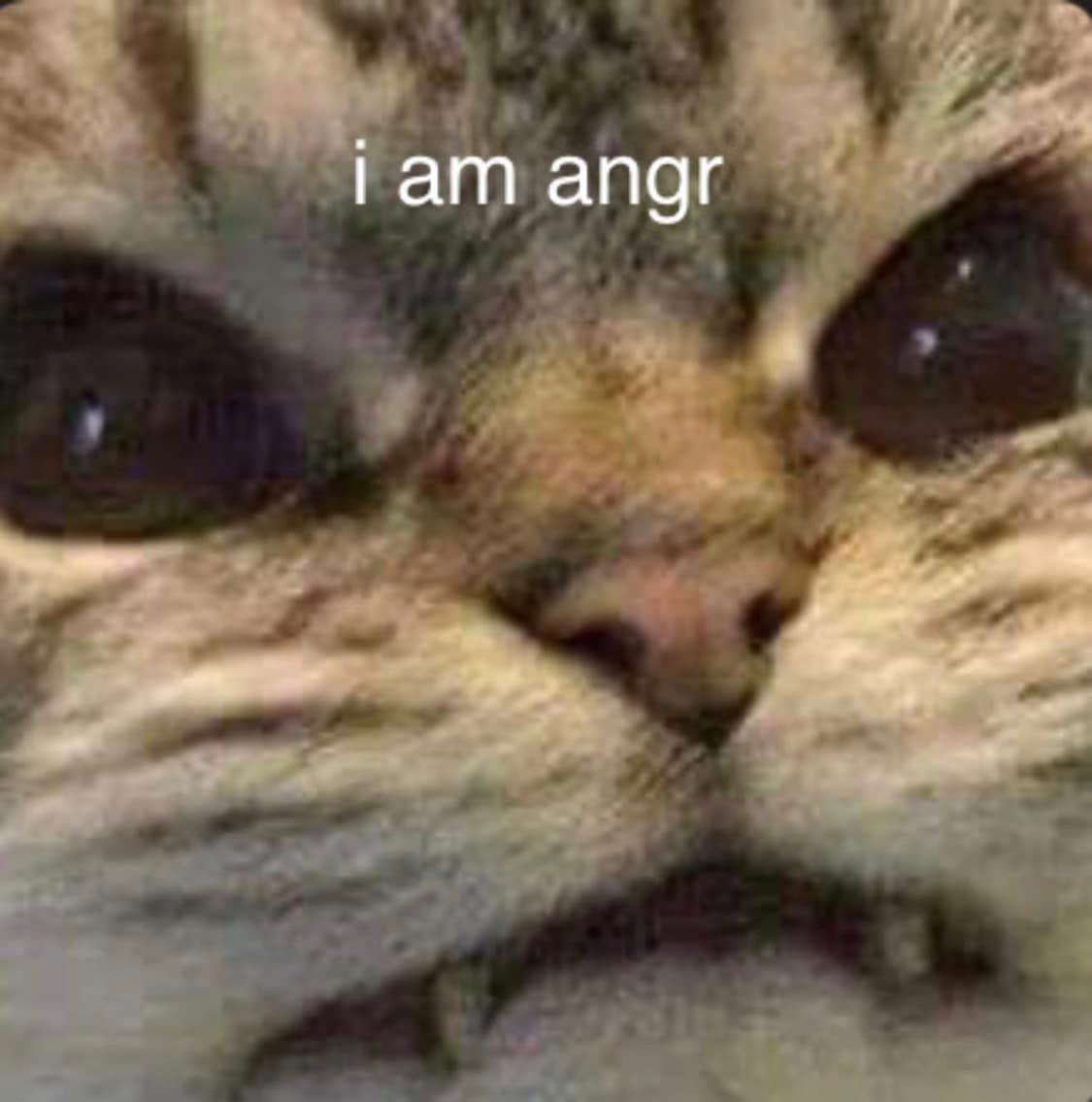
The image is a close-up shot focusing on the face of a cat, presumably a tabby due to the visible stripes. The angle is slightly upward, accentuating the cat's nose and the vastness of its eyes. The cat's expression is a clear one of displeasure. Its eyes are wide, and the lines of its mouth and nose are furrowed in what reads as anger or annoyance. The lighting is somewhat flat, and the image appears to be a candid shot – not a polished photograph. The text overlay, "i am angr," is intentionally misspelled, adding to the meme-like quality and potentially emphasizing the rawness of the emotion. The depth of field is very shallow, focusing on the nose and eyes, and the background is blurred.
Foucauldian Genealogical Discourse Analysis
This image, with its text, functions as a “discourse” around anger. Michel Foucault would be interested in how anger is constructed as a concept, rather than the anger itself. The misspelling ("angr") is crucial. It’s a deliberate subversion of correct grammar. This deconstructs the “proper” expression of emotion. Standard linguistic forms often imply a certain level of rational control. By omitting letters, the image represents a more primal, unfiltered, and potentially dangerous expression. We can see how the discourse surrounding emotion dictates how we are allowed to feel and express it.
A genealogical approach would trace the history of how "anger" has been defined and managed in society – historically, anger has been both celebrated (in warriors, for example) and pathologized (seen as a sign of instability). This image, in its raw form, could be interpreted as a rejection of the modern, controlled, "acceptable" forms of anger. The image isn’t about anger in a factual way, it is an instantiation of the discourse around anger.
Critical Theory
From a Critical Theory perspective, this image can be seen as a critique of the demands placed on individuals (and animals!) to regulate their emotions. The image highlights the societal expectation that we should not express unfiltered anger, but instead, manage it, rationalize it, or suppress it. The cat, incapable of fully engaging in the rationalizing discourse demanded by society, simply is angry.
The image also touches on the power dynamics inherent in emotional expression. Who gets to be angry, and under what circumstances? Are certain expressions of anger deemed more acceptable than others based on social status, gender, or race? The cat’s unapologetic anger could be interpreted as a rejection of these power structures.
Marxist Conflict Theory
While seemingly a stretch, a Marxist reading can identify a conflict between the cat's internal state (anger) and the external pressures of domestication and anthropocentric expectations. The cat is a creature of instinct, and its anger is a natural response to some perceived threat or discomfort. However, as a domesticated animal, it's expected to conform to human standards of behavior and suppress its more primal impulses. This creates a conflict – a class struggle within the animal itself.
The misspelling could be seen as an act of "proletarian" resistance against the "bourgeois" standards of language and emotional control. It's a disruption of the expected norms, a refusal to conform. The cat's anger isn’t simply a personal emotion, it’s a symptom of a larger systemic problem.
Postmodernism
The image perfectly embodies some core tenets of postmodernism. The intentional misspelling and meme-like quality dismantle the idea of a singular, "correct" meaning. "Angr" isn’t wrong, it is an alternative expression, a destabilization of traditional linguistic norms.
The image doesn't offer a clear narrative or explanation. It simply is. This rejection of grand narratives and emphasis on fragmented, subjective experience is characteristic of postmodern thought. The image can be interpreted in many ways, depending on the viewer’s own perspective, emphasizing the fluidity of meaning and the lack of objective truth.
Queer Feminist Intersectional Analysis
This is potentially the most nuanced and compelling reading. The cat’s “unruliness” – its refusal to be contained or controlled – can be read as a rejection of normative emotional expectations. Feminist theory often emphasizes the ways in which women and other marginalized groups are expected to suppress anger or express it in “acceptable” ways (e.g., passive-aggression). The cat’s raw, unapologetic anger can be seen as a form of resistance against these expectations.
From a queer perspective, the cat's "otherness" and rejection of societal norms can be seen as a form of radical self-expression. The image challenges the binary of “good” (compliant) and “bad” (angry) emotions.
Intersectionality comes into play because we can see the cat's anger not in isolation, but as potentially intertwined with other forms of marginalization (e.g., speciesism, the power dynamics of pet ownership). The cat's anger may be a response to a systemic lack of agency or control over its own life. It's not just anger; it's a complex emotional response rooted in power imbalances.
I hope this comprehensive analysis captures the surprising depth that can be found even in a simple image of an angry cat! Let me know if you'd like me to expand on any of these perspectives further.
simple-description (llama3.2-vision)
This meme features a photo of a cat's face with a distorted, exaggerated expression of anger or frustration. The text "i am angry" is superimposed over the cat's face, but it's misspelled as "i am angr" with a deliberate typo. The image is likely meant to be humorous or ironic, poking fun at the idea of a cat's anger or frustration.
tesseract-ocr
: > ee 5 ie 4? . 7 : fab = : § he a 4 . Deets te pate § > of 5 u od iz * , J : a . “=P ei ~. ‘ - ; : —? e FP es — - f / | ne —_ i ” Pel - UE ad we es mo 8)