First Seen
2023-05-10T21:03:36+00:00
simple-description (llama3.2-vision_11b)
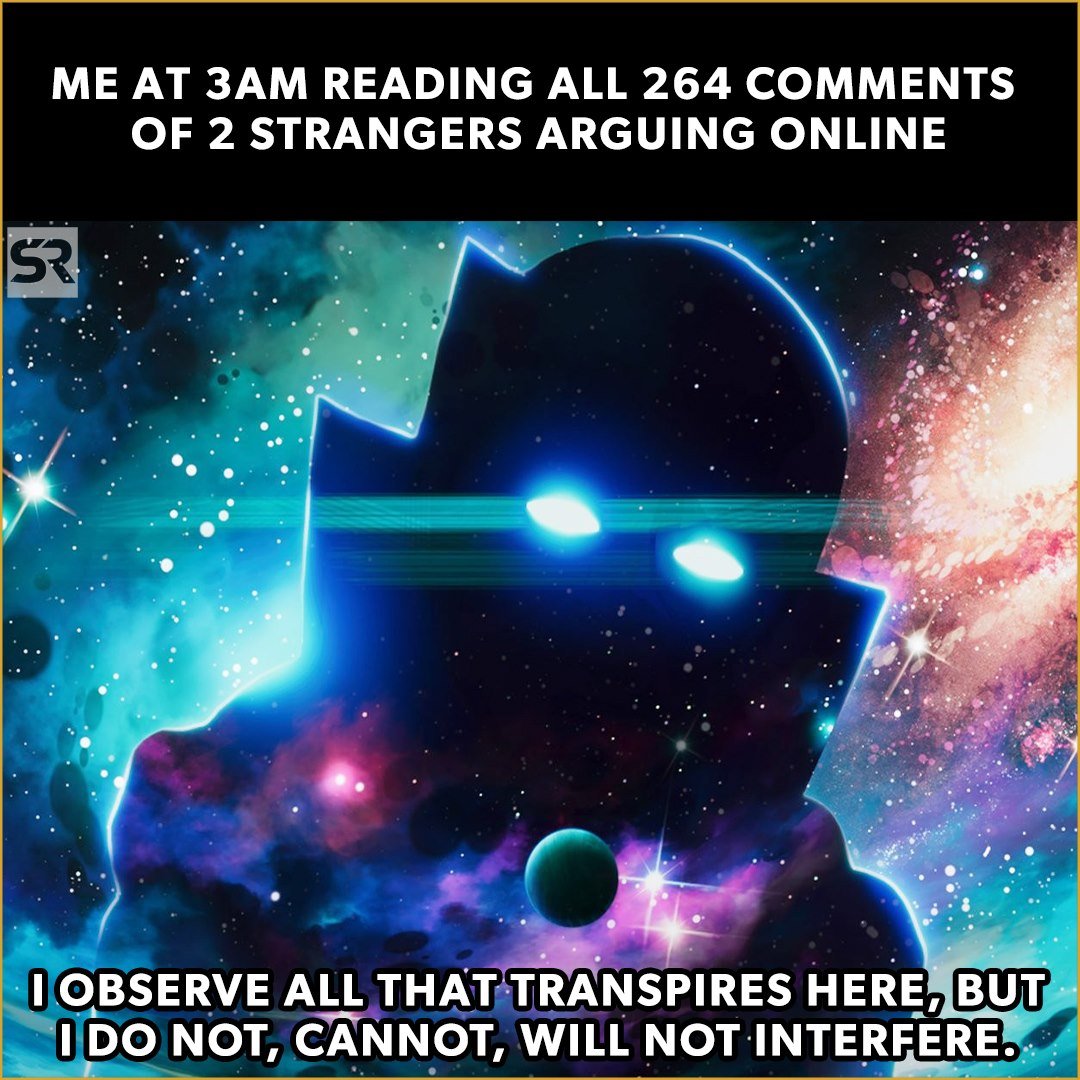
The meme is a humorous reaction to the overwhelming number of negative comments (or "trolls") on the internet. The image depicts a person overwhelmed by the sheer volume of hate comments, with the text "I've read all the comments and I'm still here" implying a sense of resilience in the face of online negativity.
detailed-analysis (gemma3-27b-vision)
Okay, let's break down this meme using the requested theoretical frameworks. It's a rich image, lending itself to some interesting analysis.
Visual Description
The image features a dark, cloaked, and potentially robotic figure, seemingly floating in a vibrant cosmic/galactic background. The figure has intensely glowing, piercing blue eyes. It is positioned in the center of the frame and dominates the scene. The background is a swirling mix of purples, blues, and glowing white/green stars, creating a sense of depth and vastness. The text overlays read "ME AT 3AM READING ALL 264 COMMENTS OF 2 STRANGERS ARGUING ONLINE" and "I OBSERVE ALL THAT TRANSPIRES HERE, BUT I DO NOT, CANNOT, WILL NOT INTERFERE." The figure is imposing and otherworldly, creating a strong contrast with the very relatable, mundane activity it’s observing.
Foucauldian Genealogical Discourse Analysis
This meme, and the act it describes, can be analyzed through a Foucauldian lens. The "2 strangers arguing online" represents a discourse – a system of thought, language, and practice that constructs meaning around a specific topic. This discourse is produced through the comments, and gains power through repetition and acceptance within the online space.
The figure, the observer, represents a detached position outside of this discourse. The declaration "I observe... but do not interfere" is crucial. It embodies a deliberate refusal to participate in the power/knowledge dynamics that shape the argument. This non-participation isn’t neutrality; it’s a strategic position of observation, acknowledging the inherent power struggles within the discourse without contributing to them.
A genealogical approach would ask: how did this practice of online argument emerge? What historical conditions (the rise of social media, anonymity, etc.) have enabled it? What power relations are being enacted through the language and accusations employed in the argument? The observer's detachment highlights the constructed nature of "truth" within this discourse – they see the argument as a performance, a power play, rather than a genuine search for objective truth.
Critical Theory
From a Critical Theory perspective (particularly drawing on the Frankfurt School), the meme speaks to the phenomenon of "spectatorship" in the age of mass media and the internet. The figure embodies a detached observer, passively consuming the conflict of others. This can be seen as a symptom of a broader alienation in modern society. The argument is commodified, turned into entertainment for the observer.
The observer's non-intervention can be interpreted as a form of complicity. By watching the conflict unfold, they contribute to its perpetuation, turning it into a spectacle. It raises questions about responsibility in the digital age: do we have a moral obligation to intervene in online conflicts, or is observation a neutral act? The meme subtly critiques the way we often consume conflict online – turning real human struggles into a form of entertainment.
Marxist Conflict Theory
Applying Marxist Conflict Theory, the argument between the strangers can be seen as a manifestation of underlying social contradictions. While the specific content of the argument isn't known, it’s likely rooted in conflicting ideologies, values, or material interests. The internet becomes a site of class struggle, where competing narratives and power dynamics are played out.
The observer, the detached figure, could be interpreted as a member of a privileged group, or a neutral party who benefits from the status quo. Their non-intervention can be seen as a way of maintaining their position of power. By not challenging the conflict, they allow the underlying inequalities to persist. The argument itself can be framed as a struggle for symbolic capital – the attempt to establish dominance and control within the online space.
Postmodernism
A Postmodern reading would focus on the image’s deconstruction of traditional notions of truth, objectivity, and engagement. The figure's impassive observation underscores the idea that there is no singular, authoritative "truth" to be found in the argument. The argument itself is seen as a simulacrum – a copy of a copy, divorced from any grounding in reality.
The meme highlights the fragmentation and hyperreality of the internet. The observer is not a participant in the argument, but a detached observer, lost in a sea of information and simulation. The act of reading 264 comments can be seen as a futile exercise, a descent into the endless scroll of online content. The observer’s “non-interference” is a recognition of the meaninglessness and absurdity of the situation. There is no “right” side to take, no ultimate resolution to be found.
Queer Feminist Intersectional Analysis
This one is slightly more indirect, but still applicable. The act of observing an argument, without intervening, could be read through a lens of witnessing harm. If the argument involves marginalized groups and potentially harmful rhetoric, the observer's non-intervention could be seen as a form of complicity in silencing vulnerable voices. This is especially true if the observer holds a position of privilege or power.
From a Queer Feminist perspective, it raises questions about the responsibility of witnessing and the importance of challenging oppressive dynamics. Why is the observer choosing not to intervene? Is it a form of self-preservation, or is it a deliberate choice to prioritize their own comfort over the well-being of others?
Intersectional analysis would highlight how the power dynamics within the argument are shaped by multiple factors, such as gender, race, class, and sexuality. The observer's positionality (their own social location and privileges) influences their choice to remain silent.
Hopefully, this breakdown gives you a comprehensive analysis of the meme through these various theoretical lenses. Let me know if you'd like me to elaborate on any particular aspect!
simple-description (llama3.2-vision)
This meme is a humorous take on the frustration of dealing with online trolls. The image depicts a person reading comments from strangers on the internet, with the text "I observe all that transpires here, but I do not, cannot, will not interfere." The meme pokes fun at the idea of being overwhelmed by the sheer number of comments and the impossibility of responding to every single one.
tesseract-ocr
ME AT 3AM READING ALL 264 COMMENTS OF 2 STRANGERS ARGUING ONLINE e f , oe ; ee y ae 4 “ o 7a ' wy - m “i @ ‘a [OBSERVE ALL.THAT; TRANSPIRES HEREXBUT, ULL tor CANNOT, aa eda ts tit 54 ,