First Seen
2023-05-10T21:03:36+00:00
simple-description (llama3.2-vision_11b)
The meme is a humorous image of a character from the animated TV series "Rick and Morty" with a confused expression. The character's face is captioned with the phrase "I never understood what any of it meant". This meme is a relatable commentary on the show's complex and often absurd storytelling, poking fun at the idea that even the characters themselves don't always understand what's happening.
detailed-analysis (gemma3-27b-vision)
Okay, let's break down this image using the requested theoretical frameworks.
Visual Description
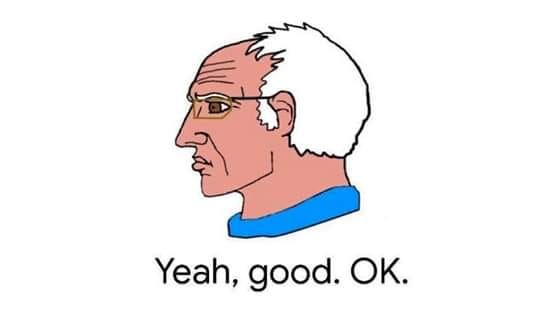
The image is a cartoon-style, side-profile depiction of an elderly man. The style is simplified and slightly crude, resembling a meme template. The man has a prominent nose, furrowed brow, and a shock of white, messy hair. He is wearing glasses. The color palette is limited – the skin tone is a reddish-pink, with a blue collar. Below the image, the text "Yeah, good. OK." is written in a simple, sans-serif font. The composition is minimal, with the man’s head filling most of the frame against a plain white background. It is clearly intended to be shared and adapted as a meme.
Foucauldian Genealogical Discourse Analysis
This image, as a meme, participates in a discourse surrounding expectations, performance, and passive-aggression. The phrase "Yeah, good. OK." doesn't offer outright affirmation, but conveys a subdued acceptance with a hint of judgment or lack of enthusiasm. A genealogical analysis would trace how this type of expression has evolved.
Historically, expressions of approval were more demonstrative or ritualized. This meme format represents a shift towards irony, understatement, and subtle communication. The man's face, used as a template, performs a certain type of weary, resigned acceptance. We can trace a "genealogy" of this performance to earlier forms of stoic or world-weary expressions in art and literature, but its current manifestation within meme culture has drastically altered its meaning.
Foucault's concept of power/knowledge is relevant. The meme’s power derives from its recognizability and shared understanding. It relies on the knowledge that this type of response is often used to subtly express dissatisfaction or disapproval, therefore the image gains power through its ability to invoke that feeling within others. The meme constructs a type of subjective feeling through recognition.
Critical Theory
From a Critical Theory perspective, this meme can be seen as a microcosm of societal power dynamics. The image expresses subtle resistance. The phrase "Yeah, good. OK." doesn't directly challenge anything, but its understated tone hints at a lack of genuine enthusiasm.
The meme can be interpreted as a commentary on performative politeness, particularly in situations where one feels pressured to offer approval even when they don't truly agree. This reflects the ways in which individuals are often compelled to conform to societal expectations of politeness and consensus, even at the expense of their own genuine feelings.
The man's face further reinforces this idea, representing a figure of authority who appears to be passively accepting something while secretly harboring reservations. This underscores the ways in which power can be exercised subtly through social norms and expectations.
Marxist Conflict Theory
While not explicitly depicting class struggle, the meme can be analyzed through a Marxist lens by considering the alienation inherent in modern communication. The understated response represents a disconnect between genuine feeling and the need to perform social acceptance.
The meme suggests a kind of alienated labor of emotional performance – one is expected to offer a positive response even when they don't feel it, sacrificing authenticity for the sake of social harmony. This can be seen as a reflection of the broader alienation experienced by individuals within capitalist systems, where genuine human connection is often sacrificed for the sake of productivity and efficiency.
It also hints at a subtle form of class consciousness – a recognition that one is being asked to conform to a system that doesn't necessarily serve their interests.
Postmodernism
This meme is deeply rooted in postmodern aesthetics and concepts. It’s a prime example of intertextuality - the meaning of the meme isn't inherent in the image itself, but derives from its relationship to other memes, internet culture, and shared social experiences.
The lack of straightforward meaning is also a hallmark of postmodernism. The phrase "Yeah, good. OK." is deliberately ambiguous, open to multiple interpretations depending on the context. This rejection of fixed meaning is central to postmodern thought.
The meme's reliance on irony and self-awareness further reinforces its postmodern credentials. It mocks the expectation of sincere approval and embraces a cynical, detached sensibility. This reflects a broader postmodern skepticism towards grand narratives and universal truths.
Queer Feminist Intersectional Analysis
This is the least directly applicable framework, but some connections can be drawn. The passive-aggressive tone and subtle expression of disapproval can be seen as reflecting the ways in which marginalized groups (women, queer individuals, people of color) are often expected to navigate power dynamics with restraint and politeness, even in the face of injustice.
The meme can be read as a commentary on the expectation that marginalized individuals should be “grateful” for any recognition or progress, even if it falls short of their needs. The understated response can be interpreted as a subtle resistance to this expectation, a refusal to offer unqualified affirmation.
The meme’s ambiguity also allows for multiple interpretations, potentially enabling queer and feminist readings that challenge dominant norms and power structures. However, this is a somewhat strained application, and the meme does not explicitly address issues of gender, sexuality, or race.
I hope this breakdown provides a comprehensive analysis of the image from various theoretical perspectives! Let me know if you’d like me to elaborate on any of these points further.
simple-description (llama3.2-vision)
This meme features a simple, cartoon-style drawing of a person with a blank expression, often referred to as "Grumpy Cat's" creator, but in this case, it's a character from the "Simpsons" series, Professor Frink. The text "Yeah, good. OK." is written in a straightforward, unenthusiastic tone, implying a lack of excitement or interest in something. The image is likely used to express a sense of boredom or apathy in response to a situation or event.
tesseract-ocr
Yeah, good. OK.