First Seen
2023-05-10T21:03:36+00:00
simple-description (llama3.2-vision_11b)
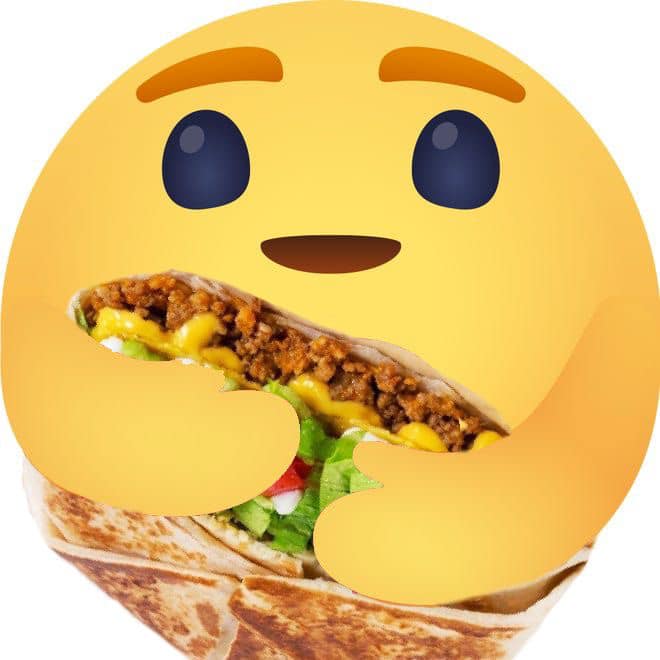
The meme is a reaction image from the Meta platform, featuring a yellow face with a surprised expression, accompanied by the text "omg". It's used to express astonishment or excitement, often in response to unexpected or surprising news. The image is a playful way to convey that something has caught one's attention or interest.
detailed-analysis (gemma3-27b-vision)
Okay, here's an analysis of the image, broken down into sections based on the requested theoretical frameworks. I'll only include sections where the theory actually applies—not all of them will! It's a bit absurd to apply all of these, but here we go!
Visual Description
The image presents a digital composite: a bright yellow emoji face with a bite taken out of it, revealing the contents of what appears to be a fast-food burrito (likely a Doritos Locos Taco from Taco Bell). The burrito filling is visible: browned meat, cheese, lettuce, and a visible red tomato slice. The bite removes a section of the emoji's mouth, aligning with the burrito bite. The image is flat, brightly colored, and digitally rendered. The visual juxtaposition is jarring and playful, creating an unexpected and humorous effect.
Foucauldian Genealogical Discourse Analysis
This image lends itself to a Foucauldian analysis concerning power and knowledge around food, consumerism, and even emotional expression.
- Discourse of Hunger/Satisfaction: The image constructs a discourse where a burrito is happiness, or at least, the visible expression of enjoyment. This isn't natural; it's a culturally constructed connection—a discourse established through advertising, marketing, and social conditioning. We've been taught to associate specific foods with pleasure.
- Discipline & Self-Control (or Lack Thereof): The "bite" itself speaks to a breakdown (or rejection) of disciplined eating. It’s a visual representation of immediate gratification. The emoji’s open, almost ecstatic expression suggests surrender to desire, subverting discourses around dieting or "healthy" eating.
- Genealogy of the Emoji: Tracing the emoji’s history reveals its origins in Japanese culture, evolving into a globally-understood language of emotion. Its co-option within consumer culture (paired with a fast-food item) demonstrates how symbols can be repurposed and their meanings altered to serve new purposes – in this case, advertising and brand association.
Critical Theory
This image strongly aligns with concepts from the Frankfurt School (Adorno, Horkheimer, Marcuse) specifically around the culture industry.
- Commodification of Emotion: The emoji represents a standardized, simplified expression of emotion. By pairing it with the burrito, the image commodifies both. The emoji is a product of the culture industry (digital communication), and the burrito is a mass-produced consumable. The image reinforces the idea that even our feelings are subject to market forces.
- Pseudo-Individualization: The image appears playful and unique, but it relies on pre-existing cultural symbols (emoji, fast-food) to convey its message. This is pseudo-individualization – the illusion of choice and uniqueness within a system of mass production. You might feel like you are expressing your enjoyment of the burrito, but the image is constructed from standardized elements.
- Distraction & Repression: The image offers a moment of fleeting pleasure (the burrito) as a distraction from deeper societal issues. It encourages a focus on immediate gratification, rather than critical reflection.
Marxist Conflict Theory
From a Marxist perspective, this image exposes the dynamics of class and exploitation within the food system and consumer culture.
- The Labor of Consumption: The image focuses solely on consumption, obscuring the vast network of labor that went into producing the burrito (farming, processing, transportation, marketing). The emoji’s blissfully ignorant expression hides the conditions of the workers who made this moment possible.
- False Consciousness: The image encourages a "false consciousness" by presenting consumption as a source of happiness, diverting attention from the systemic inequalities that structure society. It reinforces the ideology that individual purchasing choices can solve problems.
- Commodification of Desire: The image shows that even emotions (pleasure, enjoyment) are turned into commodities that can be bought and sold.
Postmodernism
The image embodies several hallmarks of postmodern art and thought.
- Pastiche & Intertextuality: The image combines disparate elements (emoji, fast-food, digital manipulation) in a playful, ironic manner. It doesn’t create a new meaning but instead remixes existing cultural symbols.
- Blurring of Boundaries: The image breaks down the boundaries between the real and the virtual, the emotional and the material. The emoji is an abstraction of emotion, yet it’s visually merged with a tangible food item.
- Simulacra & Simulation: The image is a simulation of enjoyment—a representation of a feeling that may or may not be genuine. It is a hyperreality, where the representation is more real than the reality itself.
Queer Feminist Intersectional Analysis
This is the trickiest application, but some readings can be made.
- Disrupting Normative Representations of Appetite: The image, through its playful absurdity, can be seen as challenging traditional representations of appetite and enjoyment. Traditional food marketing often relies on heteronormative and gendered tropes. This image's strangeness disrupts those expectations.
- Consumption as Resistance: For marginalized communities, pleasure and enjoyment can be acts of resistance against oppressive systems. The emoji's defiant enjoyment of the burrito, while shallow, could be read as a small rejection of dieting culture or restrictive norms.
- Intersection of Class and Consumption: The image is inherently tied to consumerism, which disproportionately impacts marginalized communities. The image's framing of pleasure through consumption requires acknowledging the systemic barriers to access and agency for those with less economic power.
I hope this provides a comprehensive analysis of the image through the requested theoretical lenses! Let me know if you'd like me to elaborate on any specific section or perspective.
simple-description (llama3.2-vision)
The meme is a photo of the "thinking face" emoji, which is a yellow face with a slightly confused expression. The emoji is holding a taco, and the text "I can smell the desperation" is written above it. The image is a humorous take on the idea that someone is so desperate for food that they can smell it, even when it's not physically present.
tesseract-ocr
6 @ - </>