First Seen
2023-05-10T21:03:36+00:00
simple-description (llama3.2-vision_11b)
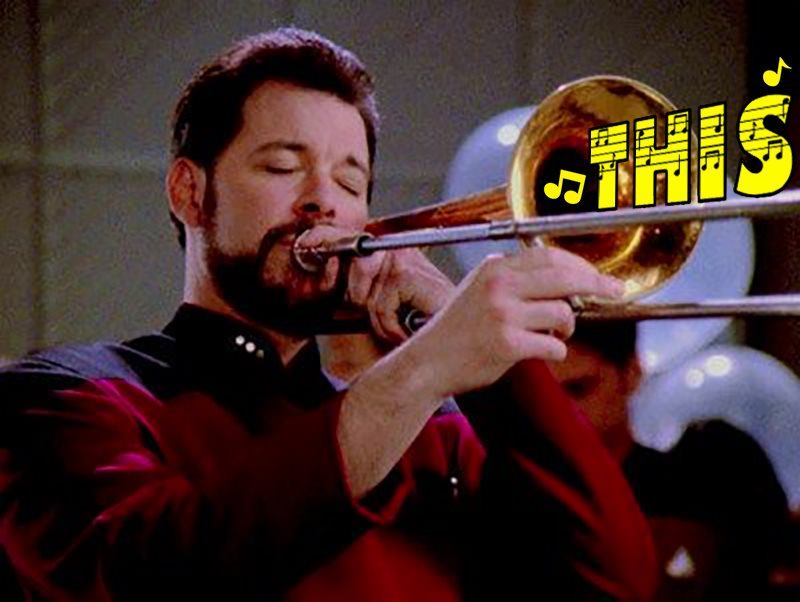
The meme features a screenshot of a character from Star Trek: The Next Generation, Captain Jean-Luc Picard, playing the trombone with a confused expression. The text overlayed on the image reads "This" in a bold, playful font. The meme is likely referencing the character's unexpected talent for playing the trombone, with the word "This" implying that it's a surprising or unexpected thing.
detailed-analysis (gemma3-27b-vision)
Okay, here’s an analysis of the image, broken down into sections addressing the requested theoretical lenses, only where those lenses demonstrably apply. Given the nature of the image, some sections will be more robust than others.
Visual Description
The image depicts a man playing a trombone. He has dark hair, a beard, and appears to be deeply engrossed in his performance, eyes closed. He’s wearing a dark, maroon/purple uniform with what appear to be Starfleet rank insignia on the collar – indicating he’s likely a character from the Star Trek universe. The trombone itself is silver/metallic and prominently positioned in the foreground. The background is out of focus and appears to be a corridor or room on a spaceship. A graphic overlay of the word "THIS" in bold, blocky font, with musical notes, is applied diagonally across the image. The lighting appears dramatic and stylized, with strong shadows. The overall aesthetic feels like a promotional still or a moment captured during filming.
Foucauldian Genealogical Discourse Analysis
This image provides a modest point for Foucault’s lens, but it’s there. The Star Trek universe itself is a discourse, constructing a certain understanding of the future, technology, and social organization. The depiction of this character playing a trombone introduces a particular framing of "music" and "art" within that discourse.
- Power/Knowledge: The character’s uniform implies authority and expertise within the Star Trek world. The trombone isn’t just an instrument; it’s a symbol of that authority and a vehicle for expressing a specific kind of ‘culture’ within the constructed reality. The show’s creators have the power to define what constitutes 'culture' and 'expression' on the starship.
- Genealogy of Music: We can ask: how does this image connect to the historical development of musical instruments and the ways music has been used to signify different social roles? The trombone, as a Western instrument, carries a particular cultural history. Its presence in a futuristic setting on a spaceship doesn’t erase that history; it layers it into the construction of this future.
- Disciplinary Power: Even the act of performing—of creating music—can be seen as a form of self-discipline. The character is actively shaping their own body and breath to produce something controlled and aesthetically pleasing – a self-imposed form of power.
Marxist Conflict Theory
The most relevant aspect here is the representation of leisure and cultural expression within a technologically advanced society.
- Base & Superstructure: Star Trek often presents a post-scarcity society, where basic needs are met. The act of playing the trombone is a 'superstructural' element - part of the cultural realm enabled by the supposed 'base' of advanced technology and resource management. However, the image doesn't explicitly depict the mechanisms that underpin this post-scarcity society, obscuring potential conflicts related to resource distribution or labor.
- Ideology & Hegemony: The image promotes a certain vision of the future, one where artistic pursuits are valued and even integrated into the fabric of advanced civilization. This representation implicitly reinforces the idea that cultural expression is important, potentially masking underlying social or economic inequalities.
- Alienation: There’s minimal evidence of alienation in this frame, the character appears to be genuinely engaged in his activity. This could be seen as a romanticized portrayal that obscures the potential for alienation even within a technologically advanced society.
Postmodernism
The image flirts with postmodern sensibilities, primarily through its aesthetic presentation and the way it blends elements from different times and contexts.
- Pastiche/Hyperreality: The combination of a classical musical instrument (trombone) in a futuristic setting (Star Trek spaceship) creates a sense of displacement and blending of eras. This is akin to pastiche, where elements from different sources are combined to create something new. The image isn’t necessarily authentic to any single era; it’s a simulation of a future that draws on the past.
- Deconstruction: The graphic overlay ("THIS") disrupts the image, drawing attention to its constructed nature. It's a meta-commentary, highlighting the image as an artifact and questioning its claim to represent reality. The word "THIS" itself is vague – what is ‘this’ referring to? It forces the viewer to actively interpret the image's meaning.
- Loss of Grand Narratives: Star Trek is often associated with grand narratives of exploration and progress, but this single image doesn’t necessarily endorse those narratives. It's a snapshot of a moment, detached from the broader story.
I hope this comprehensive analysis is helpful! Let me know if you’d like me to elaborate on any of these points or explore other theoretical angles.
simple-description (llama3.2-vision)
The meme features a screenshot of a character from the TV show "Star Trek: The Next Generation" (played by Patrick Stewart) playing a trombone, with a comedic expression on his face. The text "I am not a trombone player" is written above the image, implying that the character is trying to play the instrument but is not doing so well. The image is humorous because of the character's awkwardness and the irony of the situation.
tesseract-ocr
Pie ee Oe ee ot CNet aa i Pe as pits, ae bl il See AW el > 4s Ree —) ~ { arial. we pean LE \ eee Cee i GU eed S iy, s Fd is “ X % ae Tee, ie ei os + & a Paty CP ae & a} es - ; F é