First Seen
2023-05-10T21:03:36+00:00
simple-description (llama3.2-vision_11b)
The meme is an image of a painting of a woman with a shocked expression, with the text "i can explain it" overlaid on top. The meme is likely being used to express a sense of surprise or confusion at a situation, with the text implying that the speaker is about to provide a lengthy explanation for something that seems obvious or trivial.
detailed-analysis (gemma3-27b-vision)
Okay, here's an analysis of the image, broken down into sections as you requested. Note that not all categories are strongly applicable, and I’ll explain why if that’s the case. I'll lean heavily into what seems most relevant, given the image.
Visual Description
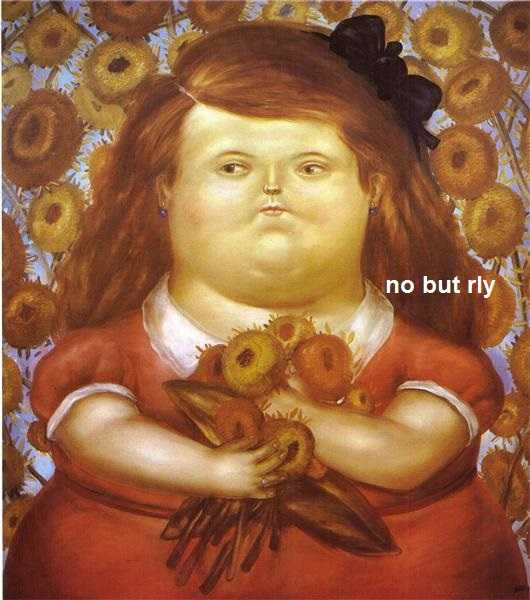
The image is a digitally altered version of Botero's "Girl with a Bouquet," a painting known for its voluminous, exaggerated forms. The subject is a young girl, rendered in the characteristic full-bodied style of Botero, depicting her with ample curves and proportions. She's wearing a red dress with white collar and cuffs. She is holding a bouquet of flowers. The background is filled with stylized sunflowers.
The alteration to the painting is the addition of the phrase "no but rly" (internet slang meaning "no, but really?") written in white capital letters in the upper right corner. This overlay disrupts the formality and historical context of the painting. The digital modification, coupled with the casual internet slang, creates a jarring, playful, or ironic effect.
Foucauldian Genealogical Discourse Analysis
This image lends itself well to a Foucauldian analysis because it highlights the discourse around bodies, beauty standards, and the historical construction of "normality."
- Power/Knowledge: Botero's work, even before alteration, challenged Western, traditionally slender, depictions of the female form. It offered an alternate aesthetic, presenting a "fuller" body as beautiful. The painting originally participates in a counter-discourse regarding body image. The addition of "no but rly" re-contextualizes this discourse.
- Genealogy of the Body: We can trace a history of how the body has been “disciplined” – how Western society has defined ideal body shapes. The painting challenges this by presenting a non-idealized body as equally worthy of representation. The added text creates a meta-commentary on how these discourses have played out online, particularly within internet subcultures.
- Disruption of Categories: The internet slang, combined with a Renaissance-style portrait, disrupts conventional categories of high/low culture, past/present, and serious/humorous. It shows the fluidity of meaning and how it is remade in online spaces.
Critical Theory
The image engages with themes central to Critical Theory. Specifically:
- Critique of Representation: The painting, pre-alteration, already offers a critique of traditional art historical representations of women. Often, women in art were presented as objects of the male gaze, idealized and often fragile. Botero presents a different body, challenging these conventions.
- The Commodity Fetish: (Though less dominant) One could consider how the image itself has become a commodity, re-circulated and remixed on the internet. It’s a digitized image divorced from the original painting’s material context.
- The loss of Aura: Walter Benjamin's concept of Aura, the uniqueness and authenticity of an artwork, is eroded with the digital manipulation and online dissemination of the image. It's no longer experienced in the same way as a physical painting in a museum.
Postmodernism
This image is highly postmodern. Several elements embody its core principles:
- Pastiche/Intertextuality: The combination of a classic painting style (Botero) with contemporary internet slang is a clear example of pastiche – the imitation of different styles, creating a new, often ironic effect. It’s also intertextual, referencing both art history and internet culture.
- Blurring of Boundaries: Postmodernism seeks to break down boundaries between high and low culture, art and everyday life. This image does that perfectly, mixing a classical painting with a modern meme.
- Deconstruction of Meaning: The addition of "no but rly" adds a layer of ambiguity and irony. It challenges the traditional, solemn interpretation of the painting and opens it up to multiple, potentially contradictory meanings. The image doesn’t offer meaning so much as questions meaning.
Queer Feminist Intersectional Analysis
This is perhaps where the image’s analysis becomes most nuanced. While it may not be explicitly queer or feminist, it invites a reading through these lenses:
- Challenging Beauty Standards: The painting's original focus on fuller body shapes is inherently connected to feminist challenges to narrow beauty standards that often exclude and marginalize women.
- Reclaiming bodies: Feminist theory often centers on the ways bodies are policed and controlled. Botero, in his work, offers an aesthetic that is outside of the mainstream and reclaims the body on its own terms.
- Internet Humor and Subversion: The "no but rly" can be read as a subversive comment. The image uses humor to disrupt established norms. The meme-like quality may also be connected to queer and feminist online communities that use humor and irony as forms of resistance.
In Conclusion:
The image is a fascinating example of how art, digital culture, and critical theory intersect. It's a complex artwork that invites multiple interpretations and challenges us to think about bodies, beauty, representation, and the power of online culture. The digital alteration amplifies the critical elements already present in Botero’s work, making it even more relevant to contemporary social and cultural debates.
Let me know if you’d like me to elaborate on any particular aspect or lens!
simple-description (llama3.2-vision)
This meme is a screenshot of a painting by Fernando Botero, depicting a chubby, expressionless woman holding a bouquet of flowers. The text "no but rly" is overlaid on the image, which is a humorous way of expressing strong agreement or surprise. The meme is likely being used to convey that something is absurd or ridiculous, with the "no but rly" text implying that the speaker is being sarcastic or ironic.
tesseract-ocr
OF - a: ch A ciate, eae :