First Seen
2023-05-10T21:03:36+00:00
simple-description (llama3.2-vision_11b)
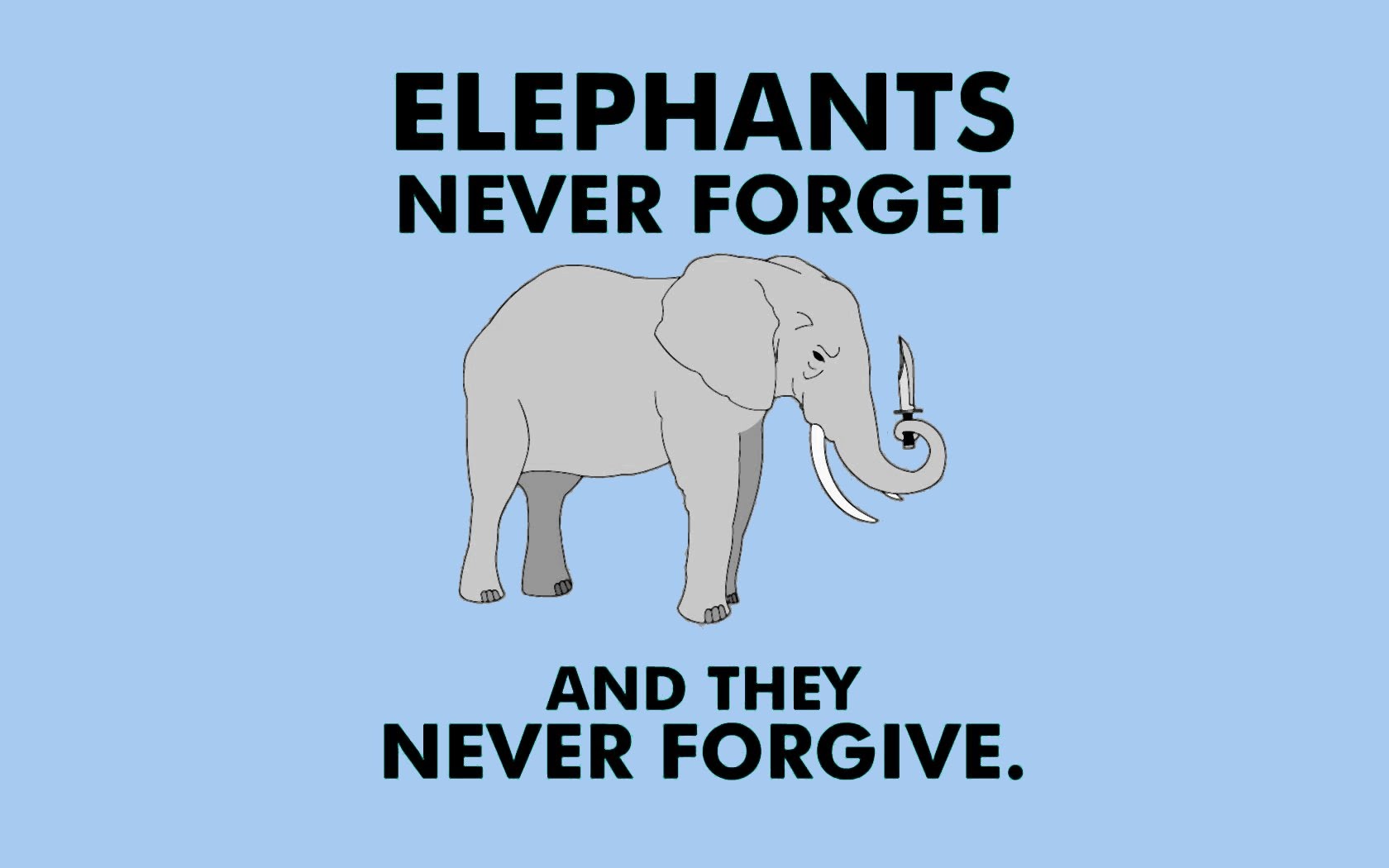
The meme is a humorous image with a cartoon elephant holding a small notebook and pencil, with the caption "Elephants never forget... and they never forgive" playing on the common phrase "elephants never forget". The text is a clever twist on the original phrase, implying that elephants not only have excellent memory but also hold grudges.
detailed-analysis (gemma3-27b-vision)
Okay, here's an analysis of the image, divided into the sections you requested, only including those that are applicable and relevant.
Visual Description
The image features a light blue background and a stylized drawing of a gray elephant in profile. The elephant is depicted with relatively simple lines, suggesting a cartoonish or illustrative style. Its tusks are prominent and curved. Above the elephant are the words "ELEPHANTS NEVER FORGET" in large, bold, black letters. Below the elephant are the words "AND THEY NEVER FORGIVE." also in large, bold, black letters. The overall impression is of a declarative statement or a meme-like visual.
Foucauldian Genealogical Discourse Analysis
This image presents an intriguing case for a Foucauldian analysis. The seemingly simple statement, “Elephants Never Forget and They Never Forgive” isn’t just a statement about animal cognition. Instead, it produces a particular discourse around memory, justice, and power.
- Discourse Formation: The statement establishes a discourse linking memory to revenge. It associates the animal ‘elephant’ with specific qualities of long memory and vengefulness. This isn’t a "natural" truth about elephants, but a constructed idea that gains meaning through repeated utterance and symbolic association.
- Power/Knowledge: The statement subtly reinforces a notion of justice based on retribution rather than forgiveness. The 'elephant' as a symbol of unwavering memory and unforgiving nature potentially serves as a justification for holding grudges or demanding retribution in human interactions. This reveals a power dynamic where memory is framed as a tool for maintaining control or enacting justice.
- Genealogy: Tracing the genealogy of this idea, one might find its roots in various cultural narratives, folklore, and stories where animals are assigned human-like qualities and used to moralize. Examining how this association with elephants developed over time, and what historical and social factors contributed to it, would reveal the underlying power relations that shaped the idea.
- Subjectification: The phrase may also encourage certain subjectivities within humans: "we must not forget," or "we must always remember injustices done to us." This creates a framework where acting on remembered slights becomes normalized.
Critical Theory
The image can be approached through a Critical Theory lens as it questions and deconstructs commonly held assumptions about memory and justice.
- Ideology: The statement subtly naturalizes a specific ideology around justice—one that prioritizes retribution over reconciliation. It presents 'forgetting' as a morally problematic act, potentially serving to maintain existing power structures.
- Domination: The notion of an animal possessing an unyielding memory and a desire for revenge can be viewed as symbolic of a broader pattern of domination and control. By associating these traits with an animal, the statement potentially reinforces the idea that power is linked to the ability to hold onto grievances and exert control.
- Deconstruction: The seemingly straightforward statement invites deconstruction. What does it mean to 'forget'? Is forgetting always negative? Is justice necessarily about retribution? Deconstructing these assumptions reveals the underlying ideological complexities.
- Cultural Critique: The image participates in a culture that often values remembering traumas and injustices, but rarely explores alternative paths to healing or reconciliation.
Marxist Conflict Theory
While not immediately obvious, a Marxist interpretation is possible, though somewhat less direct.
- Power Dynamics: The unyielding memory of the elephant could be seen as an allegory for the persistence of class consciousness or historical grievances among the oppressed. The elephant’s unwillingness to forgive might represent the sustained resistance of a marginalized group against those in power.
- Resource Control: One could stretch the interpretation to suggest the “memory” symbolizes the retention of historical knowledge about exploitation and the refusal to let it be forgotten (and thus allowing further exploitation).
- Conflict Perpetuation: The message reinforces the idea that conflict can perpetuate itself if grudges are held and forgiveness is not extended. This aligns with a Marxist understanding of how class struggle can be prolonged.
Important Note: The Marxist analysis is a bit of a reach in this case, as the image doesn’t explicitly address class conflict or economic exploitation. However, it’s possible to interpret it metaphorically within that framework.
Let me know if you'd like any of these analyses expanded or explored further!
simple-description (llama3.2-vision)
This meme is a humorous illustration of an elephant with a knife stuck in its trunk, accompanied by the text "Elephants never forget... and they never forgive." The image is meant to be a playful and ironic take on the common phrase "elephants never forget," implying that not only do they remember things, but they also hold grudges.
tesseract-ocr
ELEPHANTS NEVER FORGET ays AND THEY NEVER FORGIVE.