First Seen
2023-05-10T21:03:36+00:00
simple-description (llama3.2-vision_11b)
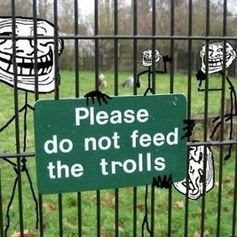
The meme is a humorous image of a sign that says "Please do not feed the trolls" with a picture of a troll's face next to it. The sign is often used in online communities to warn users that responding to or engaging with trolls can lead to negative interactions and conflicts.
detailed-analysis (gemma3-27b-vision)
Okay, let's break down this image through the requested theoretical lenses. It's a surprisingly rich image for a simple sign!
Visual Description
The image depicts a dark, metal fence with simplistic, black and white line drawings of the "trollface" meme (often called "rage comics") affixed to it. The drawings are scattered along the fence. In the center, a green sign with white lettering reads “Please do not feed the trolls.” The background is blurred greenery, suggesting a park or outdoor space. The visual aesthetic is a blend of bureaucratic signage and internet culture. There’s a clear juxtaposition between the “official” appearance of the sign and the informal, meme-based drawings.
Foucauldian Genealogical Discourse Analysis
This image is ripe for a Foucauldian analysis. The sign itself is a manifestation of power/knowledge. The act of placing the sign implies a perceived problem (internet trolls). The discourse of "trolls" as needing to be "fed" or not, operates as a regime of truth. The sign attempts to discipline behavior – to regulate the interaction between individuals and online entities.
A genealogical approach would ask how this category of "troll" came to be. When did online provocateurs become categorized and thus controllable through language and regulation? It isn’t inherently “bad” to engage with dissenting opinions, but the categorization as "troll" creates an othering that justifies silencing or ignoring. The sign isn't about genuine communication, but about controlling who is deemed worthy of engagement and by what terms. The very act of labeling something as a "troll" and issuing a directive about feeding them evokes animalistic control—it treats online actors as something to be managed rather than engaged with. The image highlights how discourse shapes behavior and creates regimes of control—even in the ostensibly open space of online interaction.
Critical Theory
The image speaks to the Frankfurt School’s critique of the culture industry and the commodification of everything, including online engagement. The “troll” has become a recognizable cultural figure – a character within the digital landscape. The sign can be seen as a symptom of the rationalization of online interactions, a desire to impose order on a chaotic digital sphere.
The image suggests a growing anxiety about authentic connection. “Feeding” the trolls, in this context, could be interpreted as engaging with bad faith arguments, amplifying negativity, or being drawn into unproductive online debates. The sign, then, is a call to withdraw from certain forms of online engagement, a self-imposed censorship disguised as pragmatic advice. This withdrawal, however, arguably reinforces the power of those who are generating the harmful content—by giving them free rein in the absence of critique. This ties into Adorno and Horkheimer's ideas of the “culture industry” producing passivity and conformity.
Marxist Conflict Theory
From a Marxist perspective, the image reveals an underlying power struggle. The “trolls” represent a form of disruptive, albeit often antagonistic, agency within the digital sphere. The sign, and the implied authority behind it, attempts to suppress this agency.
The act of “feeding” the trolls could be interpreted as engaging with dissenting voices, challenging dominant narratives. The sign, then, functions as a tool to maintain the status quo – to silence opposition and control the flow of information. It’s a way of “managing” conflict rather than addressing its root causes. The implied power structure suggests those with the authority to erect the sign (and, by extension, control the discourse) benefit from the suppression of alternative voices.
Postmodernism
The image exemplifies several key postmodern themes. The juxtaposition of the bureaucratic sign with the anarchic, meme-based drawings highlights the breakdown of grand narratives and fixed meanings. The very concept of a "troll" is a socially constructed category—it has no inherent reality. It's a label applied to a behavior, and the meaning of that behavior is constantly shifting.
The image also reflects the blurring of boundaries between online and offline worlds. The sign, placed in a physical space, refers to a purely digital phenomenon, suggesting the increasing permeability of these formerly distinct realms. It's a comment on the increasingly mediated nature of reality. Furthermore, the meme format—decontextualized and endlessly reproduced—is a prime example of postmodern simulacra—a copy without an original.
Queer Feminist Intersectional Analysis (Less Directly Applicable, but Possible)
While the image isn't immediately about gender or sexuality, a queer feminist lens can reveal interesting subtexts. Online harassment is disproportionately directed toward marginalized groups, especially women, people of color, and LGBTQ+ individuals. The "trolls" often operate as enforcers of patriarchal and heteronormative norms, attempting to silence or intimidate those who challenge them.
The “don’t feed the trolls” message can be seen as a warning to those vulnerable to online harassment—to protect themselves by avoiding engagement. While this can be a valid self-preservation strategy, it also places the burden of responsibility on the targets of harassment rather than on the perpetrators. It obscures the systemic power dynamics that enable online abuse. An intersectional analysis would highlight the ways in which online harassment intersects with other forms of oppression, creating compounded vulnerabilities for marginalized individuals. The image could be interpreted as a tacit acceptance of the status quo—a resignation to the reality of online abuse rather than a commitment to dismantling the structures that enable it.
Hopefully, this breakdown provides a comprehensive analysis of the image through the requested theoretical frameworks! Let me know if you'd like me to elaborate on any particular point.
simple-description (llama3.2-vision)
This meme is an image of a "do not feed the trolls" sign, a common warning found at parks and other public areas, but it has been altered to include the face of a troll character from the internet. The sign now reads "do not feed the trolls" but the text is replaced with "do not feed the trolls" in a font that looks like it's been written in a messy, handwritten style, similar to a troll's online persona.
tesseract-ocr
1} | , Nk seal eae a aa aed bt | 44} A\\) Ee Le Eur: io NG “the tro Is Niemen ||