First Seen
2023-05-10T21:03:36+00:00
simple-description (llama3.2-vision_11b)
The meme is a humorous take on the popular TV show "Game of Thrones" where a character named Jon Snow says "I know" in a moment of dramatic tension. The meme is a play on this phrase, replacing it with "I know" with "I can" and adding the phrase "I can" in a similar way to the original quote.
detailed-analysis (gemma3-27b-vision)
Okay, here's an analysis of the image, broken down into sections based on the theoretical frameworks you requested. I’ll flag where a section isn’t applicable.
Visual Description
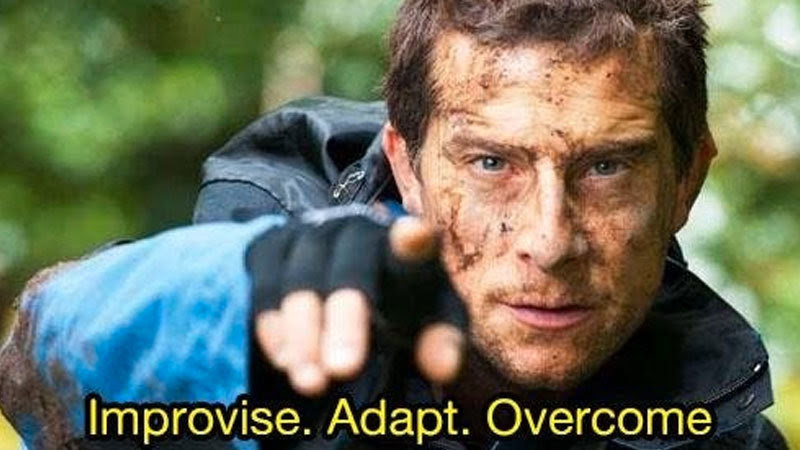
The image depicts a man in a physically aggressive stance. He is of European descent, with short dark hair and appears to be covered in dirt or mud. There are visible marks, possibly scrapes or bruises, on his face and potentially body. He's wearing a dark-colored tactical jacket, and his hand (wearing a black glove) is forcefully grabbing the shoulder/back of someone wearing a bright blue shirt – the individual is partially obscured. The background is blurred greenery, suggesting an outdoor environment. His facial expression is stern and intense, suggesting determination or even rage. Below the image, the words “Improvise. Adapt. Overcome.” are displayed in white text. The image strongly implies a struggle or confrontation, and conveys a sense of physical challenge and resilience.
Foucauldian Genealogical Discourse Analysis
The image and its accompanying phrase ("Improvise. Adapt. Overcome") can be examined through a Foucauldian lens. The phrase itself operates as discourse, a system of thought and language that constructs reality. It’s a military/survivalist mantra, which immediately embeds it within specific power relations.
- Power/Knowledge: The phrase is closely tied to the exercise of power, specifically the power to survive in a harsh environment. This isn't just physical power; it’s a regime of truth that claims this way of thinking is necessary to succeed, even "noble". The image visually performs this truth – the man demonstrates the ability to improvise, adapt, and overcome through physical action.
- Genealogy: Tracing the history of this phrase reveals it's linked to military training and survivalism. This isn’t a naturally occurring philosophy but a constructed one, born of specific historical needs and ideologies. Looking at its emergence within military doctrine and survivalist movements would reveal how it's been used to justify certain actions and behaviors.
- Discipline & Panopticism: The visual of the man’s intense focus and physical control suggests a disciplined body, a product of training and self-regulation. This connects to Foucault’s concepts of discipline and the panopticon—the internalizing of control mechanisms. The man is, in effect, a self-panoptic figure—he is always regulating himself to meet the demands of survival.
Critical Theory
From a Critical Theory perspective, this image represents the perpetuation of hegemonic masculinity and the glorification of struggle.
- Ideology: The phrase "Improvise. Adapt. Overcome" can be seen as an ideological statement reinforcing the idea that strength, resilience, and control are the most valuable traits. It encourages a worldview where overcoming obstacles—often through force—is paramount.
- Domination: The image presents a clear power imbalance—the man actively imposing himself on another individual. This reinforces a hierarchical understanding of the world, where one entity is positioned as dominant and the other as subordinate.
- Commodification of Struggle: The phrase, and the image itself, could be seen as commodifying struggle. It’s packaged as a motivational message, stripped of the complex realities of actual hardship and transformed into a marketable sentiment. It is "selling" a certain way of being as desirable, without acknowledging the systemic issues that create struggle in the first place.
- Instrumental Reason: The image embodies the notion of instrumental reason, where the focus is on effectiveness and efficiency in achieving a goal, regardless of ethical considerations. The man is solely focused on overcoming the obstacle (the person in blue), potentially disregarding the well-being or agency of the other individual.
Marxist Conflict Theory
A Marxist interpretation would view the image as a manifestation of class struggle and the inherent contradictions within capitalist society.
- Power Dynamics: The image displays a clear power dynamic between the man and the person he’s grappling with. This can be interpreted as a microcosm of the broader class struggle, where the dominant class (represented by the man) exerts control over the subordinate class.
- Alienation: The act of grappling or dominating could be seen as a manifestation of alienation—a disconnection from one’s own humanity and from others. The man is so focused on overcoming the obstacle that he loses sight of the other person's individuality and agency.
- Ideological Control: The phrase "Improvise. Adapt. Overcome" can be seen as part of the dominant ideology used to justify the exploitation and oppression of the working class. It encourages a mindset of individual resilience and self-reliance, which can mask the systemic issues that perpetuate inequality.
Postmodernism
From a postmodern perspective, the image deconstructs traditional notions of heroism, masculinity, and strength.
- Simulation & Hyperreality: The image, especially when coupled with the slogan, can be seen as a simulation of strength and resilience, devoid of genuine meaning. It presents a hyperreal representation of struggle, divorced from the complex realities of human experience.
- Deconstruction of Meaning: Postmodernism would question the inherent meaning of the phrase “Improvise. Adapt. Overcome.” It challenges the notion of a single, overarching truth, suggesting that the meaning is fluid and contingent upon context and interpretation.
- Questioning Grand Narratives: The image challenges grand narratives of heroism and struggle, exposing their underlying power dynamics and ideological biases. It suggests that there is no singular path to overcoming obstacles, and that success is often contingent upon factors such as luck, privilege, and social context.
Queer Feminist Intersectional Analysis
This framework is less directly applicable, but can still offer insights.
- Toxic Masculinity: The image embodies a performance of hypermasculinity—the aggressive stance, the physical dominance, the lack of emotional expression. Queer feminist analysis would critique this performance as harmful and oppressive, reinforcing traditional gender roles and perpetuating violence against marginalized groups.
- Power & Vulnerability: The image highlights the power imbalance between the man and the person he’s grappling with. Queer feminist analysis would question who is positioned as vulnerable and who is positioned as dominant, and how these positions are reinforced by social norms and power structures.
- Intersectional Power Dynamics: While the image itself doesn’t reveal explicit information about race, class, or other social categories, a queer feminist intersectional analysis would acknowledge that these factors intersect to shape the power dynamics at play. The man’s ability to improvise, adapt, and overcome is likely influenced by his privilege and access to resources, while the person he’s grappling with may face systemic barriers to survival.
I hope this analysis provides a comprehensive overview of the image from various theoretical perspectives. Let me know if you’d like me to elaborate on any particular aspect!
simple-description (llama3.2-vision)
This meme features a photo of Bear Grylls, a British survivalist, with a serious expression. The text "Improvise. Adapt. Overcome." is written below the image, which is a phrase often associated with the US military's core values. The meme is likely referencing the idea that one must be able to adapt and overcome in challenging situations, much like Bear Grylls does in his survival shows.
tesseract-ocr
toa - J Pa SS we oe ae p J A ” =», ath ‘ “ oe i? LS Gia. -« ¥ ; a -. . eerercon PNM Pray ee » Improvise. Adapt. Overcome