First Seen
2023-05-10T21:03:36+00:00
simple-description (llama3.2-vision_11b)
This meme is about a person stealing a meme from the internet and presenting it as their own. The image likely shows a person holding a "meme" (a humorous image or piece of content) and the text "I can meme" or a similar phrase, implying that they're taking credit for someone else's work. The meme is poking fun at the practice of stealing and repurposing memes without giving credit to their original creators.
detailed-analysis (gemma3-27b-vision)
Okay, let's break down this meme using the requested theoretical frameworks.
Visual Description
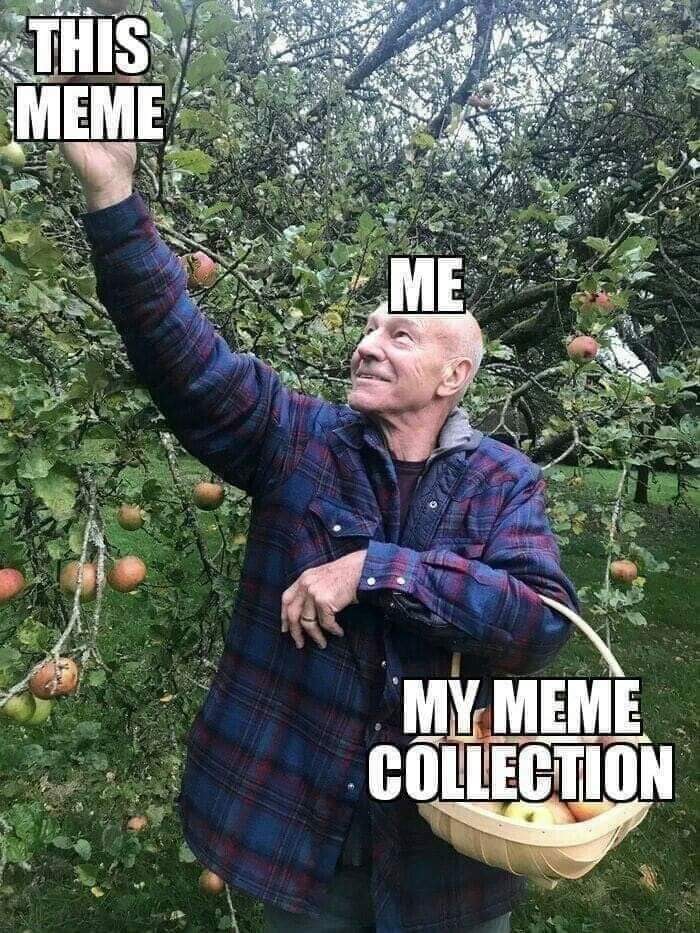
The image features an older man, likely in his 70s or 80s, standing beneath an apple tree laden with fruit. He is reaching up with his right arm, seemingly attempting to pluck an apple. He holds a woven basket in his left hand, presumably to collect the apples. He is smiling brightly. The overall composition creates a pastoral, somewhat whimsical feel. Text overlays the image: "THIS MEME" points towards the tree, "ME" is centered on the man's face, and "MY MEME COLLECTION" labels the basket.
Foucauldian Genealogical Discourse Analysis
The meme plays with the discourse surrounding “memes” and collecting. Historically, "memes" evolved from Dawkins’ concept of cultural transmission—units of culture passed on by imitation. Over time, this became digitally reconfigured, moving from specific ideas to a broader label for humorous internet images, videos, or phrases.
This meme can be seen as a genealogical analysis of the ‘meme collector’ identity. It positions the man (and by extension, the individual posting the meme) as a figure actively gathering memes like apples from a tree. This positions memes not as emergent phenomena but as a resource to be obtained and possessed. The act of collecting implies a power dynamic - the collector holds authority over the "harvest", creating a curated assemblage. It reveals the power dynamics involved in digital culture, and the assertion of ownership over circulated content.
The meme implies the collector is a figure of authority over the "harvest" of internet culture. This establishes a genealogy of the "meme collector," starting with the original concept of cultural transmission and moving toward a digitized, curated and owned collection.
Critical Theory
From a Critical Theory perspective, this meme can be understood as reflecting the commodification of culture. The "meme" itself, originally intended as a form of decentralized, participatory culture, is being positioned as something to be collected – and thus, to a degree, owned. This aligns with Adorno and Horkheimer’s ideas about the “culture industry” – how seemingly creative and spontaneous forms of expression are often absorbed into a system of mass production and consumption.
The basket, representing “My Meme Collection,” becomes a symbol of this ownership. It suggests that even online, open-source content is being privatized in the consciousness of the collector. The meme subtly critiques this tendency, highlighting how the playful, collaborative nature of internet culture is gradually replaced by a possessive, consumerist approach.
Marxist Conflict Theory
From a Marxist perspective, this meme demonstrates a microcosm of class dynamics. The "meme tree" represents the collective, open-source cultural production of the internet – a shared resource available to all. The collector, however, seeks to appropriately those shared resources (the memes) and claim them as his own – the basket symbolizing the accumulation of cultural capital.
This is analogous to the capitalist drive for accumulation. The collector isn't creating the memes, but rather profiting (in a symbolic sense – gaining social capital through curated content) from the labor of others. The meme subtly highlights the inherent conflict between collective creation and individual appropriation, reflecting the broader struggles over resources and power in capitalist society.
Postmodernism
The meme embodies several key features of postmodernism. First, it’s highly meta: it’s a meme about memes, self-referential in its construction. This breaks down the traditional boundaries between "original" content and derivative content, emphasizing the intertextuality and constant remixing of digital culture.
Second, the meme deliberately plays with simulacra and simulation. The “meme collection” in the basket isn't a collection of “real” cultural artifacts, but rather representations of representations – a hyperreality. The act of collecting is therefore divorced from any authentic connection to the memes themselves.
Third, it utilizes a deliberately ambiguous, ironic tone. The smiling man, reaching for more memes, isn’t necessarily presented as a positive figure – there’s a subtle suggestion of absurdity and excess. This embodies postmodernism’s embrace of irony, parody, and fragmentation.
Queer Feminist Intersectional Analysis
While not directly central, a Queer Feminist Intersectional analysis can add another layer. Historically, the act of collecting has often been associated with patriarchal systems of ownership and control—collecting objects, even people, often as a display of power. The meme’s use of a smiling older man could be read as reinforcing this historical power dynamic. The image normalizes the older white male gaze as the central figure of cultural consumption.
Additionally, the meme indirectly engages with the issue of authorship. In online spaces, the origins of memes are often obscured or contested. The meme collector, by claiming a "collection," can erase the contributions of those who created or shared the original content, particularly marginalized voices. Intersectionally, this erasure can disproportionately affect individuals from underrepresented groups whose creations are often appropriated or ignored. However, the analysis remains weak, given the image does not explicitly denote gender, race, or sexuality.
I hope this breakdown is comprehensive and helpful! Let me know if you would like me to elaborate on any particular aspect or explore additional theoretical frameworks.
simple-description (llama3.2-vision)
The meme features a photo of an old man picking apples from a tree. The text "This meme" appears at the top, while "My meme collection" is at the bottom. The image is humorous because it implies that the old man is proud of his extensive collection of memes, but is also struggling to keep up with the constant influx of new ones.
tesseract-ocr
S| A A es Shc a ee epee ge oc : r 4 SS Ree geet EET SON! Mocca p De Lg oe a ee oe as Ail ai 5) kan, Ree hee ad ors [LS it Slate ere tae i ae e eh a haa a 8 lee ee ye pee SL ath oH pA eile ket “% ae Sn eae Seg ee won” gr ee rola saree Set aos ye gl ne ae ge eo UL Ne ee ae SR AS ery Ate % eae eek ee oe te ee, < ae PP As Ae Re... Wee Pa a Bs ate 4 iS sf ae <y See ® = Oe . Sy a r ae OS wee eee. Bae alge es “ees “ae > Lee eos A 1p? i Bag 9S ew . fe. as x e ) : < Siew og) {= ay 4 85 ae Oe eof iE ee 3 “ a ra et p i \\ cy ts Po: ee ges : » Naa) a he 4 - A a s ee ee 5 c| zs PG GE ad TTA CH 2 je Ra s a a SNe a ess ie cy : : ¢ c igs . > es