First Seen
2023-05-10T21:03:36+00:00
simple-description (llama3.2-vision_11b)
The meme is a play on the phrase "all your base are belong to us," a classic internet meme from the early 2000s. The image shows a character from the video game Star Trek: The Next Generation, Captain Jean-Luc Picard, with a caption that says "I find your lack of memes disturbing" in a style reminiscent of the "all your base" meme. The meme is poking fun at the idea that someone is trying to steal a meme, and the caption is a humorous way of expressing frustration at the situation.
detailed-analysis (gemma3-27b-vision)
Okay, here's an analysis of the image/meme, broken down into relevant sections as requested. Not all sections will apply; I'll skip those where a meaningful analysis isn't possible.
Visual Description
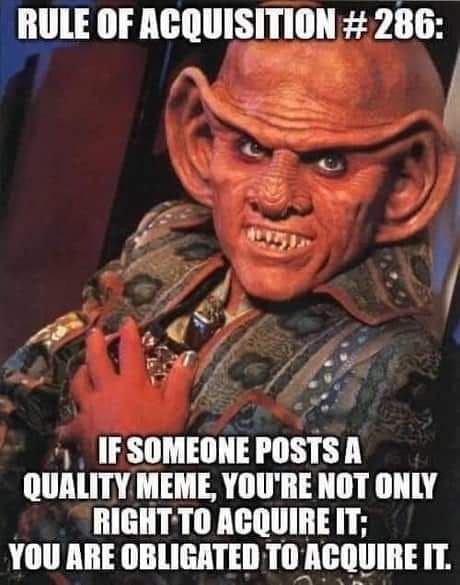
The image features a close-up of the Ferengi character Rom from Star Trek: Deep Space Nine. He is depicted with a fierce, grasping expression, his hand reaching out as if to seize something. He has prominent ears and exaggerated facial features consistent with the Ferengi’s alien design. The background is blurry and suggests a dimly lit interior, likely a Ferengi ship or station. Overlaid text at the top reads "RULE OF ACQUISITION #286." Below the image is the text: "IF SOMEONE POSTS A QUALITY MEME, YOU’RE NOT ONLY RIGHT TO ACQUIRE IT; YOU ARE OBLIGATED TO ACQUIRE IT." The overall aesthetic is intentionally over-the-top and humorous, relying on the existing characterization of the Ferengi as relentlessly materialistic.
Foucauldian Genealogical Discourse Analysis
This meme can be approached through a Foucauldian lens by examining the discourse of memetic culture and how it constructs notions of “value” and “ownership.” The “Rule of Acquisition” format itself is a constructed system of rules—a mini-discourse—within the Star Trek universe, focused entirely on profit and accumulation. This meme appropriates that discourse and applies it to a modern context: the sharing and reception of memes.
Foucault's genealogy investigates how knowledge and power are intertwined. In this case, the power dynamic is subtle but present. "Quality" is not an objective measure, but a constructed standard determined by the collective (the online community). The meme asserts an obligation to “acquire” (re-share, save, etc.) something deemed “quality” according to this collective judgment. This "obligation" isn't legal or moral, but operates as a social norm created and reinforced within memetic culture. By presenting this as a "Rule," the meme playfully mimics the Ferengi’s rigid system of economic laws, thus highlighting how even seemingly frivolous online behavior is subject to its own set of governing principles. The meme is, therefore, a meta-commentary on the rules that govern online attention and engagement.
Critical Theory
This meme speaks to the commodification of attention in contemporary digital culture. Drawing on the Frankfurt School's critique of the "culture industry," we can see the meme as reflecting how even humorous content is subject to the pressures of exchange and accumulation. The "quality meme" becomes a kind of "cultural capital" - something valuable within the online ecosystem.
The obligation to acquire it is a subtle form of ideological conditioning. It reinforces the idea that constant consumption and sharing are not merely permissible, but necessary to participate in online culture. The meme isn't about enjoying a humorous image, it's about circulating it, adding to its value through engagement and shares. This contributes to the endless cycle of content creation and consumption that characterizes the digital age, mirroring the Ferengi's relentless pursuit of profit.
Marxist Conflict Theory
From a Marxist perspective, this meme encapsulates the inherent contradictions of late-stage capitalism. The Ferengi, as a species obsessed with profit, represent the ultimate expression of capitalist drive. The "Rule of Acquisition" highlights the exploitation of value – in this case, the value of a humorous image.
The meme can be interpreted as a comment on the "attention economy," where online engagement is a scarce resource. The "obligation" to acquire a quality meme implies a competition for this resource. Those who share/repost quickly gain "social capital" (likes, shares, recognition), while those who miss out are left behind. This creates a form of symbolic class conflict within the online community. The meme ironically highlights the absurdity of applying cutthroat Ferengi logic to something as trivial as a meme, yet simultaneously underscores the pervasive influence of capitalist ideology in all aspects of modern life.
Postmodernism
The meme exemplifies several key tenets of postmodernism: intertextuality, parody, and the blurring of boundaries between "high" and "low" culture.
- Intertextuality: The meme relies on the viewer’s familiarity with Star Trek and the Ferengi to generate meaning. It weaves together elements from a science fiction television show with contemporary internet culture.
- Parody: It parodies the Ferengi’s relentless materialism and applies it to the realm of memes, creating a humorous and ironic effect.
- Blurring Boundaries: It collapses the distinction between entertainment (a television show) and communication (internet memes). The meme is both a reference to Star Trek and a statement about online behavior.
Furthermore, the meme's self-referentiality (a rule about memes referencing a rule within a fictional universe) is characteristically postmodern. It acknowledges its own constructed nature and plays with the boundaries of reality and representation. The constant re-sharing of the meme itself reinforces the idea that meaning is not fixed, but constantly negotiated and re-created through circulation.
Queer Feminist Intersectional Analysis
This analysis is less directly applicable than the others, but there are some potential connections. The Ferengi, in Star Trek, are consistently portrayed as patriarchal, misogynistic, and deeply invested in traditional power structures. Their "Rules of Acquisition" often reflect these biases.
The meme, while seemingly harmless, inadvertently reinforces this problematic framework. The aggressive, grasping imagery and the emphasis on acquisition can be seen as mirroring patriarchal attitudes towards ownership and control. The meme implicitly equates "value" with something to be possessed and exploited.
An intersectional analysis might consider how this imagery resonates with broader societal power dynamics and potentially normalizes exploitative behaviors. However, it's important to note that the meme's primary function is satirical, and a rigid application of feminist critique could overlook its comedic intent. The meme could be read as a critique of Ferengi values, but it's also possible that it inadvertently reinforces them.
Let me know if you'd like me to elaborate on any of these sections, or analyze the meme from a different perspective!
simple-description (llama3.2-vision)
This meme features an image of a character from the Star Trek: Deep Space Nine series, a Klingon named Gowk
The text at the top of the image reads: "Rule of Acquisition #286: If someone posts a quality meme, you are obligated to acquire it." The text at the bottom reads: "You are not obligated to acquire it."
tesseract-ocr
RULE OF ACQUISITION #286: a / ya a Ce Ze ‘ rae i ey PL Sey | QUALITY MEME, YOU'RE NOT ONLY RIGHT-TO ACQUIRE IT: POUT OUT