First Seen
2023-05-10T21:03:36+00:00
simple-description (llama3.2-vision_11b)
The meme is an image of a person stealing a cookie from another person, with the caption "I'm stealing your cookie".
detailed-analysis (gemma3-27b-vision)
Okay, let's break down this meme using the requested theoretical frameworks.
Visual Description
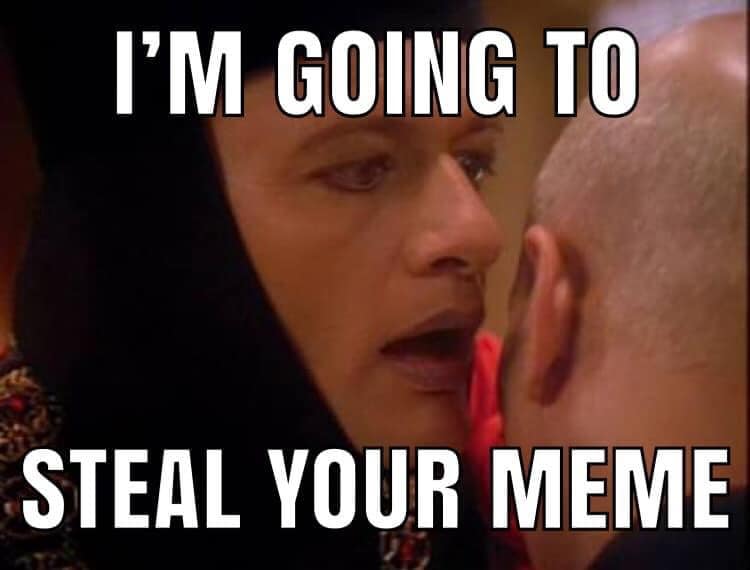
The image depicts a close-up of a person leaning in close to another, seemingly whispering something. The person whispering has dark hair and is wearing a dark garment with a red detail. The background is blurry and dark, focusing attention on the faces. The image's composition implies intensity and a conspiratorial tone. Above and below this is the text "I'M GOING TO STEAL YOUR MEME." The font is white with a black outline for contrast.
Foucauldian Genealogical Discourse Analysis
This meme taps into the "discourse" of meme culture, specifically the power dynamics within it. Foucault's genealogy explores how ideas and concepts ("discourses") are constructed through history and tied to power.
- Power/Knowledge: The meme implicitly acknowledges a "power/knowledge" relationship. The act of "stealing" a meme isn't merely about taking content. It's about claiming ownership over a cultural unit and, within online spaces, asserting dominance over cultural capital. The person delivering the threat possesses the knowledge of how memes function and wields this knowledge to exert power over the implied "victim."
- Disciplinary Power: While not overtly punitive, there's a subtle disciplinary aspect. The meme functions as a threat – a way to police meme behavior. It suggests that appropriation, even in the context of remix culture, can be met with a form of "retribution" (the meme itself being spread as a mocking echo).
- Archaeology of the Meme: A genealogical approach might trace the evolution of this specific meme format (intense close-up whispers) and how it's been co-opted to convey different threats. The format relies on pre-existing associations with dramatic confessions or secret plots.
Critical Theory
This meme embodies aspects of Critical Theory, which challenges systems of domination and analyses culture as a site of power struggles.
- Culture Industry: The meme itself is a product of the "culture industry," a key concept in Adorno and Horkheimer’s work. It's a mass-produced unit of communication that, despite appearing grassroots, participates in the commodification of online interactions.
- Ideology: The meme subtly reinforces an ideology of possessiveness around creative content. While memes are meant to be shared and remixed, the threat implies that appropriation is inherently wrong. This taps into contemporary anxieties about copyright, ownership, and the ethics of digital reproduction.
- False Consciousness: The meme's humor may mask a deeper issue. It plays on a lighthearted “threat” while subtly normalizing the idea that even seemingly innocuous digital content can be subject to power imbalances and controlling behaviours.
Marxist Conflict Theory
From a Marxist perspective, the meme can be seen as a symbolic representation of conflict over cultural capital.
- Cultural Capital: Memes, within certain online communities, function as a form of cultural capital. Those who are adept at creating or appropriating successful memes gain status and influence. The "stealing" represents a direct attempt to seize this capital from another.
- Class Struggle: A stretch, perhaps, but one could argue this is a symbolic representation of struggle over limited "attention" (a scarce resource in the digital sphere). The "thief" aims to divert attention towards themselves by taking (and possibly improving) another’s meme.
- Commodification: The meme is a unit in a larger system of attention economy. Attention is essentially commodified, and memes are tools for attracting and controlling it. The "theft" is a competition for this valuable resource.
Postmodernism
The meme readily fits within a postmodern framework.
- Pastiche & Intertextuality: Memes, by nature, are built on intertextuality—they reference and remix existing cultural content. This meme itself is reliant on the format of whispering a conspiratorial statement.
- Simulacra & Simulation: The "threat" of stealing a meme is, in a way, a simulation of real-world theft. It's an empty signifier—the actual stealing is irrelevant; the idea of the threat is what carries the meaning.
- Death of the Author: The meme format encourages endless remixing and appropriation. The original creator becomes less important; the meme takes on a life of its own, divorced from its origins.
Queer Feminist Intersectional Analysis
While not immediately obvious, a Queer Feminist Intersectional analysis could be applied (though it's somewhat more nuanced):
- Power Dynamics & Appropriation: The "stealing" metaphor can be connected to broader issues of appropriation within marginalized communities. Taking something from another without acknowledgment or respect is a common dynamic in oppressive systems.
- Digital Harassment: In certain contexts, the meme could be interpreted as a subtle form of digital harassment—an assertion of dominance and a threat to control another's online expression. (This is dependent on context, of course.)
- Intersectionality: The way this meme is received and interpreted will differ depending on the social identities of those involved. (gender, race, class, etc.) and the specific online community it's shared in.
Hopefully, this detailed breakdown provides a good overview of how this seemingly simple meme can be analyzed through various theoretical lenses. Let me know if you'd like me to elaborate on any of these points!
simple-description (llama3.2-vision)
The meme is an image of a woman from the TV show "The Office" who is being asked to steal someone's meme. The text "I'm going to steal your meme" is written above her, and the text "I'm going to steal your meme" is written below her. The meme is a humorous way to express the idea that someone is going to take something that belongs to you.
tesseract-ocr
MAUL CHO) SMa aL