First Seen
2023-05-10T21:03:36+00:00
simple-description (llama3.2-vision_11b)
This meme is a humorous image of a character from the Star Trek franchise, Data, with a caption that pokes fun at the idea of a "data scientist" being a master of data analysis. The image is likely a screenshot from the show, with Data's face and a caption that reads "I'm not a data scientist, I'm a data scientist's worst nightmare".
detailed-analysis (gemma3-27b-vision)
Okay, here's an analysis of the image (the "Data is a tailor" meme) broken down into sections based on the requested theoretical frameworks. Some sections won't apply, and I'll explain why.
Visual Description
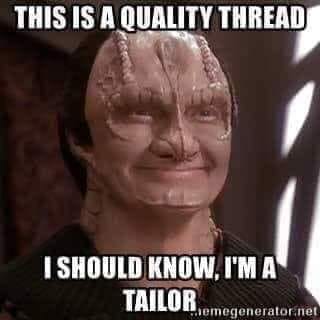
The image is a still from the science fiction television series Star Trek: The Next Generation. It features Data, an android character, with a slightly unsettling, knowing smile. His skin is visibly synthetic, and he has visible implants around his hairline. The background is dark and indistinct, likely a corridor of the starship Enterprise. The meme format consists of text overlaid on the image: “THIS IS A QUALITY THREAD” above Data’s head and “I SHOULD KNOW, I’M A TAILOR” below. The “meme generator.net” watermark at the bottom is a standard feature of the meme creation website. The image is presented in color. The expression on Data’s face contrasts with the absurd claim—an android being a tailor—creating humor.
Foucauldian Genealogical Discourse Analysis
This meme lends itself well to a Foucauldian analysis. Let's break down how:
- Discourse of Expertise: The phrase “I should know” positions Data as an authority. This relies on the discourse surrounding skill and craftsmanship, specifically in the realm of tailoring. Foucault would be interested in how this discourse is constructed and what power dynamics it supports. The absurdity of an android claiming tailoring expertise destabilizes this discourse.
- Genealogy of "Quality": The notion of "quality" isn't inherent. It’s historically constructed. Tracing the genealogy of "quality" in craftsmanship (and then its application to digital content, as in "quality thread") reveals how standards, values, and judgments are established and enforced. What does "quality" mean in the context of an internet discussion? Data, as an artificial being, is outside the natural (or even socialized) processes that would usually establish expertise.
- Power/Knowledge: The meme plays with the relationship between power and knowledge. Data’s claim doesn't derive from practical experience (he doesn't have hands to sew!), but from the assertion of knowledge. This highlights how knowledge can be performative—how simply saying you know something can grant you authority, regardless of truth. The image challenges who is authorized to declare something "quality."
- The Paradox of Artificial Expertise: The meme creates a paradox: can artificial intelligence truly know anything, and does that knowledge translate to practical skill? This disrupts the traditional link between knowledge and embodied experience.
Critical Theory
The meme can be interpreted through the lens of Critical Theory, specifically relating to the critique of technological rationality and the construction of identity.
- Technological Rationality: Data, as an android, embodies the apex of technological rationality. He's a machine designed for efficiency and logic. The meme subverts this by having him claim expertise in a traditionally craft-based and somewhat irrational field like tailoring. It questions whether technology can truly grasp (or replace) human skill, artistry, and the values associated with craftsmanship.
- Commodification of Skill: The internet "thread" is a form of digital production, akin to a modern "workshop." The meme could be seen as a commentary on the commodification of expertise in the digital age. Expertise becomes a product to be displayed and consumed, regardless of its authenticity. The assertion of skill becomes more important than the skill itself.
- Critique of Expertise: The meme is sarcastic, so it's a critique of the idea that expertise is inherently valuable or trustworthy. Anyone can claim to be an expert, and often the claim is more important than the actual knowledge.
Marxist Conflict Theory
While less direct, a Marxist reading can be applied.
- Labor and Skill: Tailoring represents a historical form of skilled labor. The meme could be interpreted as a playful commentary on the displacement of human labor by automation (embodied by Data). The android is positioned as replacing the tailor, suggesting a potential for conflict between human and artificial labor.
- Commodification of Discourse: The "quality thread" is also a form of digital labor. The meme suggests that in the attention economy, discourse itself (and the assertion of quality) becomes a commodity, bought and sold through engagement (likes, shares, etc.).
- Alienation: The fact that an android is making a claim about tailoring, a craft historically rooted in human creativity and skill, could be seen as a metaphor for the alienation of labor in a capitalist system. The inherent meaning and value of work are lost when it is performed by a machine.
Postmodernism
This meme is strongly postmodern.
- Pastiche and Irony: The juxtaposition of Data, a futuristic android, with the traditional craft of tailoring is inherently absurd and ironic. It’s a deliberate mixing of disparate elements.
- Deconstruction of Meaning: The meme deconstructs the idea of expertise. It challenges the notion that there's a stable, objective definition of "quality" or a clear connection between knowledge and skill.
- Simulation and Hyperreality: The "quality thread" is a simulation of expertise. It's an online persona claiming authority, divorced from any real-world basis. This mirrors the postmodern concept of hyperreality, where simulations become more real than reality itself.
- Playfulness and Self-Reflexivity: The meme is intentionally playful and self-reflexive. It acknowledges its own absurdity and invites the viewer to participate in the joke.
Queer Feminist Intersectional Analysis
This framework is the least directly applicable, but we can find a stretch.
- Challenging Traditional Skill Hierarchies: Historically, tailoring was often considered "women's work" and a less valued skill than other crafts. The meme, by having a non-human being (an android) claim expertise in this field, subverts traditional skill hierarchies and challenges the idea that expertise is inherently masculine or associated with specific genders.
- Deconstructing "Natural" Skillsets: Gender roles often dictate "natural" skillsets. The meme challenges this by presenting an android, outside the bounds of gender and biology, as possessing skill. It's a deconstruction of essentialist notions of skill.
- The Performance of Expertise: The claim of being a tailor is a performance. This can be linked to queer theory's emphasis on performativity – the idea that gender, identity, and even expertise are constructed through repeated acts.
In conclusion: This seemingly simple meme offers a surprisingly rich ground for analysis through multiple theoretical lenses. It engages with themes of expertise, technology, labor, meaning, and identity in a playful yet thought-provoking way. Postmodernism and Foucauldian discourse analysis are the most fruitful frameworks for understanding its complexities, but other perspectives can also illuminate its meaning.
simple-description (llama3.2-vision)
This meme features a character from the Star Trek: The Next Generation series, Lieutenant Commander Worf, with a humorous expression. The text overlayed on the image reads: "This is a quality thread. I should know, I'm a tailor." The meme is likely used to poke fun at the character's profession as a tailor, implying that he's not just a skilled warrior, but also a skilled tailor.
tesseract-ocr
ili a bs 5 teal f ae | Oca TC a,