First Seen
2023-05-10T21:03:36+00:00
simple-description (llama3.2-vision_11b)
This meme is a screenshot of a scene from the TV show "Friends," where Ross is explaining the concept of "we were on a break" to Rachel. The meme is captioned "when you delete a post and the algorithm still shows it to you." It's a humorous take on the frustration of trying to move on from a past relationship or social media post, only to have it still be visible to others.
detailed-analysis (gemma3-27b-vision)
Okay, let's break down this meme through various theoretical lenses.
Visual Description
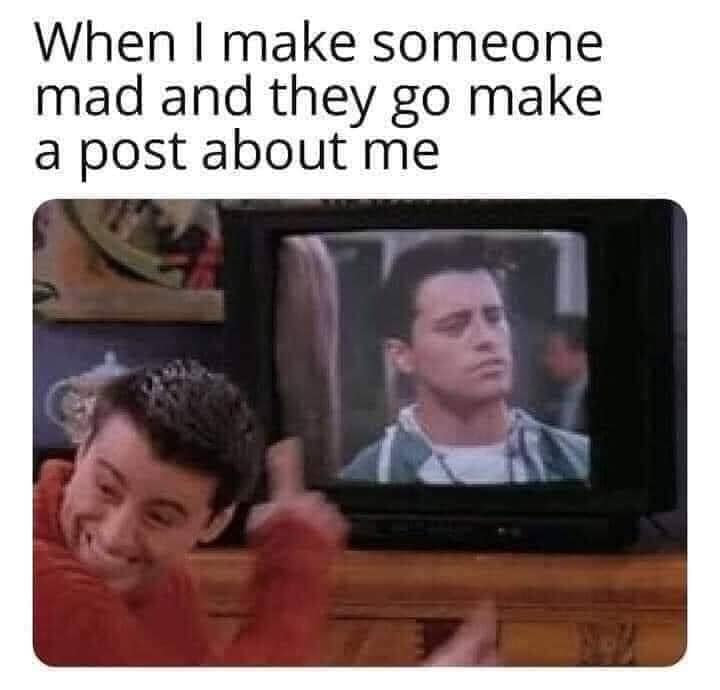
The image is a screenshot from the sitcom Friends. Joey Tribbiani is excitedly looking at a television screen. On the screen is a clip of Chandler Bing looking unhappy and judgmental. The text overlay reads: “When I make someone mad and they go make a post about me.” The composition of the image, with Joey's enthusiastic gaze directed towards the (negative) image of Chandler, is central to its comedic effect. It visually represents a sense of smug satisfaction at being the subject of someone else’s (public) grievance.
Foucauldian Genealogical Discourse Analysis
This meme touches on the discourse of online conflict and the construction of the self. Foucault would ask: How does the act of "making someone mad" and the subsequent "post" about it contribute to a system of power/knowledge?
- Power/Knowledge: The act of posting a complaint online isn't simply about expressing anger, but also a claim to be heard and to be recognized as aggrieved. This act of broadcasting establishes a power dynamic—the poster believes they have the right to publicly judge. The meme ironically subverts this by framing the target (Joey) as enjoying the attention, even the negative attention.
- Genealogy: A genealogical analysis might look at the historical trajectory of public shaming. From gossip in town squares to letters to the editor, to now social media posts, there's a lineage of publicly expressing dissatisfaction. Social media amplifies this, turning personal grievances into potentially viral events. The meme points to this evolution, where "making a post" is now the standard response to offense.
- Discipline/Panopticism: While not as direct, the knowledge that our actions could be subject to public scrutiny and documentation online introduces a form of self-discipline. The meme playfully acknowledges this, suggesting a comfort with being watched.
Critical Theory
The meme engages with elements of the culture industry and the commodification of conflict.
- Culture Industry: Adorno and Horkheimer argued the culture industry provides pre-packaged forms of entertainment and reinforces existing power structures. This meme is about the spectacle of conflict. It’s a self-aware acknowledgement that arguments are often performed for an audience. It's a metacommentary on the way disagreements are consumed as entertainment.
- Alienation: The meme indirectly suggests a degree of alienation. The primary response to being "made mad" isn't direct communication or resolution but the creation of a public spectacle. It points to a breakdown in authentic connection, replaced by the performative expression of emotion.
- The Public Sphere: Habermas theorized a “public sphere” where rational-critical debate could occur. The meme highlights how the modern “public sphere” of social media is often characterized by emotional outbursts and performative grievances, a distortion of its original intent.
Marxist Conflict Theory
From a Marxist perspective, the meme exposes underlying power dynamics even in seemingly trivial conflicts.
- Ideology: The meme hints at the ideology of individualism and self-expression. The immediate instinct to "post" about being offended reinforces the idea that individual feelings are paramount and must be publicly validated.
- Class & Visibility: While not explicit, access to social media (the platform for the "post") is linked to socioeconomic status. The ability to broadcast your grievances is a privilege, subtly reflecting the uneven distribution of power.
- Alienation and Exploitation of Emotions: The meme highlights the exploitation of emotions for engagement. The “post” is a commodity, designed to garner attention and potentially fuel further conflict.
Postmodernism
This meme is inherently postmodern in its self-referentiality and irony.
- Hyperreality: The meme suggests we're living in a hyperreal world where simulations and representations (the "post") are more important than the actual experience of being "made mad." The satisfaction derived by Joey comes from the awareness of being the subject of a social media drama, not from the original interaction.
- Irony & Parody: The meme’s humor derives from its ironic appropriation of the situation. It mocks the tendency to publicly vent grievances by framing the instigator (Joey) as pleased by the attention.
- Deconstruction of Meaning: The meme can be seen as a deconstruction of the meaning of conflict. It suggests that the content of the conflict is less important than the spectacle and performance surrounding it.
Queer Feminist Intersectional Analysis
This is harder to apply directly, but some connections can be drawn.
- Performative Suffering: The act of "posting" can be analyzed through a lens of performative suffering. While not necessarily malicious, it touches on the idea that some individuals may benefit (attention, validation) from presenting themselves as victims.
- Online Harassment & Power Dynamics: This meme exists within the context of online harassment. While the meme itself isn’t harassment, it's aware of the power dynamics inherent in online spaces where certain groups are disproportionately targeted.
- Visibility & Control: The act of posting and gaining attention can be understood as a form of control over one's narrative, but it can also make one vulnerable to further scrutiny or attack.
In Conclusion:
This seemingly simple meme is surprisingly rich in theoretical possibilities. It reflects contemporary anxieties about social media, power dynamics, and the increasingly performative nature of everyday life. Each theoretical lens illuminates different layers of meaning within the image and its textual overlay.
simple-description (llama3.2-vision)
The meme features a screenshot of Joey Tribbiani from the TV show "Friends" making a sarcastic face. The text above the image reads, "When I make someone mad and they go make a post about me." The meme is poking fun at the idea that someone might react to a perceived slight by sharing a public post about the person who made them mad.
tesseract-ocr
When | make someone mad and they go make a post about me oe 4 Gh.