First Seen
2023-05-10T21:03:36+00:00
simple-description (llama3.2-vision_11b)
The meme is a screenshot of a Star Trek: The Next Generation episode where Captain Jean-Luc Picard is trying to understand a joke. The image is captioned "When you finally understand a meme after 3 hours of research".
detailed-analysis (gemma3-27b-vision)
Okay, let's break down this meme using the requested theoretical lenses. It's a bit of a layered image, so there's room for interpretation.
Visual Description
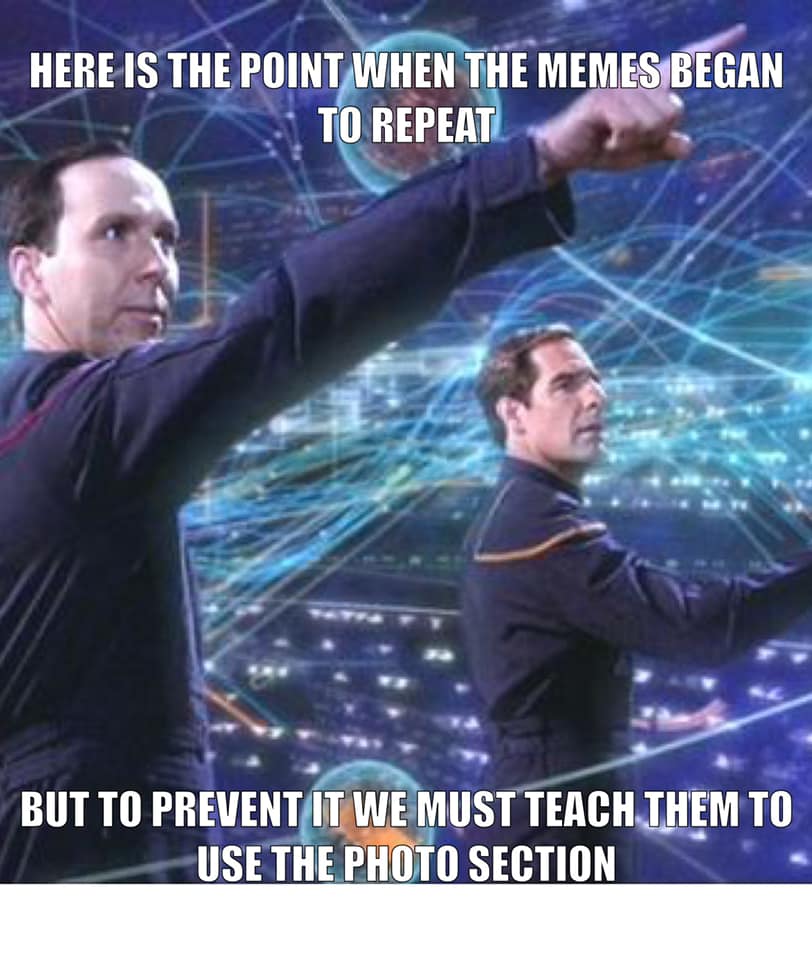
The image features a digitally manipulated composite of two figures, both portraying Captain Jean-Luc Picard from Star Trek: The Next Generation. The background is a visually striking swirl of bright blue and white light, resembling a nebula or wormhole effect. The composition places one Picard in shadow and the other more fully illuminated, creating a sense of duality or internal conflict. Text overlays the image: "HERE IS THE POINT WHEN MEMES BEGAN TO REPEAT" is above the figures, and "BUT TO PREVENT IT WE MUST TEACH THEM TO USE THE PHOTO SECTION" is below. The overall aesthetic leans towards the dramatic and slightly absurdist, typical of meme culture.
Foucauldian Genealogical Discourse Analysis
This meme lends itself well to a Foucauldian analysis. The claim that "memes began to repeat" can be seen as a moment in the discourse surrounding internet culture. The meme isn't presenting a truth, but rather producing a way of understanding the lifecycle of internet trends. The suggestion to "teach them to use the photo section" is interesting. Photo sections in platforms like Reddit or Imgur can be seen as sites of original content and a perceived break from endlessly recycled formats.
From a genealogical perspective, we can trace the history of memes, seeing how they initially represented subversive creativity. However, the meme itself points to a shift in that discourse – an acknowledgement that memes have become formulaic and predictable. Power operates not through suppression, but through shaping the very categories of thought. The meme implies that controlling the source of original images (the “photo section”) is a method of regulating the discourse itself, and potentially stifling the evolution of memes. This isn't about censorship, but about shaping the production of meaning. The power dynamic resides in those who dictate what's considered "original" or not.
Postmodernism
The meme is intensely postmodern. It revels in self-reference, meta-commentary, and the blurring of boundaries. The appropriation of a well-known science fiction character and placing them in a context wholly unrelated to the source material is classic postmodern pastiche. The statement about memes repeating is itself a commentary on the nature of repetition and the loss of originality in postmodern culture. The meme acknowledges the simulation and hyperreality that define the postmodern experience – memes are copies of copies, endlessly circulating and becoming increasingly detached from any “original” meaning. It embodies irony, cynicism, and a playful questioning of authenticity.
Critical Theory
From a Critical Theory perspective, we can view the meme as a commentary on the culture industry. The "repeating memes" can be interpreted as a symptom of the standardization and commodification of online culture. The internet, once imagined as a space of radical freedom and creativity, is increasingly governed by algorithms and market forces. The suggestion to direct attention towards the "photo section" can be read as a naive attempt to reclaim a sense of originality within a system designed to exploit and reproduce content. The meme subtly reveals the ideological underpinnings of internet culture—the illusion of choice, the constant pressure to consume, and the erasure of individual expression.
Note: This meme doesn't strongly lend itself to Marxist Conflict Theory or Queer Feminist Intersectional Analysis. While any image can be read through these lenses, those themes aren't central to the meme's message or inherent in the visual composition. One could force a reading about how the control of visual media (the photo section) contributes to broader power structures, but it would be a stretch.
Let me know if you’d like me to elaborate on any of these points or analyze the meme from a different angle!
simple-description (llama3.2-vision)
This meme features a photo of two Star Trek characters, Captain Sulu and Commander Tom
Kirk, pointing in opposite directions. The text above the image reads, "When you tell someone to use the photo section but they keep using the meme section."
tesseract-ocr
NaC Lea ice ey vd | f j _— x a am _ "A ™ j ' ri KE i pei a MMU ee Sanat ‘