First Seen
2023-05-10T21:03:36+00:00
simple-description (llama3.2-vision_11b)
The meme is a screenshot of a Twitter conversation between Elon Musk and a user who is asking him to delete a tweet. The user is jokingly asking Musk to "delete" his entire Twitter account, and Musk is responding with a sarcastic "delete" to the user's request. The meme is captioned "I can delete the entire site if you'd like"
detailed-analysis (gemma3-27b-vision)
Okay, let's break down this meme using the requested theoretical frameworks. It's a surprisingly rich image for analysis!
Visual Description
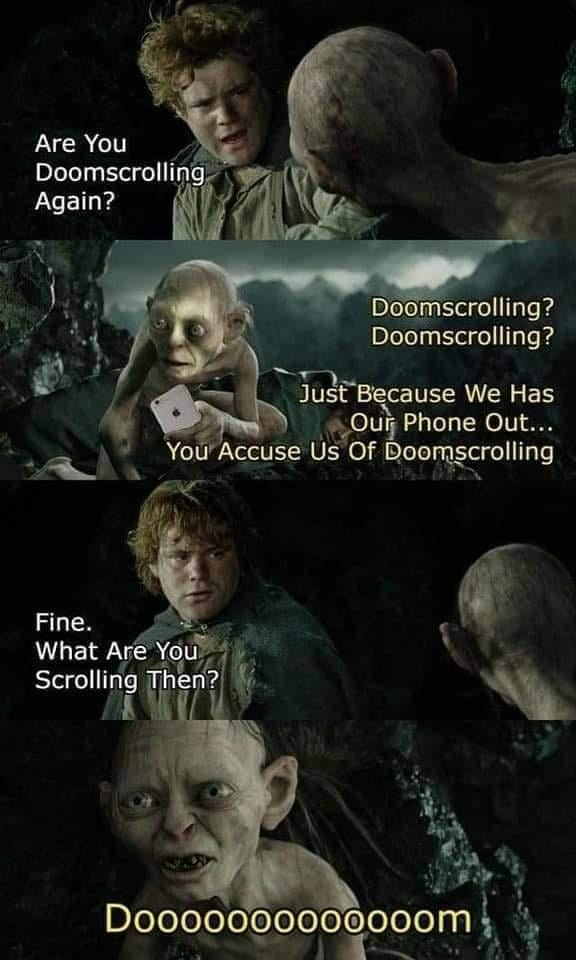
The image is a collage of stills from The Lord of the Rings films, featuring characters from various scenes and emotional states. The primary figures are Frodo, Sam, Gollum/Sméagol, and glimpses of others. The collage is overlaid with white text in a font that emulates meme formatting. The overall mood is dark and unsettling, given the source material's aesthetics. The central theme is framed as a dialogue around the modern practice of "doomscrolling" – the act of endlessly consuming negative news online. The composition feels like a frustrated internal conversation, or a passive-aggressive accusation. The final panel shows Gollum and the text "Dooooooo" indicating an overwhelming need to scroll.
Foucauldian Genealogical Discourse Analysis
This meme offers a fertile ground for Foucauldian analysis. Let's consider how discourses surrounding technology, mental health, and even addiction are being constructed and deployed.
- Discourse of ‘Doomscrolling’: The very term "doomscrolling" is a discourse—a system of thought, language, and practice that constructs a particular understanding of the world. It frames endless negative news consumption not as merely information seeking, but as a problematic behavior, potentially a symptom of anxiety, depression, or powerlessness. The meme acknowledges this discourse and, through its use of Lord of the Rings imagery, subtly interrogates it.
- Power/Knowledge: Foucault’s concept of power/knowledge suggests that power isn't simply repressive, but productive—it creates knowledge, which then reinforces power structures. The discourse of doomscrolling can be seen as a form of self-regulation. We are told this behavior is bad, leading us to internalize the judgment and perhaps feel shame about it. The meme questions this through the analogy of Gollum's obsession.
- Genealogical Trace: A genealogical approach would ask: How did this “doomscrolling” discourse emerge? One could trace a lineage from older anxieties about being “addicted” to news (newspapers, radio) to the modern form of digital consumption. The meme implies that the 'obsession' with negative news is older than technology, but manifested differently.
- Gollum as Archetype: Gollum acts as an archetype of addiction, obsession, and being consumed by something. The meme uses the archetype to highlight how the compulsion to scroll is an obsession.
Critical Theory
From a Critical Theory perspective, the meme can be read as a critique of late-capitalist society and its effects on the individual psyche.
- Alienation: The endless stream of negative news (often focused on events far removed from one’s immediate life) contributes to a sense of alienation – a feeling of separation from oneself, others, and the world. Doomscrolling can be seen as a symptom of this alienation, a desperate attempt to connect (however negatively) to a world that feels increasingly opaque and uncontrollable.
- Commodification of Attention: Capitalism relies on capturing and commodifying attention. The endless flow of news (even negative news) generates clicks, views, and data—all of which are valuable to corporations. The meme subtly implicates this system, suggesting that we are being kept scrolling, that our anxieties are being exploited for profit.
- Manufactured Consent: The information we receive through news (even “objective” reporting) is often filtered and framed in ways that serve dominant ideologies. Doomscrolling can be seen as a process of internalizing these ideologies, reinforcing existing power structures.
- Loss of Agency: When constantly bombarded with negative information, individuals may feel powerless to effect change, leading to a sense of learned helplessness. The meme suggests a lack of agency by comparing doomscrolling to Gollum's obsession.
Marxist Conflict Theory
A Marxist reading might focus on how the meme reveals the class-based anxieties embedded within modern information consumption.
- Ideological Control: News is not neutral; it's often a vehicle for disseminating the ideology of the ruling class. Negative news, particularly those centered on societal decay or conflict, can serve to distract from the underlying economic inequalities that drive these problems.
- False Consciousness: Doomscrolling can contribute to a state of "false consciousness," in which individuals are unaware of their true class interests. By focusing on sensationalized stories, the media can obscure the systemic issues that perpetuate exploitation.
- Distraction from Exploitation: The constant flow of negative news can divert attention from the real sources of oppression – the economic system that benefits a small elite at the expense of the majority. The meme suggests that doomscrolling is simply another distraction.
- Alienation of Labor: The meme could be read as a commentary on the alienation of labor in the digital age. We are "working" by endlessly scrolling, consuming information, and generating data, but this labor is largely uncompensated and serves the interests of corporations.
Postmodernism
A postmodern reading would highlight the meme's self-referentiality, its play with irony, and its questioning of grand narratives.
- Simulacra and Simulation: The meme draws on imagery from a fictional world (Lord of the Rings) to comment on a contemporary phenomenon (doomscrolling). This blurring of reality and representation is characteristic of postmodern thought. We are consuming simulations of reality through our screens.
- Deconstruction of Meaning: The meme doesn't offer a simple solution to the problem of doomscrolling. Instead, it deconstructs the concept, questioning its meaning and implications. What is doomscrolling, really? Is it simply a bad habit, or is it a symptom of something deeper?
- Irony and Parody: The use of Lord of the Rings imagery is inherently ironic. The epic fantasy is juxtaposed with the mundane reality of scrolling through social media. This juxtaposition creates a sense of detachment and skepticism.
- Fragmentation and Pastiche: The collage format of the meme reflects the fragmented and chaotic nature of modern life. The combination of different images and texts creates a pastiche of meaning, leaving the viewer to make their own connections.
Queer Feminist Intersectional Analysis
While this meme is more subtle in its intersectional implications, there's room for analysis.
- Emotional Labor & Digital Spaces: Women and marginalized groups are often expected to perform disproportionate amounts of emotional labor, including responding to and processing negative news. Doomscrolling can become a space where this labor is amplified, especially for those who are actively involved in social justice movements. The meme hints at an emotional exhaustion.
- Disproportionate Impact of Negative News: News coverage often focuses on issues that disproportionately impact marginalized communities. For example, news about violence against women, racial discrimination, or LGBTQ+ rights can be particularly triggering for those who have experienced these forms of oppression. Doomscrolling can reinforce these negative experiences.
- Gollum and the Monsterization of Difference: While not directly related to identity, the use of Gollum as a symbol of obsession and addiction can be subtly linked to the historical tendency to "monsterize" those who are considered "other" or deviant.
- Digital Surveillance & Vulnerability: Marginalized groups are also more vulnerable to digital surveillance and harassment. Doomscrolling can expose them to this risk, as they are more likely to encounter hate speech and online abuse.
In conclusion, this meme is surprisingly rich for theoretical analysis. It invites us to consider how technology, power, identity, and ideology intersect in the digital age. It’s a humorous, yet unsettling, commentary on the modern condition.
Let me know if you'd like me to elaborate on any of these points, or explore a different theoretical framework!
simple-description (llama3.2-vision)
This meme is a humorous take on the classic "You shall not pass" scene from the Lord of the Rings, but with a modern twist. The image shows a character from the movie, Gollum, asking if someone is "doin' it" (i.e., scrolling through a website) again, and the response is a sarcastic "doin' it" (i.e., scrolling through a website) again, with a snarky comment about the person's use of the internet.
tesseract-ocr
. r, ECS (ol % Be plete rege) eae ve ae EXerTiarg NRE AN p ee \\ a 7. a . ae sd an ee Doomscrolling? ita Ae is ee Pie ae an © : Doomscrolling? Df rs /\ Aa Bitig: re Mn Pr) Rec Phone Out... et ye q You'Accuse Us Of Doomscrolling ae ; allen x c ee oly i oe - eee RU arn Ne vit ¥, “ a ’ “hs a = - Saar Doooo0e0000000Mm ; * tes ~ ease a |