First Seen
2023-09-22T21:52:40+00:00
simple-description (qwen3.5_2b-q8_0)
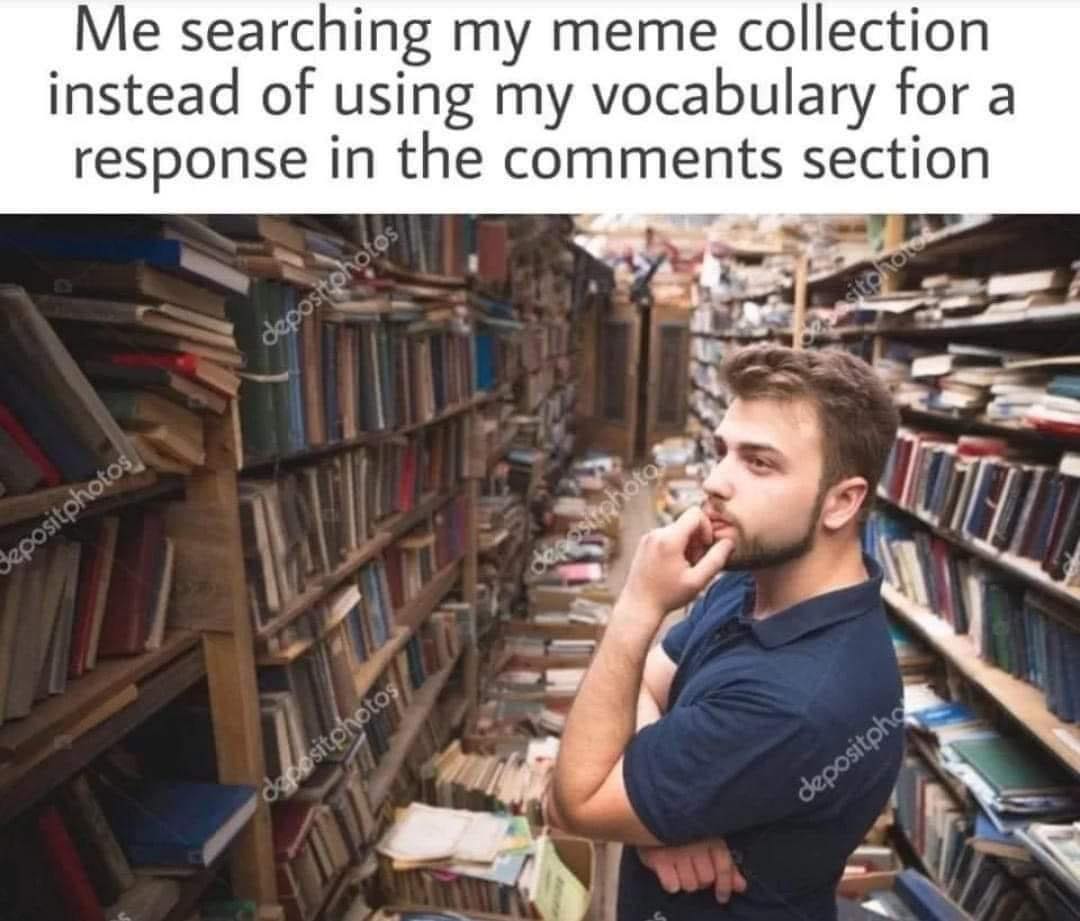
This meme is a playful commentary on the frustration of having no vocabulary to use. It features a man standing among towering shelves of books, holding his chin in a pensive or searching pose, which represents the "Me" reading the caption. The text reads, "Me searching my meme collection instead of using my vocabulary for a response in the comments section," which is meta because it personifies the reader of the image: the man is literally looking for a funny joke to replace his speech when he should be just thinking his thoughts. It humorously illustrates a situation where a person gets stuck in their own head and has to look for answers online rather than just speaking their mind.
simple-description (llama3.2-vision_11b)
This meme is a humorous take on the frustration of trying to explain a complex topic to someone who doesn't understand it. The image is of a person in a library, surrounded by books, with a thought bubble of a "I'm not arguing, I'm just explaining why I'm right" face. The text at the top reads "When you're explaining a complex topic to someone who doesn't understand it".
detailed-analysis (gemma3-27b-vision)
Okay, let's break down this image and its associated caption through several critical theory lenses. I’ll include sections only where relevant.
Visual Description
The image depicts a man standing in a densely packed, overflowing library. The bookshelves are crammed to capacity with books, stacked haphazardly on the floor, and overflowing onto the aisles. It's a visually overwhelming space, suggesting a significant accumulation of knowledge (or perhaps just a lot of stuff). The man is young, with a beard, and is in a thoughtful pose—finger to chin—appearing to be considering something deeply. He's dressed casually in a navy blue t-shirt. The background is filled with the spines of books. The image is a stock photo, evidenced by the "depositphotos" watermark. The caption reads, "Me searching my meme collection instead of using my vocabulary for a response in the comments section."
Postmodernism
This image, combined with the caption, strongly evokes postmodern themes. Several aspects support this:
- Simulacra & Simulation: The meme collection itself becomes a simulacrum – a copy without an original. It’s a ready-made response, a representation of a response, rather than a direct, original thought. The caption admits preference for this mediated representation.
- Death of the Author/Originality: The man, in choosing a pre-existing meme, effectively abandons the expectation of originality. He's leveraging something created by another, blurring the lines of authorship. Meaning is derived from the circulation and re-contextualization of the meme, not from personal expression.
- Irony and Pastiche: The act of consciously choosing a meme over "vocabulary" is inherently ironic, recognizing the absurdity of using a low-culture format for communication. It's a form of pastiche – the imitation of style, without the weight of the original.
- Fragmentation: The chaotic library, overflowing with information, can be seen as a visual representation of postmodern fragmentation – a breakdown of grand narratives and a proliferation of isolated, disconnected data (in this case, books and memes).
Foucauldian Genealogical Discourse Analysis
From a Foucauldian perspective, this image invites exploration of the discourses surrounding knowledge, communication, and online behavior.
- Power/Knowledge: The preference for memes over thoughtful, articulate responses reveals a shifting relationship with knowledge. The “power” to influence conversation seems to have shifted from those who can skillfully wield language to those who can effectively deploy cultural symbols (memes). This isn’t necessarily a negative development, but it requires a genealogical analysis of how this shift happened.
- Disciplinary Practices: The expectation of articulate, “vocabulary-rich” responses in online discussions can be seen as a disciplinary practice – a way of regulating behavior and defining acceptable forms of communication. The meme, in this context, is a form of resistance against this regulation. It offers a shortcut, a way to participate without conforming to traditional norms.
- Genealogy of the Meme: Tracing the history of the meme as a cultural form would reveal how it evolved, what power dynamics it reflects, and what social needs it fulfills. Memes aren't born in a vacuum; they emerge from specific historical and cultural contexts.
- Normalization of Superficiality: This image could be read as indicative of a broader trend toward the normalization of superficiality in online communication. The preference for quick, easily digestible content over thoughtful analysis raises questions about the impact of digital media on our cognitive habits.
Critical Theory
This image reflects a broader theme within critical theory – the commodification of culture and the culture industry.
- The Culture Industry: Memes, as easily replicated and disseminated cultural products, can be seen as part of the culture industry described by Adorno and Horkheimer. They are mass-produced, standardized forms of expression that stifle creativity and critical thinking.
- False Consciousness: The man's preference for memes over "vocabulary" could be interpreted as a form of false consciousness – a state of being unaware of the true nature of one's social reality. He's choosing a readily available, pre-packaged response over engaging in genuine thought, reinforcing the dominance of the culture industry.
- Alienation: This image could be read as an example of alienation in the digital age. The man is disconnected from his own ability to articulate thoughts and relies on external, commodified forms of expression.
Let me know if you'd like me to delve deeper into any of these theoretical frameworks or explore other potential interpretations.
simple-description (llama3.2-vision)
This meme is a photo of a person standing in a crowded, disorganized library or bookstore. The person is surrounded by stacks of books and has a thoughtful, confused expression. The text above the image reads, "Me searching my meme collection instead of using my vocabulary for a response in the comments section."
tesseract-ocr
Me searching my meme collection instead of using my vocabulary for a response in the comments section : : — we > a ee te is ee iV} 75> = a i “yf ir. o> a YE] pe A — far )\ — iJ . . . = nd 5 a sf q's J x. aS f oa