First Seen
2023-10-13T18:44:47+00:00
simple-description (qwen3.5_2b-q8_0)
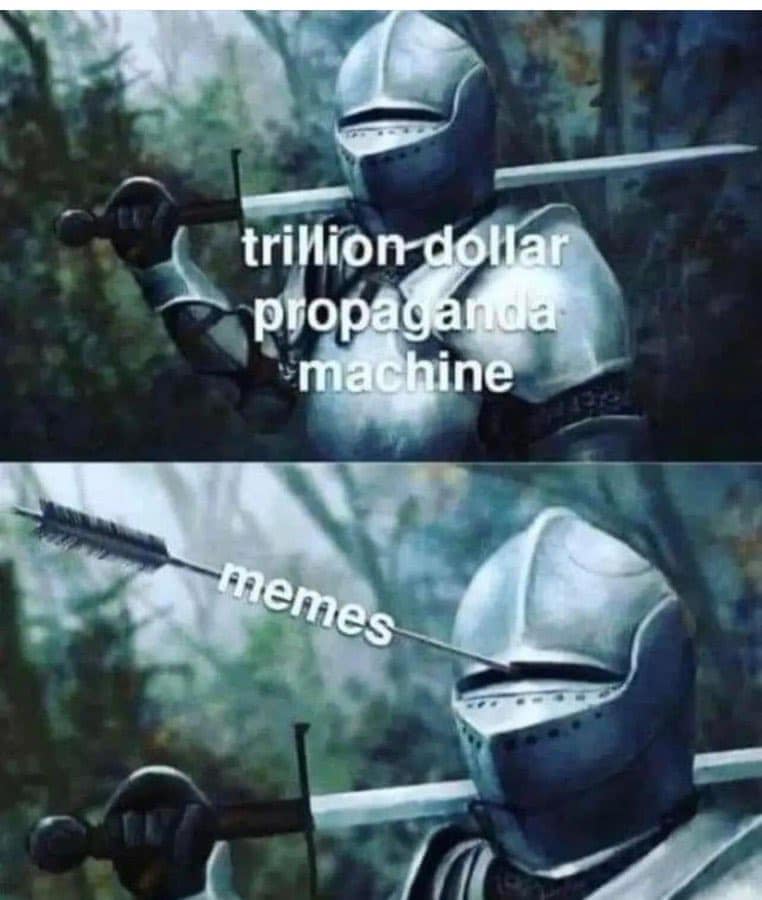
This meme is a "meta" joke that plays on the visual pun of "propaganda" combined with the cultural concept of viral internet content. The top panel shows a knight who believes he is constructing a massive "trillion dollar propaganda machine," but the bottom panel reveals that he is actually being shot at by an arrow labeled "memes." The humor lies in the literal interpretation of the meme as a deadly, internet-powered weapon of destruction.
simple-description (llama3.2-vision_11b)
The meme is an image of a knight in armor with a sword and a shield, but instead of a shield, he's holding a sign that says "I can explain". The text "I can explain" is ironic because the knight is about to be hit by an arrow labeled "explain", implying that he's about to be attacked with an explanation, which is a play on the phrase "I can explain" meaning he's about to be attacked with an explanation, but it's actually a joke about how hard it is to explain something.
detailed-analysis (gemma3-27b-vision)
Okay, here's an analysis of the meme, broken down into sections as requested. I'll note where certain approaches don't strongly apply.
Visual Description
The meme utilizes a two-panel format based on a scene from the film Monty Python and the Holy Grail.
- Panel 1: Depicts a knight in full armor, standing amidst foliage. Text overlaid on the image reads "trillion dollar propaganda machine." The knight is presented in a relatively static, imposing pose.
- Panel 2: Shows the same knight, now with an arrow protruding from the helmet's visor. Text overlaid on the image reads "memes." The arrow placement is absurd and humorous, highlighting the seeming powerlessness of such a mighty structure against something so small.
The visual contrast is key: a massive, seemingly unstoppable force (the knight/machine) is "defeated" by something as trivial as a meme. The humor is derived from the incongruity of scale and force.
Foucauldian Genealogical Discourse Analysis
This meme is very ripe for Foucauldian analysis.
Foucault's concepts of power/knowledge and discourse are central. The “trillion dollar propaganda machine” represents an established network of power – media, government, institutions – that produces knowledge (or what passes as knowledge) to maintain control. This is not necessarily about conscious conspiracy, but about the systems that define truth and normalize certain ways of thinking.
The “memes” serve as a disruptive force – a counter-discourse. Memes, with their quick, shareable nature, circumvent traditional power structures. They are a form of “insubordinate knowledge” – a way of speaking truth to power outside the established channels. They represent the proliferation of decentralized, bottom-up information, potentially destabilizing the hegemonic discourse.
The meme’s genealogy would trace the development of this “propaganda machine” – how it arose historically, the institutions that support it, and the strategies it employs. It also highlights the emergence of the meme as a counter-force within contemporary digital culture. The genealogy would demonstrate how memes gained their subversive capability and ability to puncture the image of power.
Critical Theory
The meme’s primary application of Critical Theory centers around the idea of ideology. The “trillion dollar propaganda machine” explicitly refers to the mechanisms through which dominant groups maintain their power by shaping beliefs and values.
Critical Theory would analyze how this machine operates – what techniques of persuasion it employs, what narratives it constructs, and how it silences dissenting voices.
The "memes" function as a challenge to that ideology. They expose contradictions, parody authority, and offer alternative narratives. They demonstrate how ideology isn't monolithic; it can be challenged and undermined by counter-discourse.
This meme also engages with the concept of culture industry, a key tenet of critical theory proposed by Adorno and Horkheimer. The meme suggests that the “trillion dollar propaganda machine” can be defeated by something as seemingly trivial and non-commercial as a meme, questioning the power of the culture industry to control and homogenize culture.
Marxist Conflict Theory
The meme lends itself readily to a Marxist interpretation. The “trillion dollar propaganda machine” represents the superstructure – the ideological apparatus that supports the base (the economic system). The machine’s purpose is to maintain the existing power relations and legitimize the exploitation inherent in the capitalist system.
"Memes," in this context, are a form of counter-hegemonic struggle. They represent the attempts of the oppressed (or those critical of the system) to challenge the dominant ideology and raise consciousness. While not a revolutionary force in themselves, memes can contribute to the development of class consciousness and potentially fuel social change.
The visual juxtaposition highlights the absurdity of the power imbalance – a vast, expensive machine being taken down by something so small and readily distributed. This underlines the potential for grassroots resistance to challenge even the most formidable power structures.
Postmodernism
This meme strongly embodies several postmodern themes:
- Deconstruction: The meme dismantles the notion of the "propaganda machine" as an all-powerful entity. It highlights the fragility of power and the possibility of disruption.
- Irony and Parody: The humor relies on the ironic contrast between the scale of the machine and the simplicity of the "weapon" that defeats it. It's a playful parody of power structures.
- Simulacra and Simulation: The "propaganda machine" can be seen as a system of creating simulations – constructing a reality that isn't necessarily based on truth. Memes, as digital representations, can also be considered simulacra, but they are often used to disrupt those constructions.
- Loss of Grand Narratives: The meme suggests that there are no universal truths or overarching ideologies that can effectively control discourse.
Queer Feminist Intersectional Analysis
While the meme isn't explicitly queer-feminist, an intersectional reading can be applied.
The "trillion dollar propaganda machine" can be interpreted as representing broader systems of oppression – patriarchy, white supremacy, capitalism – that intersect to marginalize various groups. This machine actively constructs and reinforces harmful stereotypes and narratives.
"Memes" become a tool for subversive resistance. They allow marginalized communities to reclaim narratives, challenge dominant ideologies, and create spaces for solidarity. Memes can spread awareness about social issues, amplify marginalized voices, and organize collective action.
The decentralized nature of memes is also important. They offer a platform for those who are excluded from traditional media and political channels to share their experiences and perspectives.
In this reading, the simplicity of the meme also hints at the fact that dismantling systems of oppression doesn't necessarily require complex strategies or massive resources—it can sometimes be as simple as challenging dominant narratives with humor and creativity.
Let me know if you'd like me to expand on any of these analyses!
simple-description (llama3.2-vision)
This meme features a medieval knight holding a sword with a broken tip, labeled "trillion-dollar propaganda machine". The knight is then shown with the sword's tip reformed, now labeled "memes". The text implies that the powerful propaganda machine has been replaced by the power of memes, which are often used to spread satire and critique.
tesseract-ocr
: nats ee : " sf Pe a " { Sf mS 4